
 AI SMM team
The best social media tips for small business are the ones that fit into a week that already has a business in it. You probably do not have a marketing team, a video crew or a spare afternoon every day, and advice written for big brands (“post five times a day, launch a podcast”) simply does not apply. Below are 25 tips we see working for shops, studios, cafes, clinics and solo experts: each one either saves time or moves someone closer to buying, and most take less than an hour to put in place.
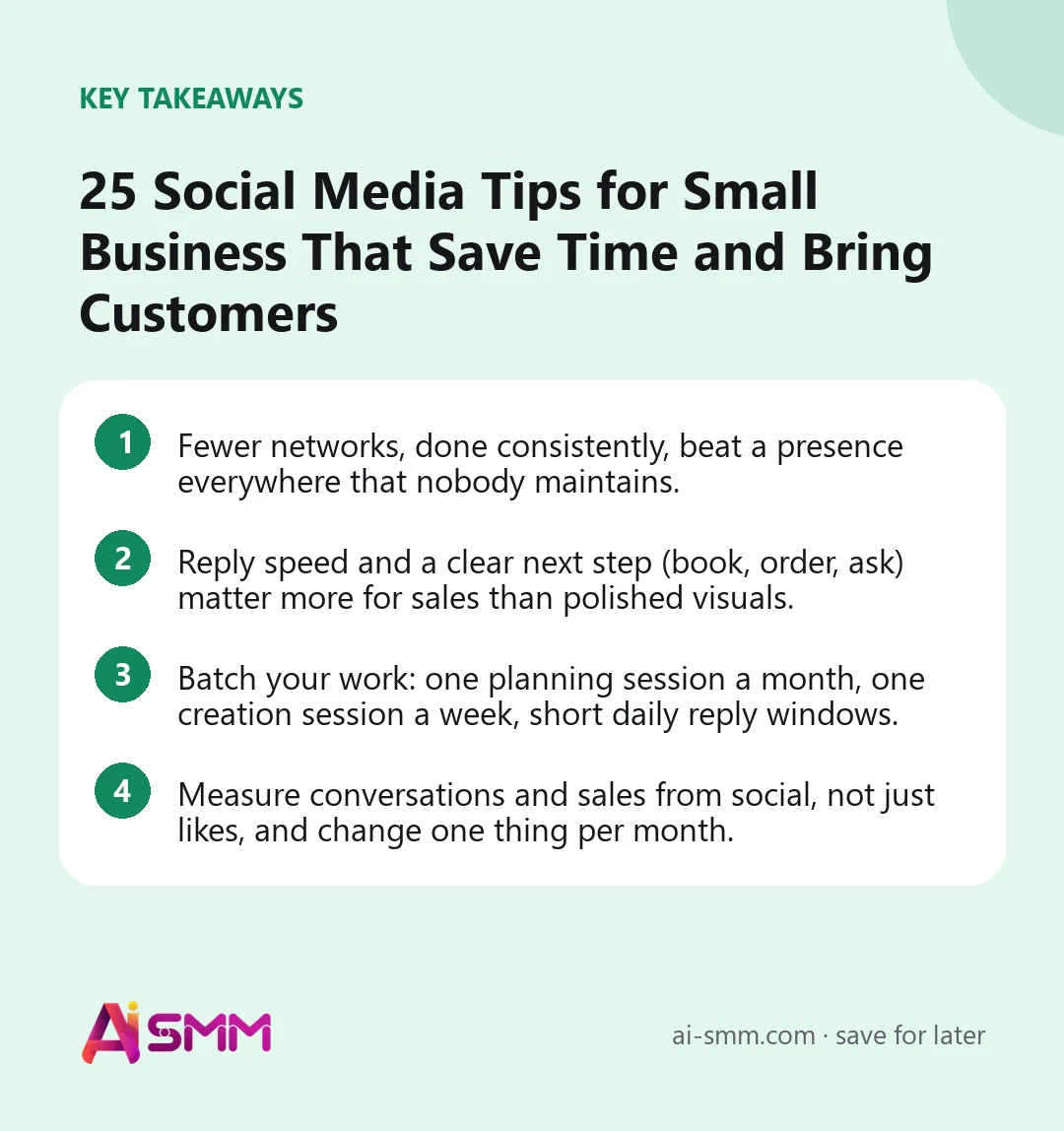
- Fewer networks, done consistently, beat a presence everywhere that nobody maintains.
- Reply speed and a clear next step (book, order, ask) matter more for sales than polished visuals.
- Batch your work: one planning session a month, one creation session a week, short daily reply windows.
- Measure conversations and sales from social, not just likes, and change one thing per month.
Social media tips for small business: the short checklist
If you only have two minutes, here is the whole article in one list. The sections below explain each point and how to do it.
- One goal, two networks, three to five recurring topics.
- A profile that says what you do, where, and how to buy, in the first line.
- A month planned in advance, a week produced in one sitting.
- One long piece a week, cut into several short ones.
- Replies within an hour during working time, templates for common questions.
- A call to action and a two-tap path to booking or ordering on every offer post.
- Monthly review of three to five numbers tied to money.
Planning tips
1. Choose one goal for the next three months
“Get more followers” is a side effect. Choose something the business feels: 20 more bookings a month, 50 orders through the online store, 10 new B2B leads. Every other tip gets easier once the goal is clear, because you can ask of every post: does this help?
2. Be excellent on two networks before adding a third
Each network has its own formats, rhythm and audience. For a local service, Instagram plus a Telegram channel or Facebook page is often enough. For a product with a visual “wow”, Instagram plus TikTok. For B2B, LinkedIn plus one more. Add a third only when the first two run on routine.
3. Write down three to five content pillars
Pillars are the recurring themes you rotate: proof (results, reviews), expertise (tips, mistakes), behind the scenes, offers, community. With pillars in place, you never face a blank page, just a question of which pillar is due this week.
4. Plan a month, produce a week
Spend one hour at the start of the month deciding the key dates, offers and themes. Then spend one session a week creating that week’s posts. Planning daily is the most expensive way to run social media, because you pay the “what do I post” tax every single time.
5. Keep a running list of ideas
Questions clients ask, objections you hear, things you explain at the counter every day: each one is a post. Keep a note on your phone and add to it whenever something comes up. On planning day, you will have more ideas than slots.
Content tips
6. Show results, not just products
A photo of a haircut on a mannequin says little. A before/after with a two-line story of what the client wanted says a lot. The same goes for renovations, cleaning, fitness, tutoring, anything with a visible change. Proof content is usually the most persuasive thing a small business can post.
7. Put faces in the feed
People buy from people. Introduce the team, show the owner explaining something, film the baker at 6 a.m. It does not need to be polished; it needs to be real. Many small businesses find that their most commented posts are the ones where a person talks straight to the camera.
8. Make one anchor piece a week and cut it up
Film one 5–15 minute video, or write one long post, and turn it into three to five smaller pieces: short clips, a carousel, a channel post, a Story poll. This is the single biggest time-saver in social media, and it keeps your message consistent across networks.
9. Adapt to each network, do not copy-paste
The same idea should look different on each platform: a vertical video with a strong first second for TikTok and Reels, a carousel with a clear headline for Instagram, a short opinion for Threads, a useful text for a Telegram channel, a professional angle for LinkedIn. Same message, native format.
10. Hook in the first line or first second
Most people decide in a moment whether to keep watching or reading. Start with the result, a question, or a surprising detail: “This client waited three years to fix her brows” works better than “Hi everyone, today I want to talk about…”.
11. Reuse what already worked
Your best post from six months ago has been seen by a fraction of your current followers. Refresh it with a new cover, a new first line or a new example and publish it again. Repeating proven topics is not lazy, it is efficient.
12. Ask customers for content
Photos from happy customers, short video reviews, tagged Stories: user-generated content is more convincing than anything you can make yourself. Ask directly at the moment of delight (“Can we share your photo?”) and make it easy to say yes.
Engagement tips
13. Reply fast, especially to DMs
A question in DMs is a customer with their wallet half-open. Set a rule, for example “within one hour during working hours”, and make it someone’s job. Slow replies are one of the most common reasons small businesses lose sales they had already earned.
14. Prepare answers to your top ten questions
Price, availability, location, delivery, how long it takes, what is included: write short, friendly answers once and reuse them. Saved replies or an AI assistant trained on your materials can handle the routine ones, leaving you the conversations that need a human.
15. Answer comments in a way that starts a conversation
“Thanks!” ends a thread. “Thank you! Which color would you choose, the green or the sand one?” keeps it going. Active comment threads also signal to many algorithms that the post is worth showing to more people.
16. Engage outside your own account
Spend ten minutes a day commenting meaningfully on posts from local partners, neighboring businesses, clients and people in your niche. It is one of the cheapest ways for new people to discover you. Quality matters: a thoughtful comment works; “Great post!” does not.
Selling tips
17. Make the next step obvious
Every offer post should end with one clear action: “Book via the link in bio”, “Write PRICE in the comments”, “Send us a DM with your size”. One action per post. Two or three options usually mean none gets chosen.
18. Fix your bio link
A link to a homepage makes people hunt. Point the bio link to a page with exactly what a visitor from social media needs: booking, a short catalog, contacts, a form. Then test it on your phone: can you book or order in two taps?
19. Use keyword comments to start DMs
“Comment GUIDE and we’ll send you the checklist” turns a public reaction into a private conversation. On Instagram and Facebook this can be automated, so every person who comments the keyword gets a message with the offer, a price list or a booking link within seconds.
20. Collect contacts you own
Algorithms change, accounts get restricted, reach drops. Email subscribers, chat contacts and channel members are an audience you can reach on your own terms. Offer something genuinely useful in exchange: a checklist, a discount, early access.
21. Give people a reason to act now
Free slots this week, a limited batch, a seasonal menu: small, honest urgency helps people who were already interested make the decision. Avoid fake countdowns; your regular customers will notice.
Measurement tips
22. Track five numbers, not fifty
A practical set for most small businesses:
| Number | What it tells you |
|---|---|
| Reach (especially among non-followers) | Are new people seeing you? |
| Engagement rate by reach | Do they care about what they see? |
| Conversations started (DMs, keyword comments) | Are they interested enough to ask? |
| Bookings, orders or leads from social | Is it making money? |
| Median reply time | Are you losing people by being slow? |
23. Ask “how did you find us?”
The simplest attribution tool is a question at booking or checkout. Add it to your booking form or ask in person, and write down the answers for a month. You will learn more about what works than from any dashboard alone.
24. Review monthly and change one thing
Once a month, look at your numbers and your best and worst posts. Decide on one change: a new format, a different posting time, a new call to action. If you change everything at once, you will never know which change mattered.
25. Watch competitors, but do not copy them
Look at which formats and topics get your competitors the most comments, and what questions their audience asks. Then answer those questions better, in your own voice. Copying rarely works because your audience follows you for what makes you different.
A weekly routine that fits into three to four hours
| When | What | Time |
|---|---|---|
| First Monday of the month | Plan key dates, offers and themes for the month | about 1 hour |
| Every Monday | Create and schedule the week’s posts from the anchor piece | 1–1.5 hours |
| Every day, twice | Reply to comments and DMs in two short windows | 15–20 minutes each |
| Every Friday | Engage with partners, clients and niche accounts; note ideas | 15–20 minutes |
| Last Friday of the month | Review numbers, pick one change | 20–30 minutes |
These time estimates come from our experience with small teams using a planner and AI drafts; without tools, add roughly half again.
If you only have 30 minutes a day
Some weeks, three to four hours is a fantasy. Here is the minimum version that still keeps social media working for the business, in order of priority:
- 10 minutes: replies. Answer every DM and question in the comments. This protects sales that are already on the way.
- 10 minutes: one piece of content. A Story from the workplace, a photo of today’s result, a short clip. Real and quick beats polished and late.
- 5 minutes: one comment elsewhere. A thoughtful reply on a partner’s or a local account’s post.
- 5 minutes: one note. Write down one question a customer asked today. That is next week’s post.
On the weekend, spend 30–40 minutes turning the week’s notes into three scheduled posts for the next week. This version will not make you grow fast, but it keeps the account alive, the customers answered and the ideas flowing until you have more time.
Mistakes that cost small businesses the most
- Disappearing for weeks, then posting five times in a day to “catch up”.
- Only selling: every post is a price or a promotion, so people stop paying attention.
- Ignoring DMs or answering them the next day.
- Buying followers or joining engagement groups; it inflates numbers and hurts reach among real buyers.
- Chasing every trend instead of building recognizable, repeatable formats.
How AI SMM helps a small business apply these tips
Most of these tips are about routine, and routine is what software is good at. In AI SMM, you plan the month and schedule posts to Instagram, Facebook, TikTok, Telegram, YouTube and other networks from one calendar. The AI content studio drafts captions and images in your brand’s tone, repurposes one text for several networks and suggests the best time to post. Your weekly anchor video can become vertical clips with subtitles via video clipping.
For tips 13–19, messages from supported networks, WhatsApp and your website chat arrive in one inbox, where AI drafts answers from your knowledge base, and keyword comments on Instagram and Facebook can trigger an automatic DM through chat flows. A link in bio page can hold booking, products and a contact form. For tips 22–25, analytics compares 12 networks and your competitors on one screen; X and Telegram are not part of AI SMM analytics, so check those in their built-in statistics. The local business page shows how a shop or studio puts this together.
FAQ
How many hours a week should a small business spend on social media?
In our experience, three to eight hours a week for two networks, including replies, is realistic. Batching work and using a planner and AI drafts brings it closer to the lower end.
Which social network is best for a small business?
The one where your buyers already spend time and whose format you can produce consistently. Local services often start with Instagram; B2B with LinkedIn; experts and communities often do well with a Telegram channel; products with a visual effect with TikTok.
How often should a small business post?
Two to four quality posts a week per network is a sustainable starting point, plus Stories or short updates when you have something to show. Consistency over months matters more than daily frequency.
Should a small business use AI for social media?
Yes, for drafts, planning, repurposing and routine replies. Keep a human check on everything that goes out, especially prices, dates and promises, and set up a brand profile so drafts sound like you.
Pick three tips from this list, put them into practice this week, and if you want the routine to run in one place, try the free plan of AI SMM.
Posts, chats, video and sales in one workspace. 7 days free.
Start free