
 AI SMM team
A social media style guide is a short document that says how your brand sounds and looks on social networks: the tone of voice, the words you use and avoid, how posts are formatted, which visuals are on-brand and how you reply to people. Without one, every new freelancer, assistant or AI tool guesses, and the account slowly turns into a patchwork of different voices. This guide explains what to include, how to keep it short enough that people actually use it, and gives you a template you can copy and fill in an afternoon.
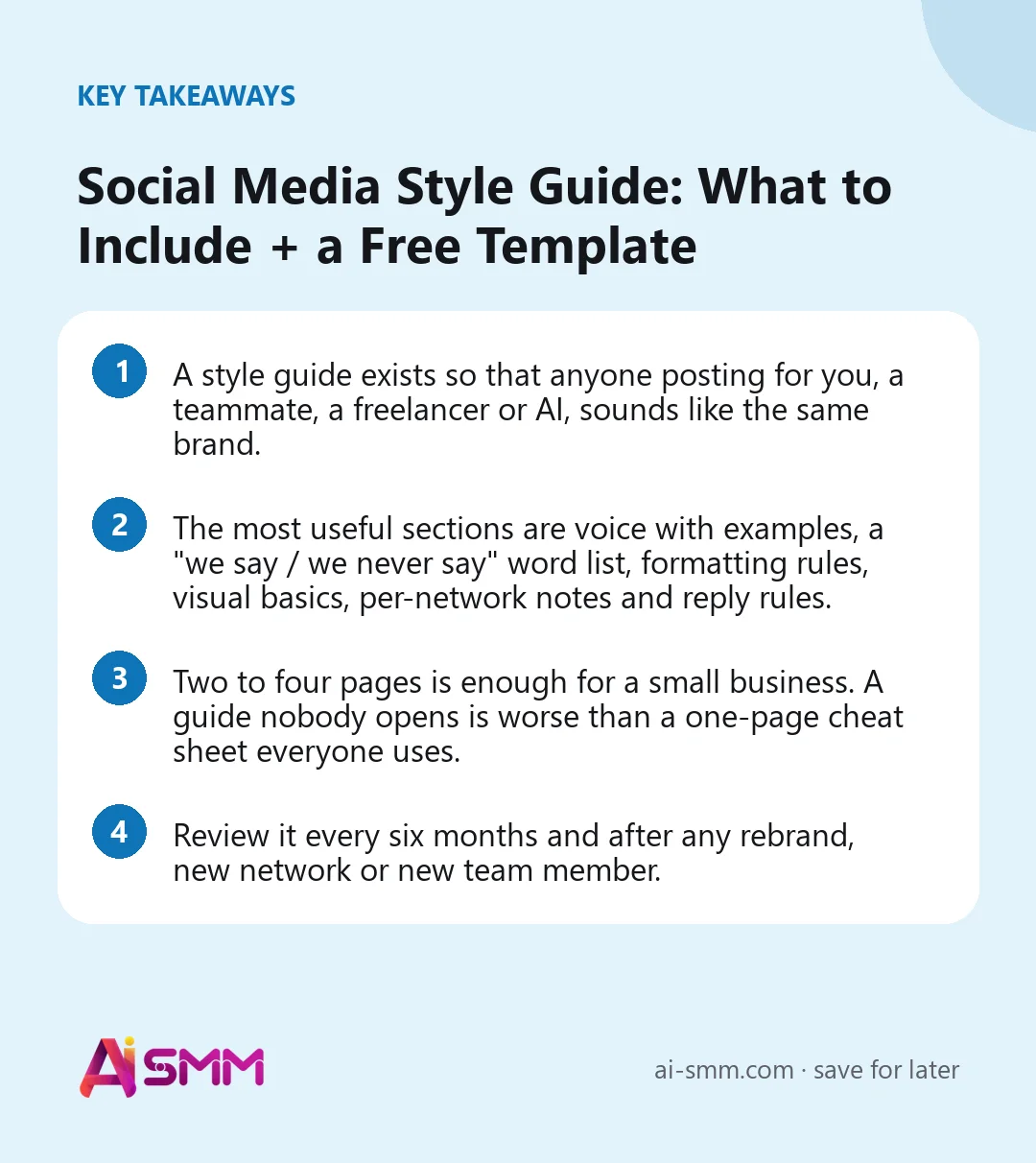
- A style guide exists so that anyone posting for you, a teammate, a freelancer or AI, sounds like the same brand.
- The most useful sections are voice with examples, a “we say / we never say” word list, formatting rules, visual basics, per-network notes and reply rules.
- Two to four pages is enough for a small business. A guide nobody opens is worse than a one-page cheat sheet everyone uses.
- Review it every six months and after any rebrand, new network or new team member.
What is a social media style guide?
A social media style guide is the practical, everyday part of your brand guidelines. Brand guidelines usually cover the logo, the colour palette and the mission statement. A style guide goes further into the decisions people make every day when they post: do we use emojis, do we write “Hi!” or “Hello”, how do we spell our product names, which hashtags are ours, what do we say when someone complains in the comments.
It is not a strategy document. Your strategy decides which networks you use, who your audience is and what results you want. The style guide decides how every single post and reply looks and sounds once those choices are made. Keep the two separate, so the style guide stays short and practical.
Why even a small business needs a style guide
It is tempting to think a style guide is for big brands with marketing departments. In practice, small teams feel inconsistency faster:
- You delegate eventually. The day you hand posting to a freelancer, an assistant or an agency, everything that lived in your head needs to be written down.
- AI tools need rules. An AI writer without a description of your tone defaults to generic marketing copy. A style guide is exactly the input it needs.
- Customers notice. A playful Instagram, a stiff LinkedIn page and a curt reply in DMs make people wonder whether they are dealing with the same business.
- It saves decisions. “Do we use the Oxford comma?” or “Can we joke about competitors?” are answered once, not in every post.
What to include in a social media style guide
You do not need every section below from day one. Start with the first four, then add the rest as questions come up.
1. Brand voice and tone
Describe your voice in three to four adjectives, and for each one say what it means and what it does not mean. “Friendly, not childish.” “Confident, not arrogant.” “Expert, not academic.” Adjectives alone are vague; the “not” half is what makes them usable.
Tone is how the voice adapts to the situation. You probably sound lighter in a behind-the-scenes Reel than in a reply to a complaint. Add a small table with situations and the tone for each: promotions, educational posts, bad news, complaints, condolences or sensitive topics.
2. Words we use and words we avoid
This is the most practical part of the guide. List:
- How you call your customers (clients, guests, members, patients).
- How you spell and capitalise your brand and product names.
- Phrases that are typical for you (“see you in the chair”, “fresh out of the oven”).
- Words you never use: overused marketing clichés, jargon your customers do not understand, anything that clashes with your positioning (“cheap” for a premium studio, “luxury” for a neighbourhood café).
3. Grammar, formatting and emojis
- Formal or informal address, contractions or not.
- Sentence case or Title Case for headlines and carousel slides.
- How you write dates, times, prices and currencies.
- Emojis: none, a few, or freely, and which ones fit the brand.
- Line breaks, bullet symbols and maximum paragraph length.
- Where the call to action goes and how it is phrased.
4. Visual style
Link to your logo files and colour codes rather than repeating the full brand book. Then add the social-specific rules: fonts for text on images, whether you use photos of people, filters or no filters, how product shots are framed, subtitle style on videos, and a few examples of posts that are clearly on-brand and a few that are not.
5. Hashtags, mentions and links
List your branded hashtags, how many hashtags you usually use on each network, how you tag partners and customers (and whether you ask permission first), and how you add links: in the bio, in Stories, in the first comment or in the post itself, depending on the network.
6. Per-network notes
The voice stays the same, but each network has its own habits. A short line per network is enough: “LinkedIn: first person from the founder, fewer emojis, no hashtag blocks.” “Telegram: bold first line, short paragraphs, one post a day maximum.” “TikTok: talk to camera, subtitles always on.”
7. Replies to comments and messages
Many brands write beautiful posts and then reply to comments in a completely different voice. Define how quickly you aim to reply, how you greet people, whether you sign replies with a name, how you handle price questions in public, and when a conversation moves to DMs or phone. Include two or three example replies for common situations: praise, a question, a complaint.
8. Sensitive topics and escalation
Write down topics you do not post about, how you respond to news events and tragedies (often: pause scheduled posts), what to do with offensive comments, and who decides in a crisis. This section is short but saves a lot of panic.
9. Accessibility and legal basics
Alt text on images where the network supports it, subtitles on videos, readable contrast on graphics, and camel case for multi-word hashtags. On the legal side: using only images you have rights to, labelling paid partnerships, and getting consent before sharing customer photos or reviews.
Social media style guide template
Copy the structure below into a document and fill in the brackets. For most small businesses the finished guide fits on two to four pages.
| Section | Fill in | Example |
|---|---|---|
| Who we are | One sentence: what we do, for whom, where | A two-chair barbershop for students and young professionals in the city centre |
| Audience | Who reads our posts and what they care about | 18–35, busy, price-aware, want a reliable cut without small talk |
| Voice (3–4 traits) | Trait + “not” + example sentence | Relaxed, not sloppy: “Walk-ins welcome till 7, grab a coffee while you wait.” |
| Tone by situation | Promo / tips / bad news / complaints | Complaints: calm, first name, apology first, move to DMs |
| We say | Our words and phrases | “clients”, “fresh fade”, “see you in the chair” |
| We never say | Banned words and clichés | “luxury”, “elevate”, “best in town”, “dear customers” |
| Formatting | Address, case, emojis, dates, prices | Informal “you”, sentence case, max 2 emojis, prices as €25 |
| Call to action | Standard wording and placement | Last line: “Book in the link in bio” or “DM us ‘CUT'” |
| Visuals | Fonts, colours, photo style, video subtitles | Natural light, no heavy filters, subtitles in white bold |
| Hashtags and tags | Branded tags, count per network, tagging rules | #FreshFadeClub, 3–5 on Instagram, tag clients only with consent |
| Per network | One line per network | Telegram: news and free slots; Instagram: results and Reels |
| Replies | Response time, greeting, sign-off, 3 sample replies | Within working hours same day; sign with barber’s first name |
| Sensitive topics | What we avoid, crisis owner | No politics; owner approves any public statement |
| Accessibility and legal | Alt text, subtitles, consent, image rights | Always ask before posting a client’s face |
| Examples | 3 on-brand posts, 2 off-brand posts with why | Links or screenshots with a one-line comment each |
How to write your style guide in one afternoon
- Collect your best 10 posts and replies. Pick the ones that got good responses and that you feel sound like you. They are the raw material.
- Collect 5 posts you dislike. Your own or competitors’. Writing down why they feel wrong is the fastest way to define what you are not.
- Draft the voice section. Look for patterns in the good posts: sentence length, humour, how you address people. Turn them into three or four traits with “not” examples.
- Write the word lists. Scan DMs and reviews for the words customers use about you. Those often belong in “we say”.
- Fill in the template and add the example posts at the end.
- Test it. Give the guide to someone who has never posted for you, or to an AI writer, and ask for three posts. Whatever feels off shows you what the guide is missing.
Style guide for agencies: one per client
For an agency or freelancer managing several accounts, the style guide is part of onboarding each client. Ask the client for their brand book if one exists, but build the social guide yourself during the first two weeks, then send it for approval. It protects both sides: the client sees that you understand the brand, and you have a signed-off reference when feedback turns into “this doesn’t sound like us”. Keep each guide in the client’s shared folder and link it from every brief.
Keeping the guide alive
A style guide goes stale quietly. Put a review in the calendar every six months, and update it when you add a network, change your offer, hire someone new or notice the same correction coming up in reviews of drafts more than twice. Every repeated correction is a rule that belongs in the guide.
Putting your style guide to work in AI SMM
A style guide only helps if it is applied at the moment someone writes. In the AI content studio the core of it, tone, audience and words to avoid, lives in the brand profile and is added to every text and image generation, so drafts start in your voice instead of a generic one. The studio can also review a post before it goes out, which is a good moment to check it against the rest of your guide.
In the calendar text limits are checked for each network, and posts can go through approval, so the owner or a client sees every post before it is published. For replies, the inbox suggests answers based on your knowledge base, which is a natural place to store the sample replies from your guide. Agencies keep a separate brand profile for every client, as described on the agency page.
FAQ
How long should a social media style guide be?
For a small business, two to four pages. Large brands have longer guides, but the parts people use daily usually fit on one page: voice, word lists, formatting and reply rules.
What is the difference between a brand book and a social media style guide?
A brand book defines the identity: logo, colours, typography, mission. A social media style guide applies it to everyday posting: tone in different situations, emojis, hashtags, formatting and how to reply to comments and messages.
Who should own the style guide?
One person, usually the owner or whoever leads marketing. Others can suggest changes, but a single owner keeps the guide consistent and decides disputes.
Do I need a separate style guide for each network?
No. Keep one guide with one voice and add a short section with per-network notes. Separate guides tend to drift apart and create exactly the inconsistency you wanted to avoid.
Write the guide once and let every post follow it. Set up your brand profile in the AI content studio and your voice comes with every draft.
Posts, chats, video and sales in one workspace. 7 days free.
Start free