

 AI SMM team
Social media content pillars are the 3–5 recurring themes that every post you publish belongs to, for example “how we work”, “client results”, “tips” and “offers”. They answer the question that stalls most small business accounts: “what do I post today?” Instead of inventing a topic from scratch every morning, you pick the next pillar in the rotation and write one post inside it.
This guide shows how to choose pillars that fit your business rather than a generic template, how many to have, how to mix them across a week, and how to turn one pillar into a month of posts without repeating yourself.
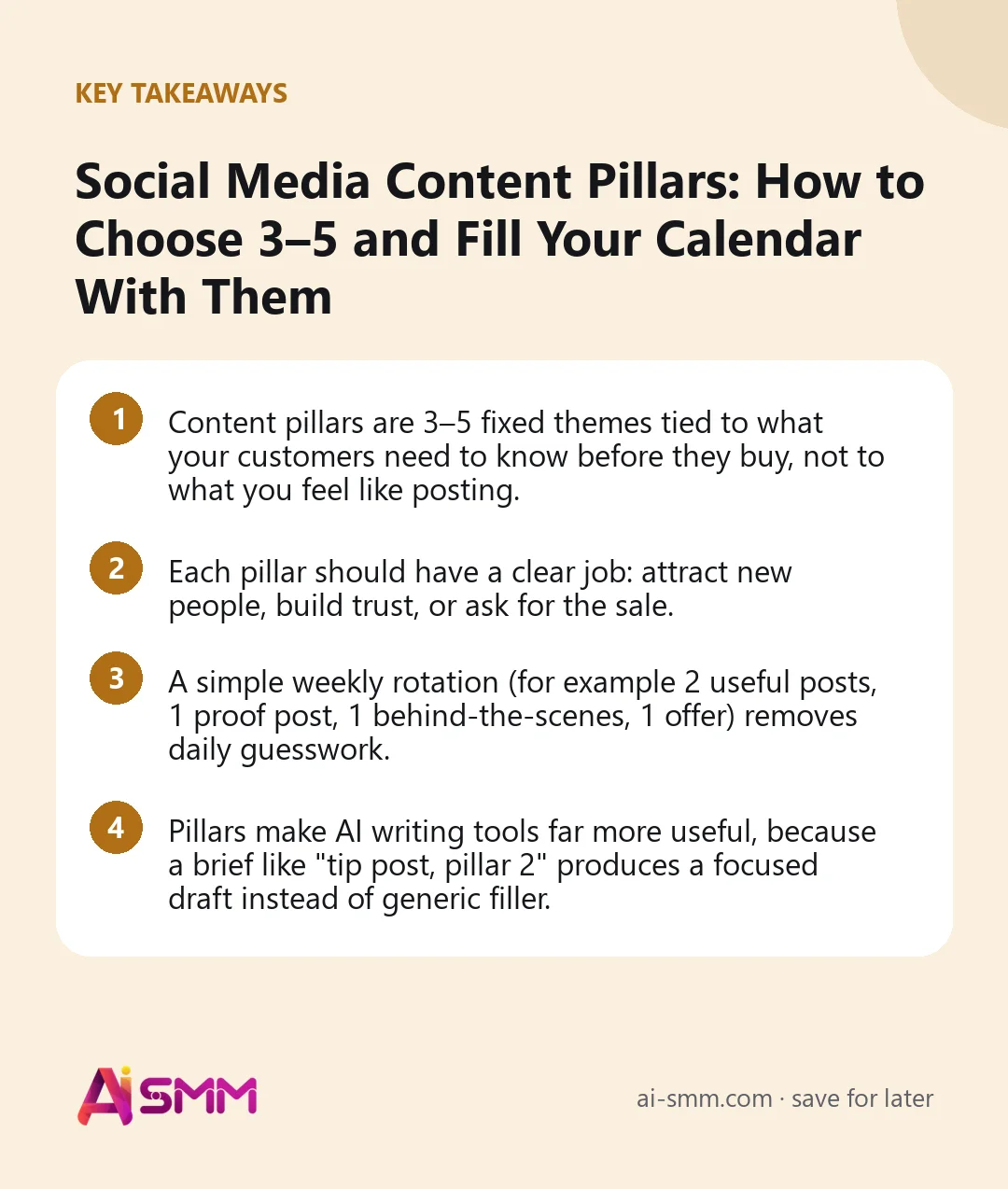
- Content pillars are 3–5 fixed themes tied to what your customers need to know before they buy, not to what you feel like posting.
- Each pillar should have a clear job: attract new people, build trust, or ask for the sale.
- A simple weekly rotation (for example 2 useful posts, 1 proof post, 1 behind-the-scenes, 1 offer) removes daily guesswork.
- Pillars make AI writing tools far more useful, because a brief like “tip post, pillar 2” produces a focused draft instead of generic filler.
What are social media content pillars?
A content pillar is a broad topic you return to again and again. It is wider than a single post idea (“5 ways to make a manicure last longer”) and narrower than your whole business (“nails”). Think of pillars as folders: every post you publish goes into exactly one of them.
Pillars are not the same thing as formats. “Reels” or “carousels” are formats; “aftercare tips” is a pillar. You can publish the same pillar as a Reel on Monday, a carousel on Thursday and a Telegram post on Saturday. Keeping those two ideas separate is what lets you plan a month in an hour: pillars decide what you say, formats decide how you show it.
They also keep the account coherent. A visitor who scrolls your last twelve posts should understand within seconds who you help, how you work and why they should trust you. Random posts, a meme here, a sale there, a holiday greeting in between, rarely tell that story. Pillars do.
Why small businesses need pillars more than big brands
Big brands have content teams, briefs and approval chains. A salon owner, a coach or a two-person shop usually has twenty minutes between clients. That is exactly the situation where a fixed structure pays off:
- No blank page. You never start from “what should I post?”, only from “what is the next tip in pillar 2?”
- Balanced selling. Without pillars, accounts drift into either all promotion (people tune out) or no promotion at all (nobody knows you sell anything).
- Easier delegation. A freelancer, an assistant or an AI tool can produce drafts if you hand them a pillar and a goal, instead of explaining your business every time.
- Clearer results. When every post is tagged with a pillar, you can see which themes actually bring comments, saves and messages, and do more of those.
How to choose your content pillars in 5 steps
Step 1. List the questions customers ask before buying
Open your DMs, comments and the notes from sales calls. Write down every question you hear more than once: price, timing, “is this right for me”, “how is it different from X”, “what happens after I pay”. These questions are the raw material for your pillars, because answering them publicly removes friction before anyone writes to you.
Step 2. Group the questions into 3–5 themes
Most lists collapse naturally into a handful of groups. For a nail studio it might be care and durability, design ideas, prices and booking, and the team. For an accountant: deadlines and rules, common mistakes, how working together looks, and client stories.
Step 3. Give each pillar a job
Every pillar should move people one step closer to buying. A useful way to check is to assign each pillar one of three jobs:
- Attract: content that new people want to share or save (tips, ideas, quick answers).
- Trust: content that proves you are good at what you do (results, reviews, process, the people behind the brand).
- Convert: content that invites action (offers, free slots, launches, “how to book”).
If all your pillars are “attract”, you will grow followers who never buy. If they are all “convert”, you will sell to the same small circle until it gets tired of you.
Step 4. Check that you can produce each pillar for months
A pillar you can fill for two weeks is really a single idea. Before committing, write ten post titles for each one. If you get stuck at four, merge it with another pillar or widen it.
Step 5. Write a one-line brief per pillar
Describe each pillar in one sentence: who it is for, what it proves, and which call to action it usually ends with. This brief is what you will paste into an AI tool or hand to a helper, so make it specific.
Content pillar examples by industry
The table below shows illustrative sets of pillars. Use them as a starting point, then adjust to the questions your own customers ask.
| Business | Attract | Trust | Convert |
|---|---|---|---|
| Beauty salon | Aftercare tips, seasonal trends | Before/after, meet the masters | Free slots this week, first-visit offer |
| Café | Recipes, how we make it | Suppliers, regulars’ favourites | Today’s special, delivery reminder |
| Online shop | How to choose, styling ideas | Reviews, packing and shipping | New arrivals, limited drops |
| Coach or expert | Frameworks, myths vs facts | Client cases, personal story | Webinar signup, consultation slots |
| Local service (repair, cleaning) | Maintenance tips, “how to spot a problem” | Jobs done, guarantees | Seasonal check-up, quote request |
| Agency | Industry breakdowns, quick audits | Case studies, team process | Free audit, open slots for new clients |
How many content pillars should you have?
For most small businesses, three to five. Fewer than three and the feed gets repetitive; more than five and each pillar appears so rarely that it stops being recognisable. If you post two or three times a week, three pillars are plenty. If you post daily across several networks, four or five give you enough variety.
One practical rule: one pillar should always be about people. Faces, names and voices outperform faceless product shots on almost every network, and a “team” or “founder” pillar is the easiest one to keep filling because something happens every day.
Building a weekly content mix from your pillars
Once pillars are set, the calendar almost fills itself. A common starting mix for five posts a week looks like this:
| Day | Pillar | Example format |
|---|---|---|
| Monday | Useful tip (attract) | Carousel or short video |
| Tuesday | Behind the scenes (trust) | Stories or a casual Reel |
| Wednesday | Useful tip (attract) | Text post or Threads thread |
| Thursday | Proof: result or review (trust) | Photo post or before/after |
| Friday | Offer or free slots (convert) | Post plus Stories with a link |
A rough balance that works for many accounts is around 60% attract, 25–30% trust and 10–15% direct selling. Treat that as a starting point, not a law: a shop in its launch week will sell more, an expert building an audience will teach more.
The same mix does not need to be identical everywhere. On LinkedIn the “tips” pillar may become short opinion posts, on TikTok a 20-second video, in a Telegram channel a longer text. The pillar stays the same; only the format adapts.
Turning one pillar into a month of posts
The fear with pillars is repetition. In practice, each pillar can be sliced in many directions. Take “aftercare tips” for a nail studio:
- Mistakes: “3 things that ruin gel polish in the first week”.
- Myth vs fact: “Does cuticle oil really matter?”
- Question from a client: “Can I go to the pool after a manicure?”
- Comparison: “Gel vs regular polish: what lasts longer on holiday”.
- Checklist: “Before your appointment: 4 things to skip”.
- Seasonal angle: “Winter hands: why nails break more in the cold”.
Six angles times a few formats gives you more than a month of posts for one pillar alone. When you run out, go back to Step 1: new customer questions are the best source of new angles.
Common mistakes with content pillars
- Pillars about you, not the customer. “Our values” is rarely a pillar people care about; “how we make sure your order arrives intact” is.
- Too broad. “Fashion” is a whole industry. “Outfits for office days under a set budget” is a pillar.
- No convert pillar. Many service businesses feel awkward selling and never tell followers how to book. Put it on the calendar so it happens.
- Never reviewing them. Check once a quarter which pillars bring messages and bookings, and swap out the one that does not.
- Copying another account’s pillars. Your competitor’s audience asks different questions. Start from your own DMs.
A simple content pillar template
Keep your pillars on one page that anyone creating content for you can read in a minute. For each pillar, fill in five lines:
- Name: short and internal, for example “Aftercare”.
- Job: attract, trust or convert.
- Who it is for: “new clients who have never had gel polish”.
- Typical call to action: “save this”, “ask in DM”, “book a slot”.
- Ten starter titles: the list you wrote in Step 4.
This page becomes your brief for every helper, human or AI. It also makes onboarding a new team member much faster, because they see what the account talks about and why, instead of guessing from the feed.
Content pillars in AI SMM
In AI SMM, pillars fit naturally into how content is planned. The AI content studio uses your brand profile (tone, audience, words to avoid) in every generation, so a brief like “aftercare tip, friendly tone, ends with a booking link” gives a draft in your voice rather than a generic caption. The AI planner turns a campaign brief into a dated plan with ideas by day, formats and networks, which is exactly where a pillar rotation belongs.
The drafts land in one content calendar with month, week and feed views, so you can see at a glance whether Friday has an offer and whether three tips in a row crept in. Repurposing turns one pillar post into versions for different networks, and the calendar checks text limits for each one. After a few weeks, analytics shows which posts brought reach and engagement on the networks it covers, so you can tell which pillar deserves more slots.
FAQ
What is the difference between content pillars and a content plan?
Pillars are the fixed themes; a content plan is the dated schedule built from them. You choose pillars once or twice a year, while the plan changes every week.
Should each network have different content pillars?
Usually no. Keep the same pillars so the brand feels consistent, and adapt the format and length to each network. The exception is a network with a very different audience, such as LinkedIn for a B2B side of the business.
How do I know if a content pillar is working?
Look beyond likes. A pillar is working if its posts bring saves, shares, DMs, bookings or link clicks. Compare pillars over a month or two, not post by post, because single posts vary a lot.
Can promotional posts be a content pillar?
Yes, and they should be. A dedicated “offers” pillar keeps selling regular and predictable, so followers are not surprised when you ask for the sale and you do not forget to ask.
Pick your three to five pillars this week, write a one-line brief for each, and let the AI content studio turn them into your next month of posts.
Posts, chats, video and sales in one workspace. 7 days free.
Start free