
 AI SMM team
A realistic social media budget for a small business is usually somewhere between €150 and €2,500 a month in cash, plus the hours someone spends on it, and the right figure depends less on your industry than on your size and goal. A solo business can run well on a tool subscription and a few focused hours a week; a shop with staff and a sales target needs money for content and ads as well. The real problem is not picking a number, it is knowing what the number should cover, so money does not disappear into boosted posts while nobody answers the DMs. This guide breaks a social media budget into its parts, gives monthly ranges by business size and shows how to split and review it.
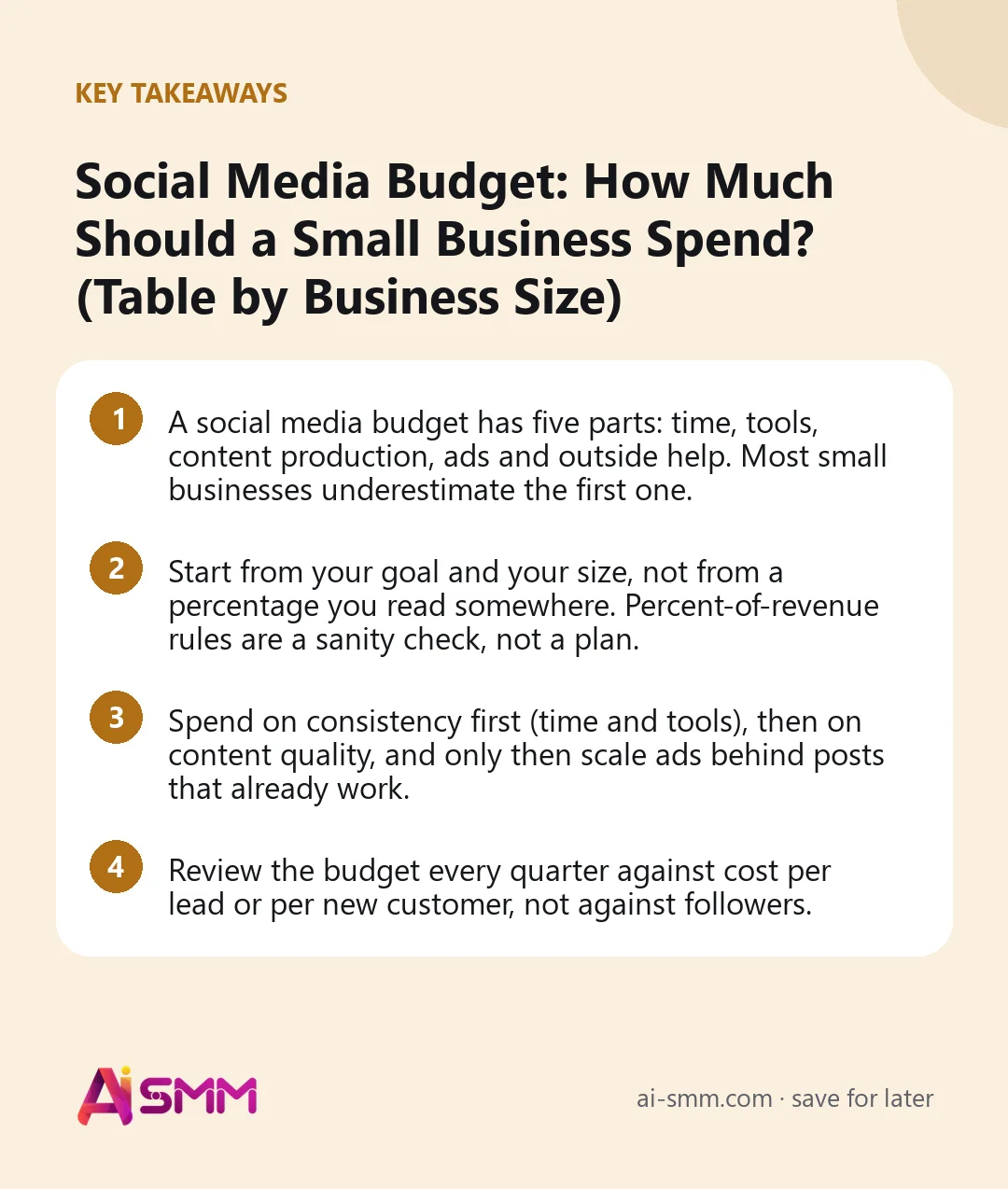
- A social media budget has five parts: time, tools, content production, ads and outside help. Most small businesses underestimate the first one.
- Start from your goal and your size, not from a percentage you read somewhere. Percent-of-revenue rules are a sanity check, not a plan.
- Spend on consistency first (time and tools), then on content quality, and only then scale ads behind posts that already work.
- Review the budget every quarter against cost per lead or per new customer, not against followers.
What a social media budget includes
Before you decide how much to spend, list what you are paying for. A social media budget that only counts ad spend is not a budget, it is one line of one.
| Line | What it covers | Typical mistake |
|---|---|---|
| Time | Your hours or staff hours for planning, creating, publishing and answering | Treated as free, so it is never planned or protected |
| Tools | Scheduler, design and editing apps, AI, link-in-bio, chat tools | Five separate subscriptions doing overlapping jobs |
| Content production | Photo and video shoots, props, samples, stock, editing | One expensive shoot, then nothing for three months |
| Ads and promotion | Boosted posts, ad campaigns, paid placements with creators or channels | Boosting posts that got no organic reaction |
| Outside help | Freelancer, agency, consultant, one-off setup work | Paying for “posting” when the gap is replying and selling |
Put a monthly figure against every line, even if it is zero. Zero is a decision; a blank is a surprise waiting to happen.
How much should a small business spend on social media?
A widely repeated rule of thumb says small businesses spend roughly 5–10% of revenue on all marketing, and social media takes a share of that. It is a useful sanity check: if your social media costs more than your entire marketing budget should be, something is off. But it is a poor starting point, because a new business with little revenue often needs to spend a higher share to get going, and an established local business with loyal clients may need far less.
A better starting point is three questions:
- What should social media do for you this quarter? Bring bookings, sell products, generate B2B leads, keep existing customers coming back or build awareness before a launch.
- How much is one new customer worth to you? Take the gross profit from a first purchase plus the repeat purchases you can reasonably expect over three to six months.
- How many hours a week can you honestly give it? Not how many you would like to, how many you actually have.
If a new customer is worth €150 in profit and you want 10 more a month from social media, spending €300–600 a month in total can make sense. If a new customer is worth €20, the same spend needs 15–30 customers just to break even, and your budget should lean on time-saving and organic reach rather than ads.
Social media budget by business size: a reference table
The ranges below are illustrative, based on what we typically see in small businesses in Europe. They include cash costs only; the hours column is separate because time is the biggest hidden cost. Use them to check whether your plan is in a sensible range, not as a target.
| Business size | Networks | Hours per week | Cash per month | Where the money goes |
|---|---|---|---|---|
| Solo, just starting (a freelancer, a home bakery) | 1–2 | 2–4 | €0–150 | A free or entry tool plan, phone photos, occasional small boost |
| Solo, established (a coach, a tutor, a single-chair studio) | 2–3 | 3–6 | €100–400 | A paid tool plan, one small shoot per quarter, €50–200 in ads for proven posts |
| Small team, 2–10 people (a salon, a cafe, a small shop) | 3–4 | 5–10 | €300–1,200 | Tools, monthly content day, ads behind offers, part-time help with replies |
| Growing business, 10–50 people (several locations, an online store) | 4–6 | 15–40 (often one dedicated person) | €1,000–5,000 | A team plan, regular production, steady ad budget, freelancer or agency support |
| Agency managing clients | Per client | Per client | Priced into each retainer | A multi-project workspace, approvals, reporting |
Notice how much of the difference between the rows is time. Moving from solo to a small team rarely doubles the tool cost; it doubles the number of conversations to answer and posts to produce.
How to split the budget between time, tools, content and ads
There is no universal split, but the order in which you fund the lines matters more than the percentages. In our experience this sequence works for most small businesses:
- Protect the time first. Block fixed hours for planning and for replies. A budget with money for ads and no time to answer the messages they generate wastes the ads.
- Then pay for tools that save hours. One workspace that schedules, drafts and collects messages usually replaces several apps and pays for itself in saved time.
- Then invest in content quality. A half-day shoot every month or quarter gives you a library of photos and clips to post for weeks.
- Only then scale ads. Put money behind posts and offers that already get saves, shares and DMs organically.
As a rough starting split for a small team with a monthly cash budget of €600: €50–100 on tools, €150–200 on content production, €250–350 on ads, and nothing on outside help until you know which gap to fill. Adjust after the first quarter based on what actually produced customers.
How to value your time in the budget
For most small businesses the owner’s hours are the largest single cost, even though they never appear on an invoice. Give them a price so you can make trade-offs honestly.
- Replacement price: what you would pay a freelancer to do the same work per hour.
- Opportunity price: what you would earn in an hour of paid work instead, for example one extra client appointment.
Once time has a price, decisions get easier. If you spend 20 hours a month on social media and your hour is worth €30, that is €600, which may be more than all your cash costs combined. A €50 tool that saves six hours a month is then an obvious buy, and a €400 freelancer who saves 15 hours may be too.
Budgeting for ads: how much and when
Ads are the most flexible line and the easiest one to waste. A few rules keep them productive:
- Start small and test. Two or three ad sets with a modest daily budget for one to two weeks tell you more than one large campaign.
- Boost proof, not hope. Promote posts that already performed organically: saved, shared, commented on or bringing DMs.
- Match the ad to a clear next step. Book, order, send a keyword in DMs. An ad that leads to a profile with no obvious next step buys views, not customers.
- Set a cost ceiling per result. Decide in advance how much you are willing to pay for a lead or a booking, based on what a customer is worth, and stop ads that stay above it.
- Keep seasonality in mind. Holiday weeks and local events can justify a temporary increase; plan it in the budget instead of improvising.
A worked example: a hair salon plans its social media budget
Say a hair salon with four stylists wants 20 new clients a month from Instagram and a Telegram channel. From past records, a new client brings about €40 gross profit on the first visit and comes back three more times in six months, so each new client is worth roughly €160 over that window. The owner can give four hours a week; one stylist can answer DMs for an hour a day.
| Line | Monthly budget | Notes |
|---|---|---|
| Owner’s time: 16 hours × €25 | €400 | Planning, content day, weekly review |
| Stylist’s time for replies: 20 hours × €15 | €300 | Answering DMs and comments, booking clients |
| Social media tool | €50 | Scheduling, AI drafts, one inbox |
| Content production | €100 | A half-day shoot every two months, spread monthly |
| Ads behind before/after posts and free-slot offers | €250 | Only posts that already brought DMs |
| Total | €1,100 | Cash part: €400 |
If the plan brings 20 new clients, the cost per new client is about €55 against a value of €160, so the budget pays off over the six-month window. If it brings 8, the cost per client is over €130, and the first thing to check is not the ad budget but whether DMs are answered fast enough and whether posts carry a clear booking step.
How to review and adjust your social media budget
Look at the budget once a month briefly and once a quarter properly. The quarterly review answers four questions:
- What did each line produce? Leads, bookings or orders by network and by paid versus organic, as far as you can trace them.
- What did one new customer cost? All social media costs, including time, divided by new customers from social.
- Where are the hours going? If creation eats most of the time, invest in batching, templates and repurposing. If replies do, consider automation for routine questions.
- Which network earns its place? After a fair test of two to three months, cut or reduce the one that brings neither customers nor useful reach.
Move money gradually: shift 10–20% between lines per quarter rather than rebuilding the whole budget every month. Small, measured changes show you what actually made the difference.
Common social media budget mistakes
- Counting only ads. The budget then ignores the hours that are often most of the cost.
- Buying followers or engagement. It inflates numbers, attracts the wrong audience and can get accounts restricted.
- Too many networks for the budget. Four half-run accounts cost more and bring less than two done well.
- No money for replies. Ads and good posts generate questions; if nobody answers quickly, the spend is lost at the last step.
- Judging by followers. Budget decisions should follow cost per lead or customer, not audience size.
How AI SMM fits into a social media budget
For most small businesses, AI SMM sits in the tools line and mainly cuts the time line. The planner publishes to 14 networks from one calendar, and the AI content studio drafts posts and images in your brand’s tone from a short brief, so a planning session covers a month instead of a week. One long video can become several vertical clips with video clipping, which stretches the content production budget further.
On the return side, messages from supported networks, WhatsApp and your website chat arrive in one inbox, and chat flows answer routine questions, so ad-driven DMs do not wait. Analytics shows engagement and growth for 12 networks side by side, which helps with the quarterly “which network earns its place” review; X and Telegram are not included, so check those in the networks’ own statistics. Plans start with a free tier for two accounts; paid plans from €50 a month come with a 7-day trial.
FAQ
What percentage of revenue should a small business spend on social media?
There is no fixed percentage. A common rule of thumb puts all marketing at around 5–10% of revenue, with social media as part of that, but a young business may need more and an established local business with repeat clients may need less. Start from your goal and the value of a new customer, then use the percentage only as a sanity check.
Can I do social media marketing with no budget?
You can start with no cash budget, but not with no time budget. A free tool plan, phone photos and a few protected hours a week are enough to test one or two networks. Add cash when you know which posts bring customers.
Is it better to hire a freelancer or spend on ads?
It depends on your bottleneck. If you do not have time to post and reply consistently, help with time pays off first. If you post consistently and some posts clearly bring customers, ads behind those posts usually pay off faster.
How often should I change my social media budget?
Review it monthly and change it quarterly. Organic results build over months, so changing the budget every few weeks makes it impossible to see what worked.
If you want to cut the hours that make up most of your social media budget, try the free plan of AI SMM and compare your time and cost per new customer after one full month.
Posts, chats, video and sales in one workspace. 7 days free.
Start free