
 AI SMM team
Organic vs paid social media is not a choice between two rivals: organic social is the free content you post and the conversations you have, which builds trust slowly, while paid social is money spent to show content to people who would not see it otherwise, which buys speed and reach. Most small businesses need organic first, because it tells you which messages work and gives paid traffic somewhere credible to land, and then a measured amount of paid to scale what already works. The expensive mistakes happen at both extremes: boosting posts on an empty, inactive account, or refusing to spend anything and waiting a year for reach that a small, well-aimed campaign could have bought in a week. This guide compares the two honestly, shows when each fits and how to split effort by business stage.
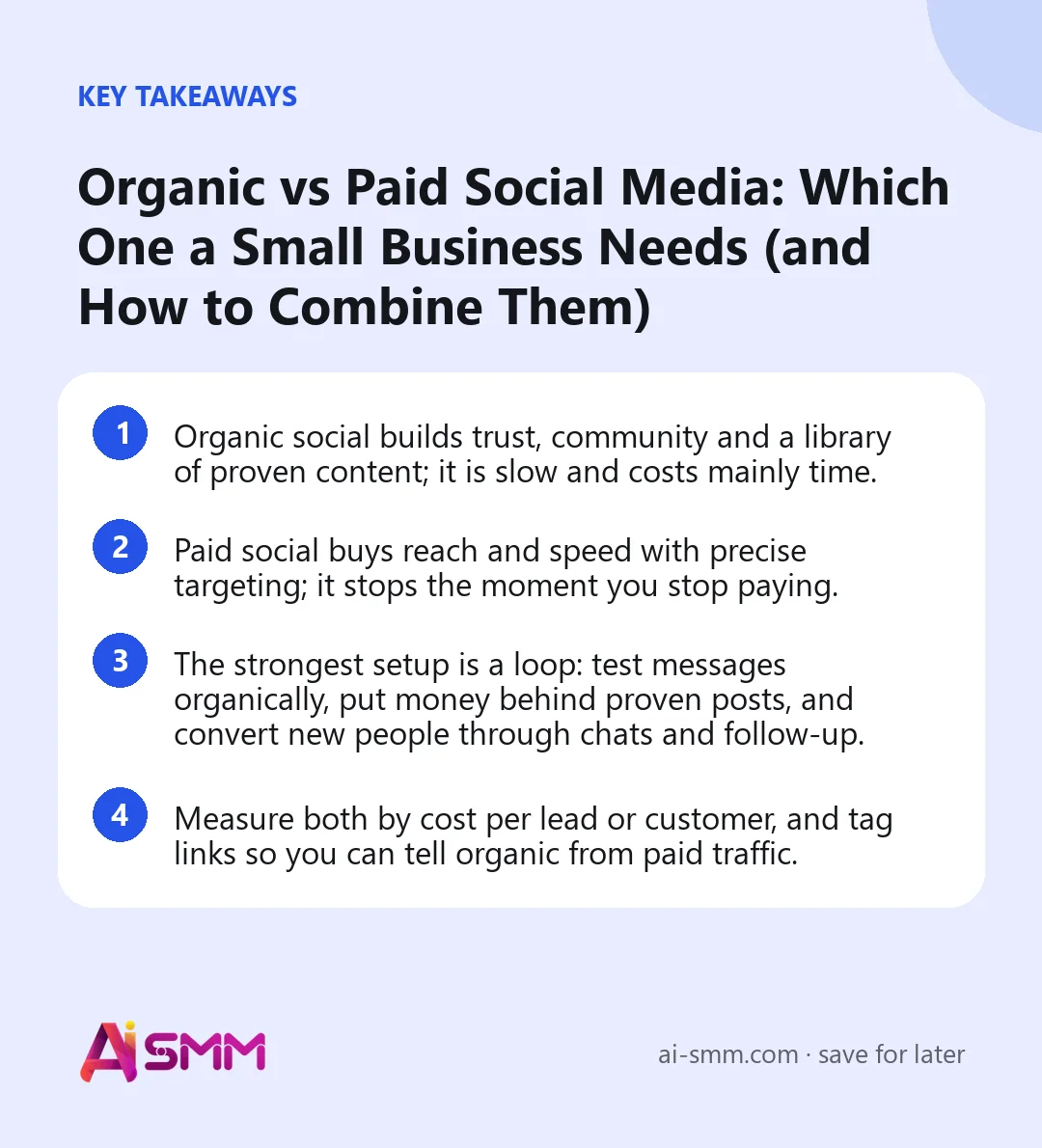
- Organic social builds trust, community and a library of proven content; it is slow and costs mainly time.
- Paid social buys reach and speed with precise targeting; it stops the moment you stop paying.
- The strongest setup is a loop: test messages organically, put money behind proven posts, and convert new people through chats and follow-up.
- Measure both by cost per lead or customer, and tag links so you can tell organic from paid traffic.
What organic and paid social media mean
Organic social media
Everything you publish and do without paying the network: posts, Reels, Stories, videos, replies to comments, conversations in DMs, community in groups and channels. Its reach comes from your followers, shares, search and recommendation feeds.
Paid social media
Anything where money decides who sees the content: boosted posts, ad campaigns built in the network’s ad manager, sponsored placements in channels, and paid collaborations with creators. You choose the audience, budget and goal; the network shows the content accordingly.
The grey zone
Some activities sit in between: a giveaway with a prize you pay for, free products sent to creators, or customer content you encourage. Count their cost in your paid budget so the comparison stays honest.
Organic vs paid social media: side-by-side comparison
| Organic | Paid | |
|---|---|---|
| Main cost | Time and content production | Ad spend plus time to set up and manage |
| Speed | Weeks to months to build momentum | Results within days |
| Reach | Mostly existing followers and their circles, plus recommendation and search | Anyone matching your targeting, within budget |
| Targeting | Indirect: through topics, hashtags, location, language | Direct: location, age, interests, lookalike audiences, retargeting |
| Lifespan | Posts keep working in search and profiles for months | Stops when the budget stops |
| Trust | Higher: people see you choose to show up and answer | Lower on first contact; labeled as sponsored |
| Best for | Loyalty, community, proof, repeat customers | Launches, local reach, promotions, testing new audiences |
| Risk | Slow results, unpredictable reach | Burning money on the wrong audience or weak creative |
When organic social works best
- Your business runs on trust and repeat customers. Salons, clinics, tutors and cafes win by being visibly present and responsive over months.
- You are still finding your message. Organic posts are free experiments: which offers, formats and topics get saves, shares and DMs?
- Your audience is small and specific. A B2B niche or a single neighborhood can often be reached through consistent posts and conversations.
- You have more time than money. Organic is the right starting point, as long as the time is protected and used well.
When paid social works best
- You have a deadline. An opening, a seasonal peak, a limited offer or an event that needs people now.
- Your organic content already works. Posts that bring messages from followers will usually bring messages from similar people who do not follow you yet.
- You need a precise local audience. Ads can target a radius around your location, which organic reach cannot promise.
- You want to retarget. People who visited your site or engaged with your profile can be shown a reminder or an offer.
- You know what a customer is worth. Then you can set a maximum cost per lead or booking and scale while you stay below it.
Paid options for small businesses, from simplest to most involved
“Paid social” covers several quite different tools. Small businesses usually move through them in this order.
| Option | What it is | Good for | Watch out for |
|---|---|---|---|
| Boosted post | Paying to show an existing post to more people, set up from the post itself | A first test with a proven post | Default audiences can be broad; narrow them yourself |
| Ad campaign | An ad built in the network’s ad manager with a chosen goal, audience and placements | Bookings, messages, orders, local reach | Takes setup time; learn one network before adding others |
| Sponsored placement in a channel or newsletter | Paying another channel’s owner to post about you | Reaching a ready-made niche audience | Check the audience is real and relevant before paying |
| Creator collaboration | A creator makes and posts content about your product for a fee or free product | Trust and social proof in a specific community | Agree on deliverables and labeling in advance |
| Retargeting | Ads shown to people who already visited your site or engaged with your profile | Bringing back people who almost bought | Needs enough traffic to build an audience |
You do not need all of them. One well-run option, measured honestly, beats five half-tested ones.
How organic and paid work together
The best results come from a loop in which each side feeds the other:
- Test organically. Post consistently and note which posts get saves, shares and DMs.
- Put money behind the winners. Boost or advertise those posts to a similar, wider audience.
- Land people somewhere credible. A profile with recent posts, answered comments and a clear next step converts ad visitors far better than a neglected one.
- Convert in conversation. Many small-business sales happen in DMs; fast replies and simple automations stop paid traffic from leaking away.
- Keep them organically. New followers and customers stay for the regular content, channel or newsletter, which lowers the cost of every future sale.
Seen this way, paid is an amplifier for what organic has proven, and organic is what keeps paid customers from being one-time buyers.
How to split organic and paid by business stage
These splits are illustrative starting points, not rules. They describe where most of your effort and cash goes, not exact percentages to hit.
| Stage | Organic focus | Paid focus | Typical balance |
|---|---|---|---|
| Just launched | Set up profiles, post regularly, answer everything | A small local campaign so the first posts reach anyone at all | Mostly organic, a small test budget |
| Finding what works | Test formats and offers, track which bring DMs | Boost the 1–2 best posts a month | Organic-led, paid for proven posts |
| Growing | Consistent content, community, repurposing | Steady campaigns with a cost ceiling per result | Balanced, paid scales what works |
| Established with loyal clients | Community, referrals, repeat purchase reminders | Retargeting and seasonal pushes | Organic-led, paid in peaks |
| Seasonal peak or launch | Teasers, countdowns, behind the scenes | Short, focused campaign with a clear offer | Temporarily paid-heavy |
How to test paid social without wasting money
- Pick one goal and one offer. “Bookings for a first visit at 20% off” is testable; “awareness” is hard to judge on a small budget.
- Choose a proven post. Use one of your best organic posts from the last two months as the creative.
- Keep the audience tight. Your area, your persona’s age and interests. Broad audiences need bigger budgets to learn.
- Set a small budget and a fixed period. One to two weeks is enough to see whether messages and bookings come in.
- Prepare for replies. Someone answers DMs quickly during the test; a slow reply wastes the money spent on the click.
- Judge by cost per result. Compare cost per lead or booking with what a customer is worth, then scale, adjust or stop.
How to measure organic and paid results
| Question | Organic metrics | Paid metrics |
|---|---|---|
| Are people seeing it? | Reach, views, share of non-followers | Reach, frequency, cost per 1,000 impressions |
| Do they care? | Saves, shares, comments, engagement rate | Click-through rate, engagement on the ad |
| Do they act? | DMs, link clicks, profile visits | Cost per click, cost per message or lead |
| Do they buy? | Leads, bookings, orders attributed to organic | Cost per booking or order, return on ad spend |
To separate the two in your web analytics, tag links: use a medium such as “social” for organic posts and “paid_social” for ads, with the network as the source. For sales that happen in chats, tag the contact with where the conversation started, including whether it came from an ad.
Common mistakes
- Advertising an empty profile. Paid visitors check your account; three old posts and unanswered comments cost you the conversion.
- Boosting whatever was posted last. Promote proven content, not the newest.
- Treating paid as a switch for followers. Followers bought through broad campaigns often do not buy. Aim ads at actions: messages, bookings, orders.
- Judging organic after two weeks. Organic needs months of consistency before it can be fairly evaluated.
- Not counting time in organic. Organic is not free. Compare its cost per customer, including hours, with paid.
Where AI SMM fits in organic and paid
AI SMM works on the organic side and on converting people who arrive from both organic and paid; ad campaigns themselves are set up in each network’s own ad tools. The planner publishes to 14 networks from one calendar, and the AI content studio drafts posts in your brand’s tone, which keeps the consistent organic presence that makes paid traffic convert. Analytics compares engagement across 12 networks, which is how you spot the organic winners worth putting money behind; X and Telegram are not included.
When ads or organic posts bring people in, chat flows can answer a keyword comment on Instagram or Facebook with an automatic DM and handle routine questions, while conversations from supported networks, WhatsApp and your website chat collect in one inbox. A link in bio page gives both kinds of visitors a clear next step, and leads from it go straight to contacts. Online sellers can see how this comes together on the online sellers page.
FAQ
Is organic social media still worth it?
Yes, especially for small businesses. Organic reach is lower than it once was on some networks, but short video, search and recommendation feeds still show good content to non-followers, and organic presence is what makes people trust you when they see your ads.
How much should I spend on paid social as a small business?
Start with a small test budget for one to two weeks behind a proven post, then scale based on cost per lead or booking compared with what a customer is worth to you. There is no universal figure; the ceiling is set by your margins.
Can I grow on social media without paying for ads?
Yes, but it takes longer. Consistent posting, fast replies, short video and collaborations with local partners can grow a small business without ads. Paid mainly shortens the time and helps at launches and seasonal peaks.
Should I boost posts or create separate ads?
Boosting a proven post is the simplest start. Separate ad campaigns give more control over goals, audiences and placements, and make sense once you know which messages work and want to scale them.
Paid works best on top of a strong organic base. Build yours with the free plan of AI SMM, then put money behind the posts that prove themselves.
Posts, chats, video and sales in one workspace. 7 days free.
Start free