
 AI SMM team
How often should you post on social media? For most small businesses, a realistic starting point is 3–5 posts a week on your main network, 2–3 a week on a secondary one, and short daily touches (Stories, a quick update) where the format allows it. The exact number matters less than keeping it steady: an account that posts three times a week every week almost always does better than one that posts daily for a fortnight and then disappears for a month.
Below you will find starting ranges for each major network, a way to pick a schedule based on how much time you really have, and the signs that you are posting too much or too little.
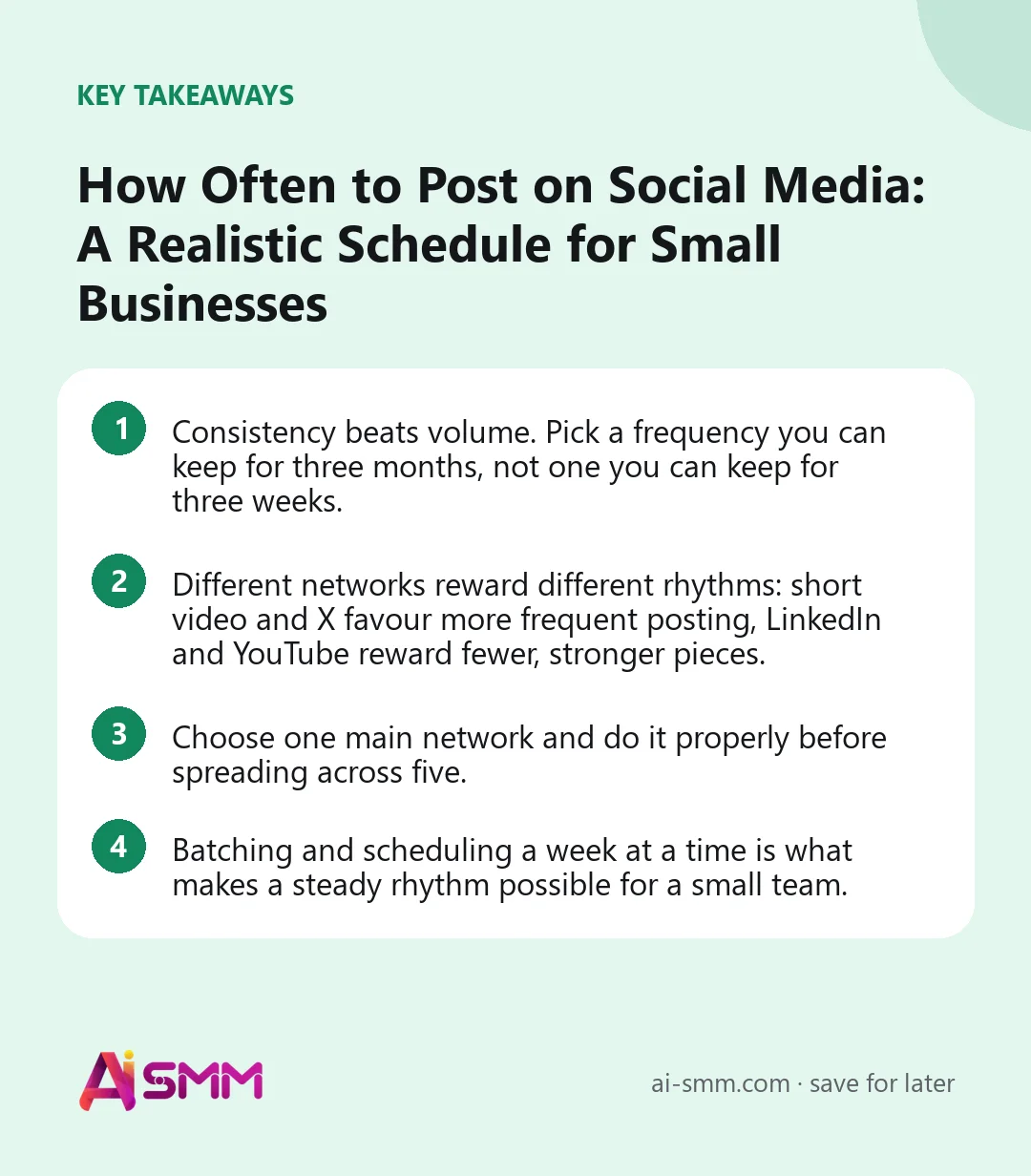
- Consistency beats volume. Pick a frequency you can keep for three months, not one you can keep for three weeks.
- Different networks reward different rhythms: short video and X favour more frequent posting, LinkedIn and YouTube reward fewer, stronger pieces.
- Choose one main network and do it properly before spreading across five.
- Batching and scheduling a week at a time is what makes a steady rhythm possible for a small team.
Why posting frequency matters (and where it stops mattering)
Recommendation systems learn from each post you publish. The more often you post, the more chances the network has to find the people who respond to you, and the more chances you have to learn what works. Regular posting also keeps you visible to existing followers, who see only a fraction of what the accounts they follow publish.
But frequency has diminishing returns. After a certain point, each extra post gets less attention, quality drops because you are rushing, and followers start to feel spammed. For a small business the real limit is almost never the algorithm. It is the time and energy of the one or two people making the content.
That is why the right question is not “what is the ideal number?” but “what is the highest frequency I can keep up at good quality for months?”
How often to post on each network: starting ranges
These ranges come from networks’ public guidance and from what we see work for small accounts. They are starting points to test, not rules.
| Network | Starting frequency | What to focus on |
|---|---|---|
| 3–5 feed posts or Reels per week; Stories most days | Reels for reach, carousels for saves, Stories for daily contact | |
| TikTok | 3–7 videos per week | Short, frequent tests; the more videos, the faster you learn what hooks work |
| Facebook Page | 3–5 posts per week | Local news, offers, events; Reels for reach |
| 2–4 posts per week | Fewer, thoughtful posts; comments on others’ posts count too | |
| X (Twitter) | 1–3 posts per day | Short posts move fast; replies and conversations matter as much as posts |
| Threads | 3–7 posts per week | Conversational text; reply to replies |
| YouTube | 1 long video per week or two; Shorts 2–4 per week | Quality and searchable titles over quantity |
| Several pins per week, spread out | Pins live for months, so steady volume beats bursts | |
| Telegram channel | 3–7 posts per week | Readers get notifications, so too many posts lead to muted channels |
If a range looks unrealistic, start at the bottom of it. Three good TikToks a week for six months will teach you more than fifteen a week for three weeks.
Pick a schedule that matches your time
A schedule you cannot keep is worse than a modest one you can. Here are three levels depending on the hours you really have each week.
Level 1: about 2 hours a week
- One main network: 3 posts per week.
- Stories or short updates on 2–3 days.
- One batch session per week to write and schedule everything.
Level 2: about 4–5 hours a week
- Main network: 4–5 posts per week, including 2 short videos.
- Second network: 2–3 posts per week, mostly adapted from the main one.
- Daily Stories or a Telegram update.
Level 3: a part-time person or agency
- Main network: daily.
- Two or three secondary networks: 3–5 posts per week each.
- Long video every week or two, cut into short clips for the rest of the week.
Whatever level you choose, commit to it for at least a month before judging the results. Algorithms need a few weeks of consistent signals to settle on who your audience is.
Posting frequency by type of business
What you sell also shapes the right rhythm. These are illustrative starting points; adjust them to your capacity and results.
| Business | Main network and rhythm | Why |
|---|---|---|
| Beauty salon or studio | Instagram: 4–5 posts or Reels a week, Stories daily with free slots | Visual results sell, and free slots change every day |
| Café or restaurant | Instagram or Telegram: 3–5 posts a week, daily specials in Stories or a short post | Menus and specials are time-sensitive; regulars want a quick daily nudge |
| Online shop | Instagram and TikTok: 4–7 posts a week around new arrivals and styling | New products give natural content; short video drives discovery |
| Expert or coach | One main network daily or near-daily, plus a weekly longer piece | Trust grows with regular useful content and a recognisable voice |
| B2B service or agency | LinkedIn: 2–4 posts a week; X or Threads if the audience is there | Buyers read fewer, deeper posts; quality beats frequency |
| Local service (repair, cleaning) | Facebook or Instagram: 2–3 posts a week, more in the busy season | Demand is seasonal; steady presence keeps you remembered |
Seasonality matters too. A florist before holidays, a tax adviser before deadlines or a gift shop in December should post more during those weeks and can ease off afterwards. Plan those peaks into the calendar in advance rather than scrambling when they arrive.
Quality vs quantity: finding the balance
There is a simple test for whether you are posting too often: would you stop scrolling for this post if someone else had published it? If the honest answer is “no” for more than a third of your recent posts, cut the frequency and put the saved time into making each post better.
The opposite problem is also common. Some owners polish one “perfect” post a week and wonder why nothing grows. On short-form networks especially, the tenth video is usually better than the first simply because of practice. If you post rarely, you learn slowly.
A good middle path: keep one “hero” piece per week that you put real effort into (a useful carousel, a longer video, a case study) and fill the rest of the week with lighter content made from it: a quote, a clip, a behind-the-scenes shot, a question to your audience.
Signs you are posting too much or too little
| Posting too much | Posting too little |
|---|---|
| Reach per post keeps falling while the number of posts rises | Followers forget you; each post starts from zero |
| Unfollows or muted Telegram notifications after busy days | Few comments and DMs because people do not see you often enough |
| Captions are rushed, visuals repeat, you dread the next post | Long gaps between posts, then a burst of “catch-up” content |
| No time left to answer comments and messages | Not enough posts to tell what works and what does not |
The last row on the left is the one to watch. Posting more is pointless if it leaves you no time to reply to the people who respond. Conversations in comments and DMs are where followers turn into customers.
How to test your ideal frequency
- Set a baseline. Post at your current comfortable rate for four weeks and note reach, engagement, profile visits and messages per week.
- Change one thing. Increase frequency by one or two posts a week on one network only, keeping the same kind of content.
- Compare weekly totals, not single posts. If total reach and messages grow while per-post numbers hold steady, the extra posts are worth it.
- Watch the cost. If quality or response time slipped, go back to the previous rate.
- Repeat once a quarter. Your capacity and audience change, so the right frequency changes too.
Make any schedule easier: batch, repurpose, schedule
Almost every small business that posts consistently does three things:
- Batches creation. One or two sessions a week to write captions, shoot a few videos and pick photos, instead of creating something every day.
- Repurposes. One idea becomes a carousel on Instagram, a short text on Threads, a longer post in Telegram and a clip on TikTok.
- Schedules ahead. Posts go into a calendar a week or two in advance, leaving room for spontaneous content on top.
This is also where your content pillars help: when every day of the week has a theme, batching is fast because you know what each slot needs.
Keeping a steady posting rhythm in AI SMM
AI SMM is built around exactly this workflow. The content calendar shows every network in month, week and feed views, so gaps and pile-ups are visible at a glance. You can upload dozens of photos and videos at once and spread them over the calendar, connect RSS feeds for digest posts, and send drafts for approval in Telegram if someone else signs off on content.
The AI content studio turns a campaign brief into a dated plan and writes drafts in your brand’s voice, and repurposing adapts one text for several networks. For video-heavy schedules, video clipping cuts one long video into several vertical clips for TikTok, Reels and Shorts, which covers a week of short-form posts from a single recording.
To decide whether your frequency is working, analytics compares followers, reach and engagement across networks and includes a Best time tab. Note that X and Telegram have no analytics in AI SMM, so for those channels judge by replies, DMs and the view counts the apps themselves show. The Start plan includes 200 posts a month and Business has no post limit, so a daily multi-network schedule fits comfortably.
FAQ
Is posting every day on Instagram too much?
Not if you can keep quality up and still answer comments. For most small businesses, 3–5 feed posts or Reels a week plus Stories is a more sustainable rhythm than daily feed posts.
Should I post the same content on every network at the same time?
You can share the same idea, but adapt the format and text for each network. Identical copy everywhere looks lazy and ignores how each audience reads. Staggering by a few hours or days is fine.
Does posting more often hurt reach?
Posting more does not usually get you penalised, but weaker posts get less reach, and a string of weak posts can pull your average down. On Telegram, too many posts can lead readers to mute the channel.
What if I miss a week?
Just restart at your normal rhythm. Do not try to “catch up” with a burst of posts. Scheduling a buffer of one or two weeks ahead is the easiest way to avoid gaps in the first place.
Choose a frequency you can keep, fill two weeks ahead in the content calendar, and let consistency do the rest.
Posts, chats, video and sales in one workspace. 7 days free.
Start free