
 AI SMM team
The best time to post on TikTok is the hour, one to three hours before your own followers are most active, and for most local audiences that lands on weekday evenings (roughly 18:00–22:00), lunch breaks (12:00–14:00) and late weekend mornings. That is a starting point, not a rule. Your real answer sits in TikTok’s follower activity chart and in a short test with your own videos, and this guide shows how to run both without turning posting into a science project.
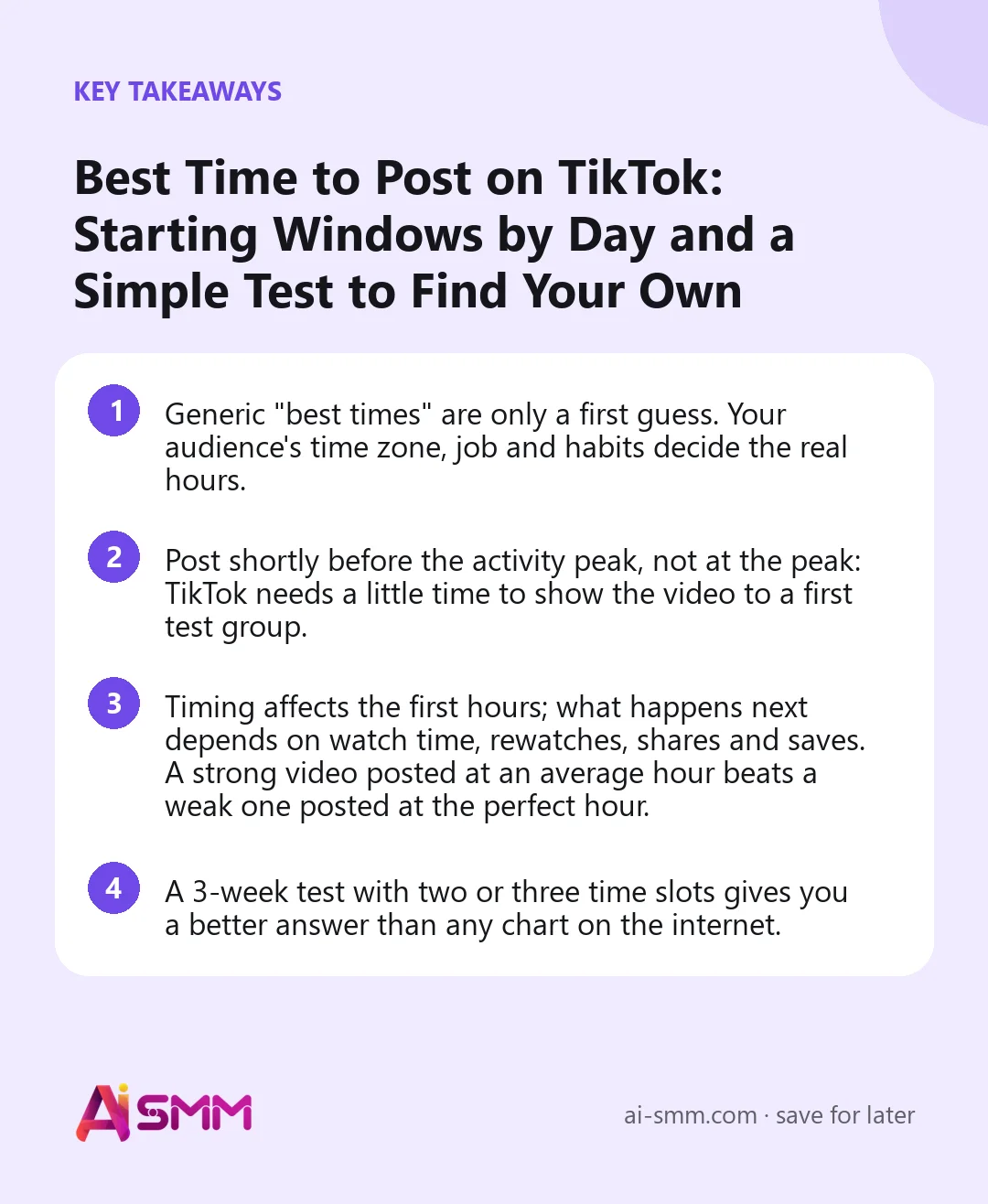
- Generic “best times” are only a first guess. Your audience’s time zone, job and habits decide the real hours.
- Post shortly before the activity peak, not at the peak: TikTok needs a little time to show the video to a first test group.
- Timing affects the first hours; what happens next depends on watch time, rewatches, shares and saves. A strong video posted at an average hour beats a weak one posted at the perfect hour.
- A 3-week test with two or three time slots gives you a better answer than any chart on the internet.
Does timing still matter on TikTok?
Yes, but less than on networks with a strictly chronological feed. TikTok shows a new video to a small group first, watches how they react and then decides whether to widen the audience. That first group often includes some of your followers. If they are asleep or at work when you publish, the video starts slower, and a slow start can mean the second wave is smaller.
At the same time, TikTok videos can pick up views days or even weeks after upload, especially from search and from the For You feed when a topic becomes relevant again. So think of timing as a way to give each video a fair first test, not as the thing that makes or breaks it. If you have to choose between spending an hour on a better hook or an hour on finding the perfect minute to publish, choose the hook.
Best time to post on TikTok: starting windows by day
These windows come from what we see across small-business accounts and from the general rhythm of people’s days. Use them in your audience’s local time until you have your own data.
| Day | Starting windows (audience local time) | Why it tends to work |
|---|---|---|
| Monday | 12:00–14:00, 19:00–21:00 | Lunch scroll, evening wind-down after the first workday |
| Tuesday | 07:00–09:00, 18:00–21:00 | Commute and after-work browsing |
| Wednesday | 12:00–14:00, 18:00–22:00 | Midweek evenings are consistently busy |
| Thursday | 12:00–14:00, 19:00–22:00 | People start planning the weekend: good for cafés, events, beauty |
| Friday | 15:00–18:00, 20:00–23:00 | Early finish, then late-evening scrolling |
| Saturday | 10:00–13:00, 20:00–23:00 | Slow mornings and late nights |
| Sunday | 10:00–13:00, 18:00–21:00 | Relaxed browsing and “planning the week” mood |
Two practical notes. First, publish at the start of a window, not in the middle, so the video is ready when attention peaks. Second, do not try to hit all fourteen slots. Two or three regular slots a week that you can actually keep are worth more.
Best times by type of business
Your customers’ routine matters more than the day of the week. A few examples of how to adjust the starting windows:
| Business | Who watches | Try first |
|---|---|---|
| Beauty salon, nail or brow studio | Clients planning their next appointment | Thursday–Sunday, 19:00–22:00; lunch on weekdays |
| Café, bakery, delivery | Hungry people deciding what to eat | 11:00–12:00 before lunch, 17:00–19:00 before dinner, weekend mornings |
| Online shop | Browsers who buy in the evening | 20:00–23:00 weekdays, Sunday evening |
| Expert, coach, tutor | Working adults, students | 07:00–09:00 and 19:00–21:00 on weekdays |
| B2B service, agency | Owners and managers | Weekday lunch and early evening, less on weekends |
| Fitness studio, gym | People with a routine | Early morning 06:00–08:00, Sunday evening for “new week” motivation |
Say a bakery in Tallinn posts a “how our croissants are laminated” video at 21:00 on a Tuesday. The people who see it cannot buy a croissant at that hour, and by morning the video is already competing with newer ones. The same video at 07:30, when people walk past on their way to work, can turn views into a queue. Think about when watching can lead to action, not just when people are online.
How to find your best time in TikTok analytics
If you have a business or creator account, TikTok shows when your followers are active. The menu names change between app versions, but the path is roughly the same:
- Open your profile, then the menu, then TikTok Studio (or Creator tools in older versions), then Analytics.
- Go to the Followers or Viewers tab.
- Scroll to the activity section: it shows the hours and days when your followers were most active over the recent period.
- Check which time zone the chart uses and convert it to your audience’s local time if needed.
- Write down the two or three highest hours and the busiest days. Your posting slots go one to three hours before those peaks.
Keep in mind what the chart does and does not show. It reflects your followers, not everyone who might see your video. If most of your views come from the For You feed and search rather than from followers, the chart is a weaker guide, and the test below matters more. The chart also needs some history: a brand-new account with a few dozen followers will not have a reliable pattern yet.
Where your audience lives changes everything
Time zones are the most common reason a “best time” does not work. Check the top locations in your follower data. If you are a local business, you probably want local viewers anyway, so post by local time. If you sell online to several countries, pick the time zone that holds most of your buyers, not most of your viewers. A Warsaw-based online jewellery shop with buyers mostly in Germany and Poland can use one schedule; a course creator with students split between Europe and North America may need two slots, one for each region, on different days.
A 3-week test to find your own best time
This is the part that gives you a real answer. It takes little effort if you already post two or three times a week.
- Pick three slots from the starting windows and your follower chart, for example Tuesday 07:30, Thursday 19:00 and Saturday 11:00.
- Post similar content in each slot. Do not put your best video on Thursday and a weak one on Tuesday, or you will measure the video, not the time.
- Keep everything else stable: similar length, similar topic mix, similar hooks.
- Record results after 48 hours for each video: views, average watch time, likes, comments, shares, new followers.
- Repeat for three weeks, so each slot gets at least three videos.
- Compare medians, not single hits. One viral video can make a slot look great by accident. Look at the typical result per slot.
- Keep the winner, replace the loser with a new slot and keep testing in the background.
| Slot | Video | Views at 48 h | Avg watch time | Shares + saves | New followers |
|---|---|---|---|---|---|
| Tue 07:30 | |||||
| Thu 19:00 | |||||
| Sat 11:00 |
Judge the slot mostly by early reactions per view (shares, saves, comments) and by watch time, not only by raw views. A slot where fewer people watch but more of them react tells you your core audience is there.
How often to post on TikTok
Frequency and timing go together. Posting ten times a day will not help if the videos are rushed; posting once a month gives TikTok and your audience nothing to build on. For a small business, a realistic rhythm is 3–5 videos a week. Two videos a week, every week, is better than seven in one week and nothing for a month.
- Just starting: 3 videos a week in fixed slots, so you learn fast which topics work.
- Steady state: 3–5 a week, with one “search” video that answers a common customer question.
- If you post more than once a day, leave at least a few hours between videos so they do not compete for the same followers.
What matters more than the hour
If a video fails, timing is rarely the main reason. Before you move your slots around, check these:
- The first two seconds. Does the video open with the result, a question or movement, or with a greeting and a logo?
- Length versus content. A 20-second answer with no filler usually keeps more viewers than a 60-second one that repeats itself.
- One clear topic. Videos that try to cover three things tend to lose people halfway.
- Searchable wording. Say and write the phrase customers would search, so the video keeps getting found long after the posting hour.
- Replies in the first hour. Answering early comments keeps the conversation going and brings viewers back to the video.
How to post at the best time in AI SMM
Being online at 07:30 on Tuesday and 19:00 on Thursday is the hard part, so hand it to a scheduler. In AI SMM’s content calendar you place TikTok videos and photo carousels in your chosen slots, and they are published automatically at that time, alongside posts for your other networks. If the videos come from longer recordings, video clipping cuts one lesson or walkthrough into several vertical clips with subtitles, which is how you fill three slots a week without filming three times. AI Content Studio drafts a caption and hashtags for each clip in your brand’s tone.
To read the test, open analytics: for TikTok it shows views, likes, followers and engagement rate per video, so you can compare the slots side by side, and the Best time tab suggests hours based on your own account’s history rather than a generic chart. Average watch time and the follower activity chart stay in TikTok Studio, so use both views together. TikTok comments are not part of the AI SMM inbox; reply to them in the TikTok app during the first hour after each scheduled post.
FAQ
What is the single best time to post on TikTok?
There is no universal hour. For most local audiences, weekday evenings between 18:00 and 22:00 are a safe first guess, but your follower activity chart and a short test will beat any general answer within a few weeks.
Should I post at the exact peak hour?
Aim one to three hours before the peak. TikTok needs time to show the video to a first group and react to their behaviour, so publishing slightly earlier lets the video be ready when most followers open the app.
Does the time zone of my phone matter?
No. What matters is the local time of your audience. If your followers are in another country, convert your slots to their time zone, and check which time zone TikTok’s analytics chart is using.
Can a video go viral if I post at a bad time?
Yes. Timing mostly affects the first hours. A video with a strong hook and high watch time can still spread days later, especially through search. Timing gives each video a fair start; content decides how far it goes.
Pick three slots from this guide, post similar videos in them for three weeks and keep the one that wins. Schedule the test in AI SMM once, and the videos will go out on time while you get on with running the business.
Posts, chats, video and sales in one workspace. 7 days free.
Start free