
 AI SMM team
X (Twitter) marketing works for a small business when the business has something to say in real time and a founder or expert willing to join conversations: SaaS and tech products, B2B services, consultants, local news-driven businesses, creators. It works less well for purely visual products that sell through photos, where Instagram, TikTok or Pinterest usually do more. If X fits you, the formula is simple: short, frequent posts with a clear point of view, lots of replies to the right people, and fast answers in DMs.
This guide covers who should be on X, how to set up the profile, what to post, how to use replies and DMs to find clients, and how to measure progress honestly.
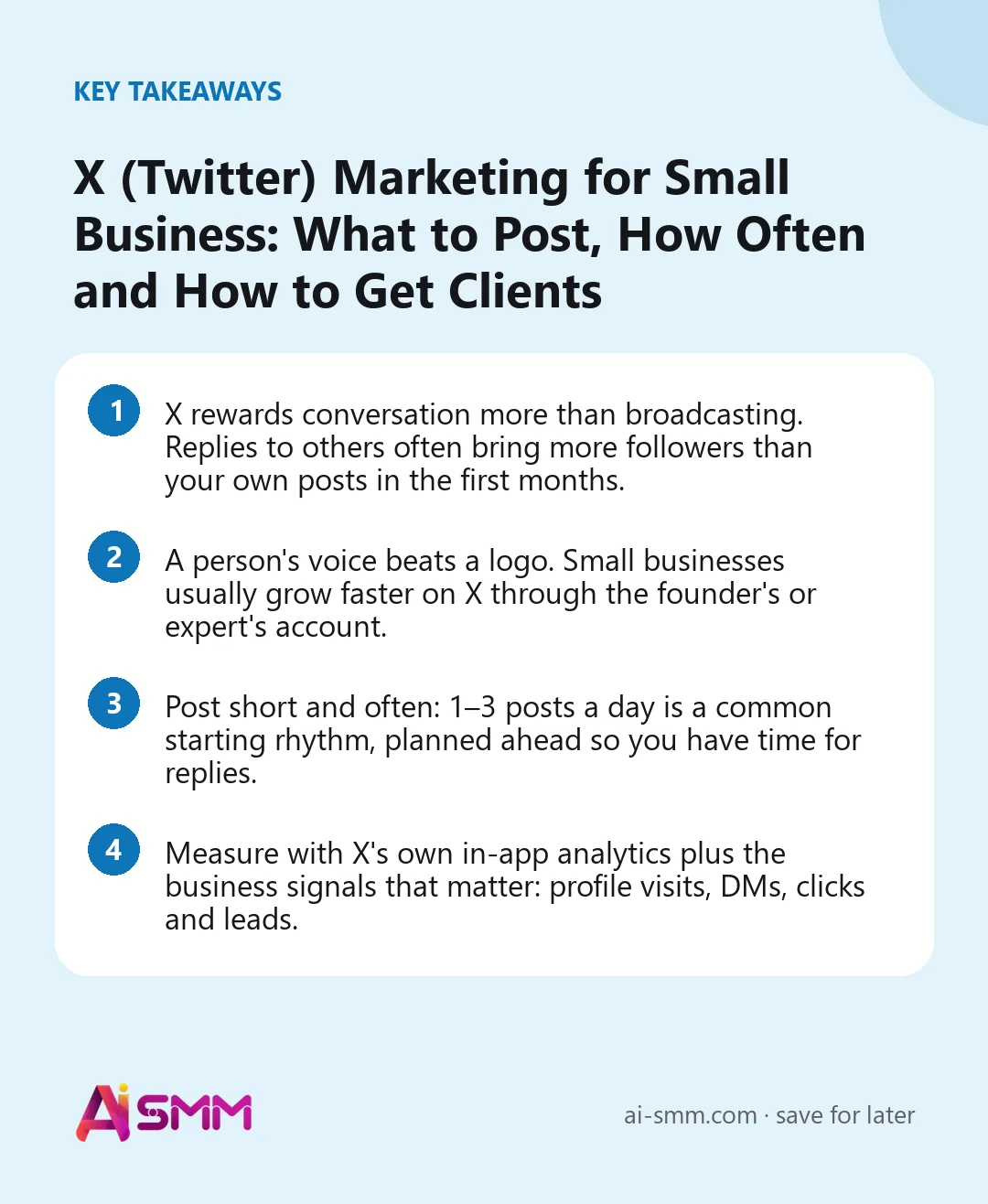
- X rewards conversation more than broadcasting. Replies to others often bring more followers than your own posts in the first months.
- A person’s voice beats a logo. Small businesses usually grow faster on X through the founder’s or expert’s account.
- Post short and often: 1–3 posts a day is a common starting rhythm, planned ahead so you have time for replies.
- Measure with X’s own in-app analytics plus the business signals that matter: profile visits, DMs, clicks and leads.
Is X (Twitter) marketing right for your small business?
Before investing time, check whether your customers are actually there and whether your business suits the format. X is a fast, text-first network where news, opinions and industry talk dominate.
| X usually works well for | X usually works less well for |
|---|---|
| SaaS, apps and tech products | Beauty, fashion and food that sell through visuals |
| B2B services, agencies, consultants | Local services with an older, non-online audience |
| Experts, coaches and creators building a personal brand | Businesses with no one willing to write and reply regularly |
| Businesses tied to news, events, sports or finance | Products that need long explanations and lots of photos |
A quick test: search X for the words your customers would use (“looking for an accountant”, “best CRM for”, your city plus your service). If you find real people asking real questions, there is an audience to reach.
Setting up your X profile for business
- Decide whose voice. A brand account works for support and announcements; a founder or expert account usually grows faster because people follow people. Many small businesses run both, with the personal account doing most of the talking.
- Name and handle. Clear and searchable. “Anna | Bookkeeping for freelancers” is more useful than a clever pun.
- Bio. Who you help, with what, and one proof point. Add a link to a booking page, store or link in bio page.
- Pinned post. Your best introduction: what you do, a useful thread, or your main offer. It is the first thing profile visitors read.
- Header image. Use it as a billboard: your offer, a product shot or a line about who you help.
What to post on X: 8 content types that work
1. Quick tips
One useful idea in a few lines. “If your invoices get paid late, put the due date in the subject line, not just the body.” Tips get saved and shared.
2. Opinions on your industry
A clear take on a trend, a tool or a common practice. X rewards a point of view; neutral posts disappear.
3. Threads
A series of connected posts that explain something step by step: a process, a case, a checklist. Threads are the closest thing on X to a blog post and often bring the most new followers.
4. Behind the scenes and build in public
What you are working on, what went wrong, what you learned. For founders and small teams this is often the most engaging content, because it is honest and specific.
5. Polls
Two to four options, one clear question. Polls are cheap market research: which feature to build next, which time slot suits people, which product to restock.
6. Images and short videos
Up to four images or one video per post. Screenshots of results, a product in use, a short explainer. Visuals stop the scroll in a text-heavy feed.
7. Customer stories
A short before/after in words, with the customer’s permission. Proof works on X as well as anywhere.
8. Offers and announcements
New product, open slots, a launch date. Keep these to a minority of posts so the account does not feel like an ad feed.
How often to post on X
X moves fast, so posts have a short life. A common starting rhythm for a small business is 1–3 posts a day, plus replies. If that sounds like a lot, remember that many posts are one or two sentences, and a single idea can be turned into a tip, a poll and a thread over a week.
Plan your core posts ahead so they go out even on busy days, and spend your live time on the part that cannot be scheduled: conversations. A week of drafted posts also leaves room to react to news in your industry the moment it happens.
A sample week of X marketing for a small business
Here is an illustrative plan for, say, a small bookkeeping firm that serves freelancers. It takes about 20–30 minutes a day, most of it for replies.
| Day | Scheduled post | Live work (15–20 min) |
|---|---|---|
| Monday | Tip: one deadline freelancers often miss this month | Reply to 5 posts from accounts on your list |
| Tuesday | Poll: “How do you track expenses?” with 3 options | Answer DMs, reply to poll comments |
| Wednesday | Thread: “How to prepare for your first tax return in 6 steps” | Search for people asking for bookkeeping advice and help them |
| Thursday | Customer story: before/after in two sentences, with permission | Reply to mentions and everyone who engaged |
| Friday | Behind the scenes: what the team learned this week | Reply to 5 posts; note questions for next week’s content |
| Weekend | Optional: an opinion post on an industry change | Light check of DMs |
Notice the ratio: one scheduled post a day, and more time spent in other people’s conversations. The questions you see during the live part become next week’s tips and threads, so the plan feeds itself.
Replies: the growth engine most businesses ignore
On X, a thoughtful reply under a popular post in your niche can bring more profile visits than your own post to a small audience. People see your reply, click your name, and follow if your profile is clear.
- Make a list of 20–50 accounts your customers follow: industry voices, media, communities, complementary businesses.
- Reply early and add value. A useful addition, a counterpoint, a short example. “Great post!” does nothing.
- Answer everyone who replies to you. Conversations under your own posts signal that the post is worth showing to more people.
- Search for buying signals. People asking for recommendations in your field are warm leads. Answer helpfully first; do not jump in with a pitch.
DMs and mentions: turning attention into clients
When X works, it brings DMs: questions about prices, partnership offers, requests for a call. Speed matters here as much as on any other network. Tips:
- Keep ready answers for the common questions: pricing, how to start, availability.
- Move serious conversations to a clear next step: a booking link, a call, a proposal.
- Watch mentions, not only DMs. People often tag a business publicly with a question or a complaint, and a quick public reply shows everyone you are responsive.
Measuring X marketing results
X provides post analytics inside its own app: impressions, engagements, profile visits and link clicks, with more detail on paid tiers. Use them to see which content types travel. But for a small business, the numbers that matter sit further down:
- Profile visits and new followers per week.
- DMs and mentions that turn into real conversations.
- Clicks to your site or booking page (use a tagged link so you can see them in your web analytics).
- Leads, calls and sales you can trace back to X.
Review monthly. If after three months of consistent posting and replying X brings no conversations, it may simply not be your network, and that is useful to know.
Common X marketing mistakes
- Only broadcasting. Posting links to your site and never replying to anyone.
- Copying Instagram captions. Long, emoji-heavy captions look out of place. Rewrite for X.
- Arguing with critics. A calm, factual reply or a move to DMs almost always works better than a public fight.
- Giving up after a month. Growth on X is slow at first and compounds as your replies and threads bring people in.
- Aggressive automation. Mass follows, generic auto-comments and cold DMs can get an account restricted and damage your reputation.
Running X marketing in AI SMM
AI SMM covers the practical side of X for a small team. In the content calendar, you schedule X posts with text, up to four images or one video, or a poll, next to your other networks, and text limits are checked before publishing. The AI content studio drafts short posts and poll questions from a brief in your brand’s voice, and repurposing turns an Instagram caption or a blog idea into a version that fits X.
X DMs and mentions arrive in the unified inbox, and chat flows can answer recurring questions automatically and hand unusual ones to a person. For finding the right people, the Chrome extension works as an assistant in your own browser: it can find people in your audience, like and follow within X’s limits, and drafts comments that are posted only after you approve them.
One honest limitation: AI SMM has no analytics for X. Use X’s own in-app analytics for post-level numbers, and the inbox (DMs, mentions and how fast you answer them) plus your site and booking data as the main signals of whether X brings clients.
FAQ
Is X (Twitter) still worth it for small businesses?
For B2B, tech, experts and news-driven businesses, often yes, because decision-makers and communities still talk there. For visual consumer products, Instagram, TikTok or Pinterest usually bring more for the same effort.
Should I post as the brand or as the founder?
If you can only run one account, the founder or expert account usually grows faster, because people follow people. A brand account is useful for announcements and support.
Do I need X Premium for marketing?
Not to start. Paid tiers add features like longer posts and more analytics detail, which can help later. Consistent posting and good replies matter more.
How do I get my first followers on X?
Reply thoughtfully to accounts your customers follow, publish a few useful threads, pin your best one, and answer everyone who engages. The first few hundred followers usually come from replies, not from your own posts.
If X fits your business, plan a week of posts in the content calendar and spend the time you save on the conversations that bring clients.
Posts, chats, video and sales in one workspace. 7 days free.
Start free