
 AI SMM team
Social media for hotels is one of the few marketing channels a small property fully controls. Booking platforms bring guests, but they also take a commission, decide how you are displayed and keep the relationship with the traveler. A good Instagram or TikTok account does the opposite: it makes people want your place specifically, answers their questions directly and sends them to book with you. This guide is for small hotels, boutique properties and guesthouses: what to post, how to handle guest questions in chats, how to nudge people toward direct bookings, a weekly plan and the mistakes that make a beautiful feed useless.
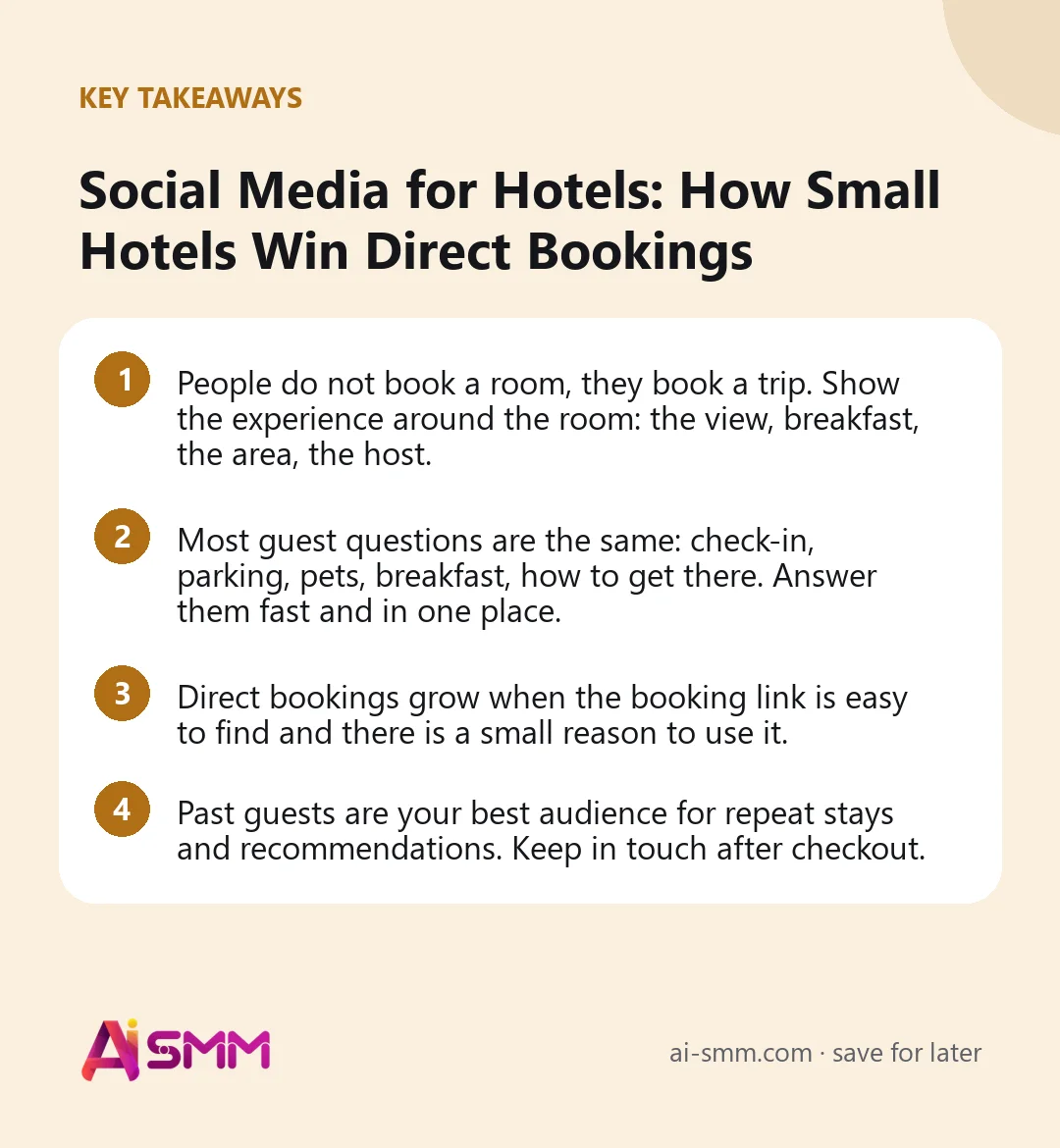
- People do not book a room, they book a trip. Show the experience around the room: the view, breakfast, the area, the host.
- Most guest questions are the same: check-in, parking, pets, breakfast, how to get there. Answer them fast and in one place.
- Direct bookings grow when the booking link is easy to find and there is a small reason to use it.
- Past guests are your best audience for repeat stays and recommendations. Keep in touch after checkout.
1. Why social media for hotels is about the trip, not the room
Every hotel has a bed, a bathroom and Wi-Fi. What makes a traveler choose yours is everything around it: the morning light on the terrace, the bakery across the street, the host who knows the best hiking route. Social media is where you show that, because booking platforms mostly compare prices and ratings.
Think about three moments in a traveler’s journey:
- Dreaming: they are not planning yet, just scrolling. Beautiful, atmospheric content reaches them.
- Planning: they compare places. Practical content wins: room tours, prices from, how to get there, what is nearby.
- Staying and after: they tag you, leave reviews and may come back. Community content and good service keep them close.
2. Choose networks that match how travelers search
| Network | Role for a hotel |
|---|---|
| The main showcase: Reels of rooms and views, carousels of the area, Stories with daily life and availability | |
| TikTok | Discovery: short room tours, “hidden gems near us”, seasonal moments |
| Older travelers, families, local events, groups about the region | |
| YouTube | Longer tours of the property and the area, found through search while planning |
| Pins with room and destination photos that link to your site, useful for inspiration-driven trips | |
| WhatsApp and Telegram | Direct conversations with guests before and during the stay |
A small hotel can start with Instagram plus one discovery network (TikTok or Pinterest) and a messaging channel that guests actually use in your market.
3. Content pillars with examples
Rooms and spaces
- A 20-second walk from the door to the balcony, filmed in daylight.
- A carousel: “Which room to choose: for couples, for families, for longer stays.”
- Details that make a difference: the coffee machine, blackout curtains, a desk for remote work.
The experience
- Breakfast being prepared, with local products named.
- “A perfect day from our hotel”: morning walk, lunch spot, sunset view.
- Seasonal moments: first snow, blooming garden, the terrace opening for summer.
The area and local tips
- “Five places locals love within a 10-minute walk.”
- How to get to you from the airport or train station, step by step.
- Events in town this month and how to combine them with a stay.
People and guests
- The host, the chef or the housekeeper introduced in a short video.
- Guest photos and reviews, reposted with permission.
- Behind the scenes: preparing a room, the garden, renovating a space.
A useful balance: about 35% experience and area, 30% rooms, 20% people, 15% offers and practical information.
4. Show real photos and honest details
Nothing damages a hotel faster than a guest who says “it looked different online”. Content that builds trust:
- Real photos and videos with natural light, not heavily edited wide-angle shots that make rooms look bigger.
- Honest descriptions: street noise, stairs without a lift, a shared bathroom. People who mind will choose elsewhere; people who book will not be disappointed.
- Current prices or “from” prices that match what the guest will actually see.
- Accessibility and practical information in a pinned post or highlight.
Check the local rules for advertising accommodation, especially how prices, taxes and fees must be shown.
5. Turn guest questions into bookings
A post that goes well brings a stream of the same questions: “Is there parking?”, “Can I bring my dog?”, “Do you have a room for four on the 12th?”, “What time is check-in?”. A traveler usually asks several places at once and books with whoever answers first and clearly.
Answer standard questions instantly
Write clear answers once: check-in and check-out times, parking, pets, breakfast, cancellation terms, directions. Keep them updated when something changes, so an answer at midnight is as accurate as one at noon.
Make the direct booking easy
- Put the link to your own booking page in the profile, not only a phone number.
- Answer an availability question with the link and a specific suggestion: “We have a double with a garden view on those dates, here is where you can book it directly.”
- Offer a small benefit for booking directly where your contracts with platforms allow it: a welcome drink, late checkout on request, a local tip sheet.
Book extras separately
Many small hotels also sell things guests book by the hour: a massage, a sauna session, a guided walk, an airport transfer, a cooking class. These are easy to offer through a booking page with available times, even if rooms are managed in a separate system.
Stay in touch after checkout
A thank-you message after the stay, a request for a review and, a few months later, a note about the next season. Invite guests to your channel, where you post seasonal offers first.
6. Work with guest content and reviews
- Make photo spots: a window seat, a sign, a view guests want to share.
- Ask for tags gently with a small card in the room, not a demand.
- Repost with permission and credit the guest.
- Answer reviews and comments calmly, including negative ones. Future guests read your replies as much as the complaint.
Partner with local businesses
A small hotel is part of its neighborhood, and so is its audience. Team up with a winery, a surf school, a hiking guide or the café next door: film a joint Reel, run a small giveaway with a night’s stay and a tasting, or create a “weekend package” that both of you promote. Each partner brings their own followers, and the content is more interesting than another photo of a made bed. Agree in advance who posts what, tag each other and keep the terms of any giveaway clear and honest.
Speak your guests’ language
If a large share of your guests come from abroad, write the key information, such as check-in, directions and house rules, in the two or three languages they use most. Captions can stay in one main language with a short line in a second one. A question answered in the guest’s own language is often the moment they decide to book with you rather than with a larger hotel nearby.
7. A weekly plan for a small hotel
| Day | Post | Goal |
|---|---|---|
| Monday | Reel: a room tour or a view at a special time of day | Reach, desire |
| Tuesday | Carousel: local tips or “a perfect day from our hotel” | Planning stage |
| Wednesday | Stories: availability for the coming weekends and a booking link | Direct bookings |
| Thursday | People: the host, the chef, a staff member | Trust, personality |
| Friday | Guest photo or review, reposted with permission | Social proof |
| Saturday | Stories from breakfast, the garden or a local event | Atmosphere |
| Sunday | Channel post: seasonal offer or news for subscribers | Repeat stays |
About two hours a week is realistic: film on one sunny morning, write captions in one sitting and schedule the week ahead. In high season, reduce feed posts and keep Stories and fast replies.
8. Common mistakes
- Only empty rooms. Rooms without people, light or life look like a catalog. Show the experience.
- Photos that promise more than reality. Short-term likes, long-term bad reviews.
- No booking link or a hidden one. Interested people end up booking through a platform, and you pay the commission.
- Slow replies in high season. The busiest months are when fast answers matter most.
- Only posting offers. Constant discounts make your regular price look like a mistake.
- Forgetting past guests. They already like you. A seasonal message costs almost nothing.
9. How AI SMM helps a small hotel
AI SMM brings content and guest conversations into one workspace. The AI content studio drafts captions and seasonal content plans in your property’s tone, and posts for Instagram, Facebook, TikTok, YouTube and Pinterest go into one calendar. Analytics shows which posts brought the most reach and profile visits, so you know whether room tours or local tips work better for you.
The unified inbox gathers Instagram and Facebook messages and comments, WhatsApp and Telegram in one list, and the AI knowledge base answers questions about check-in, parking, pets and breakfast from the information you wrote, as a ready reply or as a draft for a person to check. Chat flows can send everyone who comments “INFO” under a post the rates and your direct booking link. Room reservations stay in your own booking system, while the booking page is handy for extras with time slots, such as spa sessions, transfers or tours. Put your booking link, the extras, gift certificates from the store and your contacts on one link in bio page. For more ideas, see the local business solutions.
10. What to measure
- Direct bookings where the guest mentioned or came from social media.
- Questions received in chats and the share that ended in a booking.
- Average reply time, especially in high season.
- Returning guests and bookings from your channel subscribers.
FAQ
What is the best social network for a hotel?
Instagram is the main one for most properties, because travelers look for visual inspiration there. TikTok and Pinterest help people discover you while dreaming about a trip; Facebook works for families and older travelers.
Can social media really bring direct bookings?
Yes, when the booking link is easy to find, questions get quick answers and there is a small reason to book directly. Platforms will still bring guests, but a share of travelers who find you on social media will happily book with you if you make it easy.
How often should a hotel post?
Three to four feed posts a week plus Stories is enough for a small property. In high season, prioritize replies and Stories over new posts.
Should we show prices?
Showing “from” prices for each season saves many back-and-forth messages. Make sure they match what guests will see when they book, including taxes and fees where your local rules require it.
Want guest questions answered in minutes, even at night? Connect your channels to the unified inbox in AI SMM and add your hotel’s details to the knowledge base.
Posts, chats, video and sales in one workspace. 7 days free.
Start free