
 AI SMM team
Social media for auto repair shops solves the oldest problem in the trade: drivers do not trust mechanics they do not know. Most people choose a garage by recommendation, and when there is none, they look for signs that a shop is honest, explains things clearly and will not invent extra work. Your feed can be that sign. This guide covers what an independent shop should post, how to turn “how much for…?” messages into booked diagnostics, seasonal reminders that bring cars back, a weekly plan that fits around real work in the bays, and the mistakes that make shops look like everyone else.
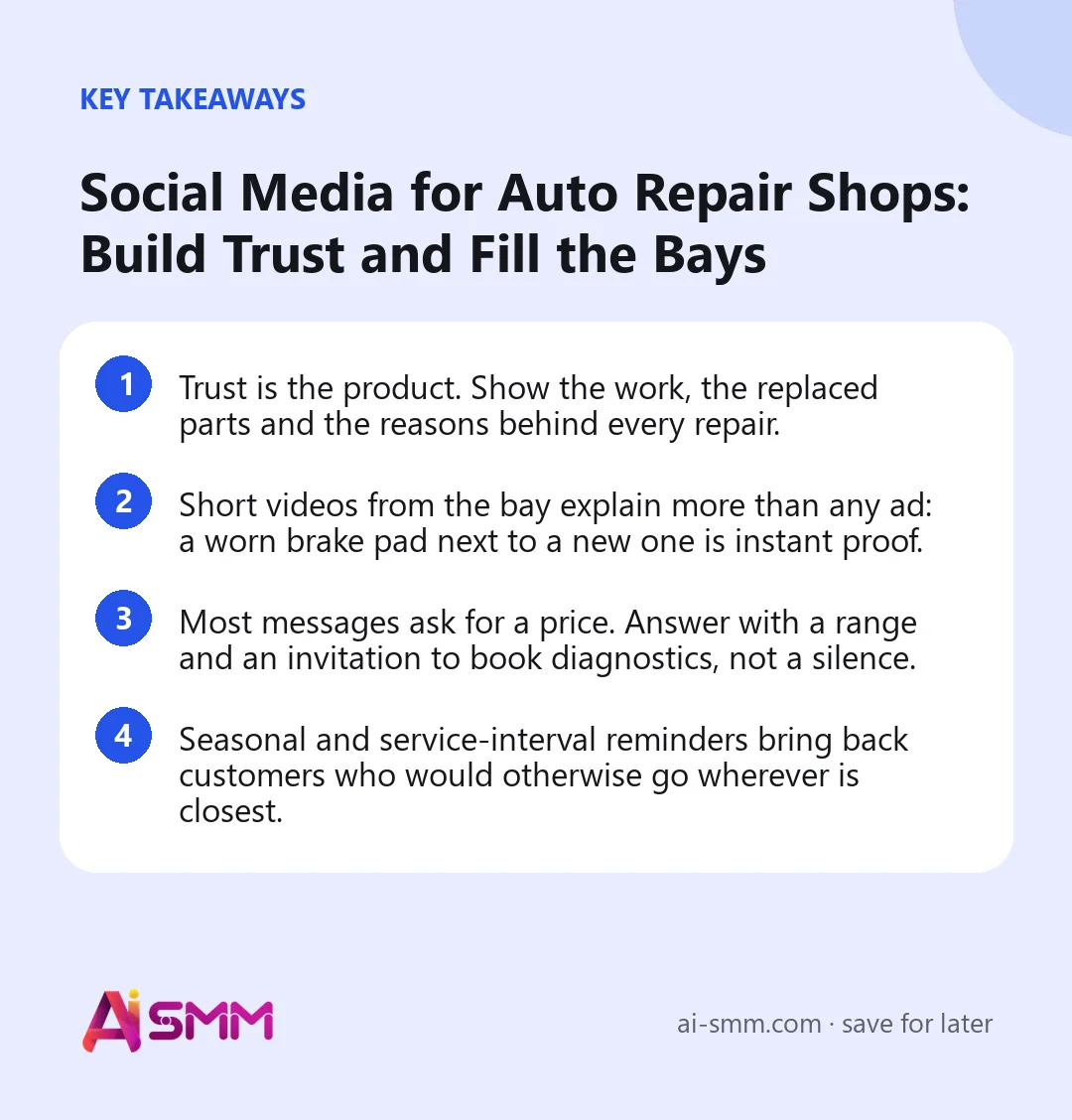
- Trust is the product. Show the work, the replaced parts and the reasons behind every repair.
- Short videos from the bay explain more than any ad: a worn brake pad next to a new one is instant proof.
- Most messages ask for a price. Answer with a range and an invitation to book diagnostics, not a silence.
- Seasonal and service-interval reminders bring back customers who would otherwise go wherever is closest.
1. Why social media for auto repair shops is about honesty
Car owners worry about three things when they leave a car at a garage: that the shop will find problems that do not exist, that the price will grow during the repair, and that the work will not be done well. Social media lets you answer all three before the car arrives:
- Show, do not claim. “We are honest” means nothing. A video of a mechanic showing a customer the old part means a lot.
- Explain in plain words. Drivers trust people who can explain a problem without jargon.
- Be visible as people. A face and a name behind the shop make it easier to call.
An auto repair shop does not need a huge audience. It needs the drivers within a reasonable drive to know that you exist and that you can be trusted.
2. Choose networks that drivers use
| Network | Role for a repair shop |
|---|---|
| Reels from the bay, before-and-after carousels, Stories with free slots today | |
| YouTube | Longer explanations: “what that noise means”, diagnostics of a common model, maintenance guides |
| TikTok | Short, surprising finds from repairs that reach drivers who do not follow you yet |
| Local community groups, reviews, an older audience of car owners | |
| Telegram | A channel for regulars: seasonal offers, tire change schedule, useful reminders |
| Photos of the dashboard or the problem, updates during the repair, “your car is ready” |
Start with Instagram or YouTube (depending on whether your mechanics like short or long videos) plus a messenger for customer conversations.
3. Content pillars with examples
From the bay
- “What we found”: a 30-second video of a problem during a routine service, with the explanation.
- Old versus new: a worn brake disc next to a new one, a clogged filter next to a clean one.
- A time-lapse of a full service, from the car arriving to the key handover.
Driver education
- “Five warning lights you should never ignore”, as a carousel.
- What a squeak when braking usually means, and when it is urgent.
- How to check tire pressure and oil level yourself in two minutes.
Transparency and prices
- “How we price a repair”: diagnostics, parts options, labor, and when we call before doing extra work.
- Price ranges for common jobs, updated when prices change.
- Original versus aftermarket parts: when each makes sense.
The team and customers
- A mechanic’s story: how long they have worked on cars, which models they know best.
- Customer reviews and cars that come back year after year, shared with permission.
- Training, new diagnostic equipment, a clean workshop.
Hide license plates and any personal details visible in the car before posting, and ask the owner before showing their car in a recognizable way.
4. Film in the workshop safely and quickly
- Keep a phone holder in each bay so a mechanic can start filming in seconds.
- Film only when it is safe. Content never comes before safety procedures.
- One finding, one video. “Here is why this car was pulling to the left” is better than a ten-minute unedited clip.
- Record the explanation in a quieter spot if the workshop is loud, or add subtitles.
- Save everything. Interesting finds are rare; keep a folder to use on slow weeks.
One good finding can be used several times. The short video goes to Reels, TikTok and Shorts; a photo of the old and new part becomes a carousel slide with a plain explanation; the same story makes a short post in your Telegram channel; and if a mechanic enjoys talking, a five-minute version with more detail can go to YouTube. Four pieces of content from one clip take about as long to prepare as one.
5. Get leads from chats and booking
Messages to a repair shop usually look like this: “How much to change the timing belt on a 2016 hatchback?”, a photo of a dashboard warning light, or “Can you look at it today?”. Each one is a customer comparing several shops right now.
Answer price questions honestly
You often cannot give an exact price without seeing the car, but “we need to see it” alone sounds like avoiding the question. Give a range for the typical case, explain what can change it, and offer a diagnostic slot: “For most cars of that year it is usually in this range with parts; the exact price after a 30-minute check. Tomorrow at 9:00 or 14:00?”
Let customers book a slot themselves
A booking page with services such as diagnostics, oil change, tire change or air-conditioning check, each with its duration, lets drivers choose a time without calling. Confirmations and reminders reduce the number of empty slots when someone forgets.
Keep customers updated during the repair
- A message when the car is checked in.
- A photo and an explanation if additional work is needed, with the price, before doing it.
- “Your car is ready” with the pickup time and the total.
Bring customers back
Tag each customer with their car and the last service. Then send a reminder when it matters: tire change season, the next oil change, a check before a long summer trip. A short, useful reminder with a booking link brings more returning customers than any discount.
Handle complaints in public carefully
Sooner or later someone will write an angry comment: the noise came back, the bill was higher than expected, the car was not ready on time. How you answer is read by every future customer. Reply the same day, thank them for telling you, avoid arguing about details in public and offer a concrete step: “Please bring the car in tomorrow morning, we will check it free of charge.” Then continue in private messages. If the complaint turns out to be fair, say so publicly once it is solved. A shop that admits a mistake and fixes it earns more trust than one with no complaints at all.
6. Seasonal content calendar
| Season | Content and offers |
|---|---|
| Autumn | Winter tires, battery check, antifreeze, lights before dark evenings |
| Winter | Starting in the cold, what salt does to the underbody, emergency kit |
| Spring | Tire change back, underbody wash and inspection, suspension after potholes |
| Summer | Air conditioning, check before a road trip, cooling system |
Start seasonal posts two to three weeks before the rush so customers book early and your schedule fills evenly.
7. A weekly plan for a small shop
| Day | Post | Goal |
|---|---|---|
| Monday | Stories: free slots this week and a booking link | Fill the schedule |
| Tuesday | Reel: “what we found” from last week | Reach, trust |
| Wednesday | Carousel: driver tip or warning lights explained | Education, saves |
| Thursday | Old versus new part, with the explanation | Proof of honest work |
| Friday | Mechanic introduction or customer review | People and trust |
| Saturday | Seasonal reminder in the channel and Stories | Returning customers |
About one and a half hours a week: mechanics record short clips during the week, and one person edits captions and schedules everything on Friday.
8. Common mistakes
- Only posting shiny cars. Clean cars on a lift look nice but say nothing about the quality of your work.
- Avoiding prices entirely. Customers assume the worst when there is no range at all.
- Jargon. “CV joint boot replacement” means nothing to most drivers; “the rubber cover that protects the joint near the wheel” does.
- Mocking previous shops or customers. It looks unprofessional, even if the previous repair really was bad.
- Showing license plates and personal items. Always blur or crop them.
- Slow replies. A driver with a warning light on wants an answer today.
- No follow-up. Without reminders, customers go wherever is nearest when the next service is due.
9. How AI SMM helps an auto repair shop
AI SMM gives a shop one place for content, conversations and appointments. Short videos from the bay go into one calendar for Instagram, YouTube, TikTok, Facebook and your Telegram channel, and the AI content studio turns a mechanic’s two-line note into a clear caption or a seasonal content plan. Analytics shows which videos brought the most reach and profile visits.
The booking page lists services with duration and price and the schedule of each mechanic or bay, so customers choose a slot themselves and get confirmations and reminders automatically. The unified inbox collects Instagram and Facebook messages, WhatsApp and Telegram in one list, and the AI knowledge base answers standard questions about opening hours and typical price ranges from what you wrote, sending the rest to a person. Chat flows can reply to a comment “PRICE” with a direct message and a booking link, and send a seasonal reminder to customers tagged with their car. Put the booking link, a map and your contacts on one link in bio page. For more ideas, see the local business solutions.
10. What to measure
- Appointments booked from social media and messengers.
- Share of price questions that ended in a booked diagnostic.
- Returning customers after seasonal reminders.
- Reviews mentioning honesty or clear explanations.
FAQ
What should an auto repair shop post on Instagram?
Short videos from the workshop, especially “what we found” and old-versus-new parts, driver tips, seasonal reminders and the people who do the work. Proof of honest work does more than photos of shiny cars.
Should a repair shop show prices on social media?
Show ranges for common jobs and explain what changes the final price. It filters out people who are only price shopping and makes the rest more comfortable booking diagnostics.
How often should a repair shop post?
Three to four posts a week plus Stories is realistic. It is better to post one real finding a week than daily generic posts.
Can mechanics really find time to film?
Yes, if it takes seconds: a phone holder in the bay and one short clip when something interesting appears. Editing, captions and scheduling can be done by one person once a week.
Want every “how much?” message to end with a booked slot? Set up a booking page for your services in AI SMM and link it from your profile and chats.
Posts, chats, video and sales in one workspace. 7 days free.
Start free