
 AI SMM team
A Threads marketing strategy for business comes down to three habits: post short, opinionated text most days, spend as much time replying in other people’s conversations as posting your own, and judge success by replies and profile visits rather than likes. Many brands opened a Threads account when it launched, cross-posted a few Instagram captions, saw little happen and left it idle. That is a missed opportunity, because Threads rewards exactly what small businesses and experts do well: talking like a real person about the thing they know best. This guide shows how to build a Threads presence that brings followers who later become clients.
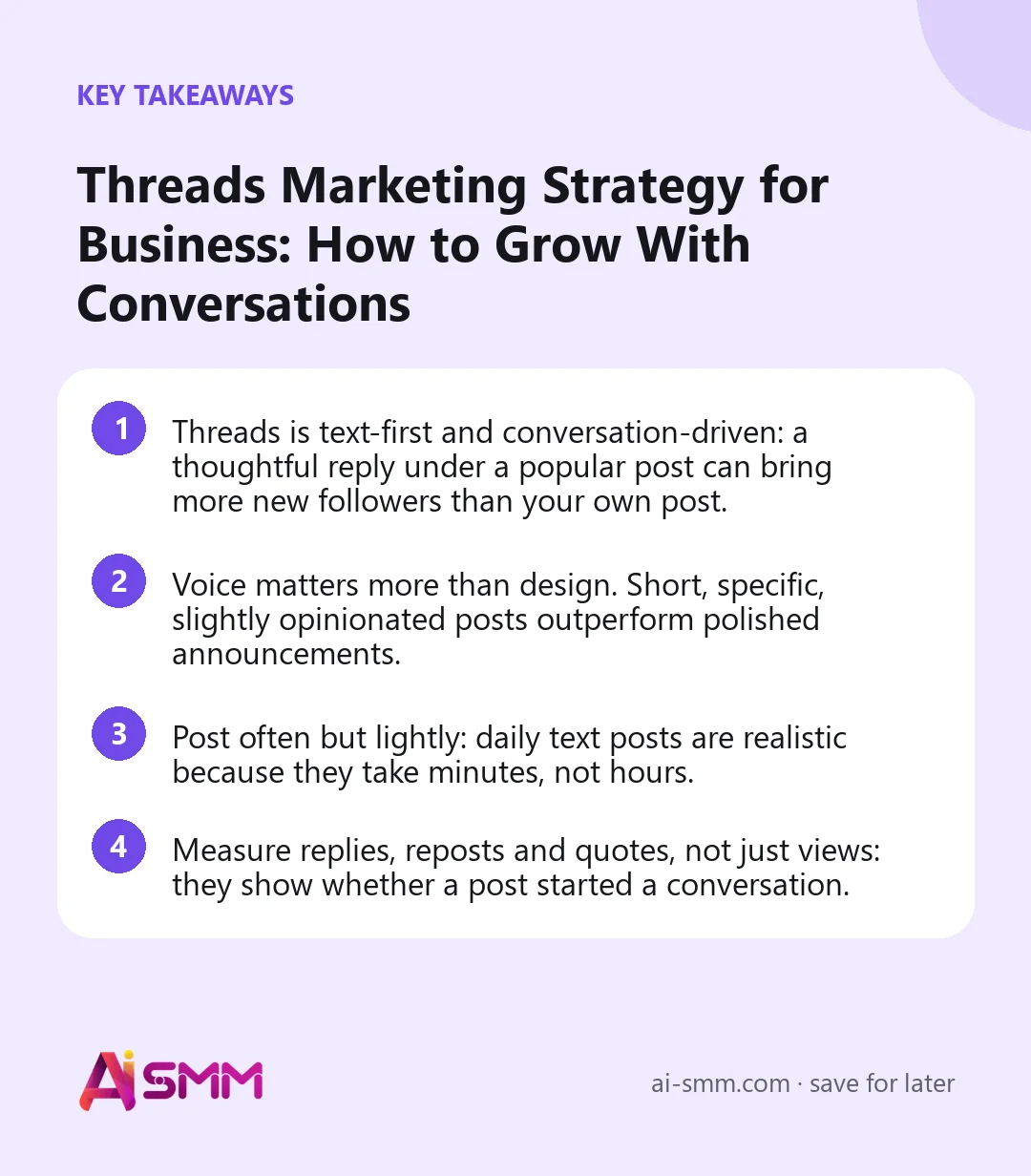
- Threads is text-first and conversation-driven: a thoughtful reply under a popular post can bring more new followers than your own post.
- Voice matters more than design. Short, specific, slightly opinionated posts outperform polished announcements.
- Post often but lightly: daily text posts are realistic because they take minutes, not hours.
- Measure replies, reposts and quotes, not just views: they show whether a post started a conversation.
What Threads is good for (and what it is not)
Threads is Meta’s text-based network, closely linked to Instagram, with Meta reporting hundreds of millions of monthly users. Posts are short (up to 500 characters), can include photos, video and carousels, and are shown to both followers and people who do not follow you yet. The feed favors posts that start conversations, so replies and quotes are a big part of how content spreads.
| Threads works well for | Threads works poorly for |
|---|---|
| Experts, consultants and coaches sharing opinions and lessons | Pure product catalogs with no voice behind them |
| Founders building in public | Brands that cannot reply to comments regularly |
| Creative and service businesses with a strong personality | Heavy video-first strategies (Reels and TikTok fit better) |
| Testing messages and ideas quickly | Hard selling in every post |
If your business depends on one recognizable voice, Threads is worth a serious try. If you sell commodities with no story, put your energy into formats where visuals carry the message.
1. Set up your Threads profile for business
Your profile is the page people visit after a good reply, so it has to explain in seconds why they should follow.
- Name and photo: for experts, your face; for businesses, the logo or a recognizable storefront.
- Bio in one line: who you help and with what. “Kitchen renovations in Lisbon, tips on what actually lasts” beats “Passionate about quality”.
- A link: to your booking page, store or a link-in-bio page with several options.
- Pinned post: your best explanation of what you do, or the post that brought the most followers.
2. Choose three content pillars
Consistency on Threads is not about posting at the same hour; it is about people knowing what to expect from you. Pick three topics you can talk about for months:
- Expertise: lessons, mistakes, how-tos from your field.
- Behind the scenes: what building and running the business really looks like.
- Point of view: your opinions on industry trends, common advice you disagree with, questions to your audience.
Add offers and news occasionally, but on Threads they work best when they grow out of these pillars: “We kept getting this question, so we made a guide” lands better than “New product, link in bio”.
3. Post formats that work on Threads
| Format | Example | Why it works |
|---|---|---|
| Hot take | “Most small cafés don’t need a loyalty app. They need to remember regulars’ names.” | Invites agreement and disagreement in replies |
| Question | “Business owners: what’s the one question every client asks you?” | Easy to reply to, surfaces your audience’s problems |
| Short lesson | “3 things I check before accepting a renovation job” | Saves and reposts from people who find it useful |
| Mini series | A post plus several replies continuing the story | Keeps readers on your content longer |
| Photo or carousel with a story | Before and after with two sentences of context | Visual proof in a mostly text feed stands out |
| Build in public | “This month we tried X. Here’s what happened.” | Creates followers who come back for updates |
Write like you speak. Short sentences, one idea per post, no hashtag blocks. Threads supports a topic tag per post, which helps your post appear in topic feeds; pick the single most relevant one instead of decorating.
4. Make replies half of your Threads strategy
This is where most businesses underinvest. On Threads, a thoughtful reply under a popular post in your niche is seen by that post’s audience, and people who like your reply click through to your profile. Treat replying as a daily task:
- Make a list of 20–30 accounts in your niche: peers, industry voices, local businesses, potential partners.
- Spend 15 minutes a day adding something useful under their new posts: an example, a counterpoint, a question.
- Reply to every comment on your own posts, ideally within the first hour, and ask a follow-up question when it fits.
- Quote-post good content with your own angle instead of just reposting.
In our experience, accounts that split their time roughly half posting and half replying grow noticeably faster than accounts that only publish, especially in the first months.
5. How often to post on Threads
Because posts are short, daily posting is realistic for most small businesses and experts. A sustainable plan is one or two posts a day on weekdays, plus replies. If that is too much, three strong posts a week with daily replying still works better than daily posts with no replies.
Write in batches. One session on Sunday can produce a week of posts: ten minutes on lessons from the week, ten on questions clients asked, ten on opinions. Schedule them, and spend the weekdays on conversations.
6. Use Instagram and Threads together
Most Threads profiles are linked to Instagram accounts, and your Instagram followers can find you there easily, which gives you a head start. Mention your Threads posts in Instagram Stories, bring your best Threads discussions into Instagram carousels, and use Threads to test which ideas deserve a full Reel or carousel. An idea that sparked fifty replies on Threads is a proven topic for your next Instagram post.
Do not simply copy Instagram captions to Threads. A caption written for a photo reads flat as a standalone text post. Shorten it, lead with the opinion or the lesson, and end with a question.
7. Measure what matters on Threads
- Views show reach, but on their own they tell you little.
- Replies show that a post started a conversation, the main signal on Threads.
- Reposts and quotes show that people found it worth passing on or debating.
- Follower growth week to week shows whether your posts and replies are converting attention.
- Profile link clicks and DMs, tracked through your link-in-bio or booking page, show business impact.
A post with fewer views but many replies is often more valuable than a high-view post nobody answered. Write more of the first kind.
8. Turn Threads conversations into clients
Threads is rarely where the sale happens; it is where trust starts. Build a path from conversation to action:
- Link your profile to one clear next step: a booking page, a free resource, a store.
- When someone asks a detailed question in replies, answer publicly first, then offer to continue in private.
- Once a month, post a clear, low-pressure invitation: “I have two consultation slots open next week, reply if you want one.”
A sample week on Threads for a small business
Here is what a realistic week looks like for, say, an interior designer who has about 20 minutes a day for Threads:
| Day | Post | Replying focus |
|---|---|---|
| Monday | Short lesson: “3 lighting mistakes that make small rooms feel smaller” | Comments under the post, two niche accounts |
| Tuesday | Question: “What’s the one room in your home you’d redo first?” | Every reply to the question, with follow-ups |
| Wednesday | Photo with a story: before and after of a hallway, two sentences of context | Local business accounts, one industry voice |
| Thursday | Hot take: “Open shelving in the kitchen is overrated. Here’s why.” | The debate under your own post |
| Friday | Build in public: what went wrong on a project this week and the fix | Catch up on mentions and unanswered replies |
Each post takes minutes to write, the replying is spread across the week, and every post type feeds one of the three content pillars. After a month, look at which days produced the most replies and new followers and shift more effort there.
How to handle debates and negative replies
Opinionated posts attract disagreement, and that is part of how they spread. A few rules keep it productive:
- Thank people for thoughtful disagreement and answer the argument, not the tone.
- Add a concrete example when challenged; it convinces onlookers more than repeating your point.
- Admit when someone has a fair point. It builds more trust than winning every exchange.
- Do not argue with obvious trolls; hide or ignore and move on.
- Move customer complaints to a private conversation quickly and follow up publicly once solved, if appropriate.
The people reading a debate under your post are potential followers and clients. They judge you less by who is right and more by how calmly and helpfully you respond.
How to run your Threads strategy in AI SMM
AI SMM covers the parts of a Threads strategy that take the most time.
- Writing and scheduling. The AI content studio drafts text posts, captions for photos and video, and carousel slides from a brief in your brand’s tone, and can shorten an Instagram caption into a Threads post instead of copying it. Posts go into the same calendar as your other networks.
- Replies and mentions. Replies and mentions arrive in the shared inbox, so a question under a fast-moving post does not get missed.
- Analytics. Views, likes, replies, reposts, quotes and followers in analytics show which posts started conversations.
- Outreach with care. The Chrome extension is an assistant in your own browser: it can find people in your audience, like and follow within Threads’ limits, and draft comments that are posted only after you approve them.
Threads marketing mistakes to avoid
- Cross-posting Instagram captions unchanged, hashtags included.
- Posting and disappearing without replying to anyone.
- Sounding like a press release instead of a person.
- Selling in every post.
- Chasing views with vague viral bait that attracts the wrong audience.
- Giving up after two weeks, before the replying habit has had time to compound.
FAQ
Is Threads good for small business marketing?
Yes, especially for businesses with a strong personal voice: experts, consultants, creative studios and founders. It is less suited to brands that only want to show products without conversation.
How often should a business post on Threads?
One or two short posts on weekdays is a realistic target, plus daily replies. If time is limited, prioritize replying over posting more.
Should I use hashtags on Threads?
Threads uses topic tags rather than hashtag blocks. Add the one topic that best describes the post; more words in the text itself help people find you in search.
Can I reuse my Instagram content on Threads?
Reuse the ideas, not the exact captions. Shorten the text, lead with the point and end with a question so it works as a standalone conversation starter.
Ready to turn Threads into a steady source of conversations? Plan your first week of posts with the AI content studio in AI SMM and spend the time you save on replies.
Posts, chats, video and sales in one workspace. 7 days free.
Start free