
 AI SMM team
Social media lead generation is the work of turning people who notice you on Instagram, Telegram, LinkedIn or WhatsApp into contacts you can actually follow up with: a name, a chat thread, a phone number or an email tied to a clear interest. Most small businesses already get attention, likes and the occasional “how much?”, but that attention evaporates because nothing catches it. This guide lays out a simple system: one offer worth a contact, a profile that works like a landing page, capture points in comments and DMs, fast qualification and a follow-up that happens before the lead goes cold.
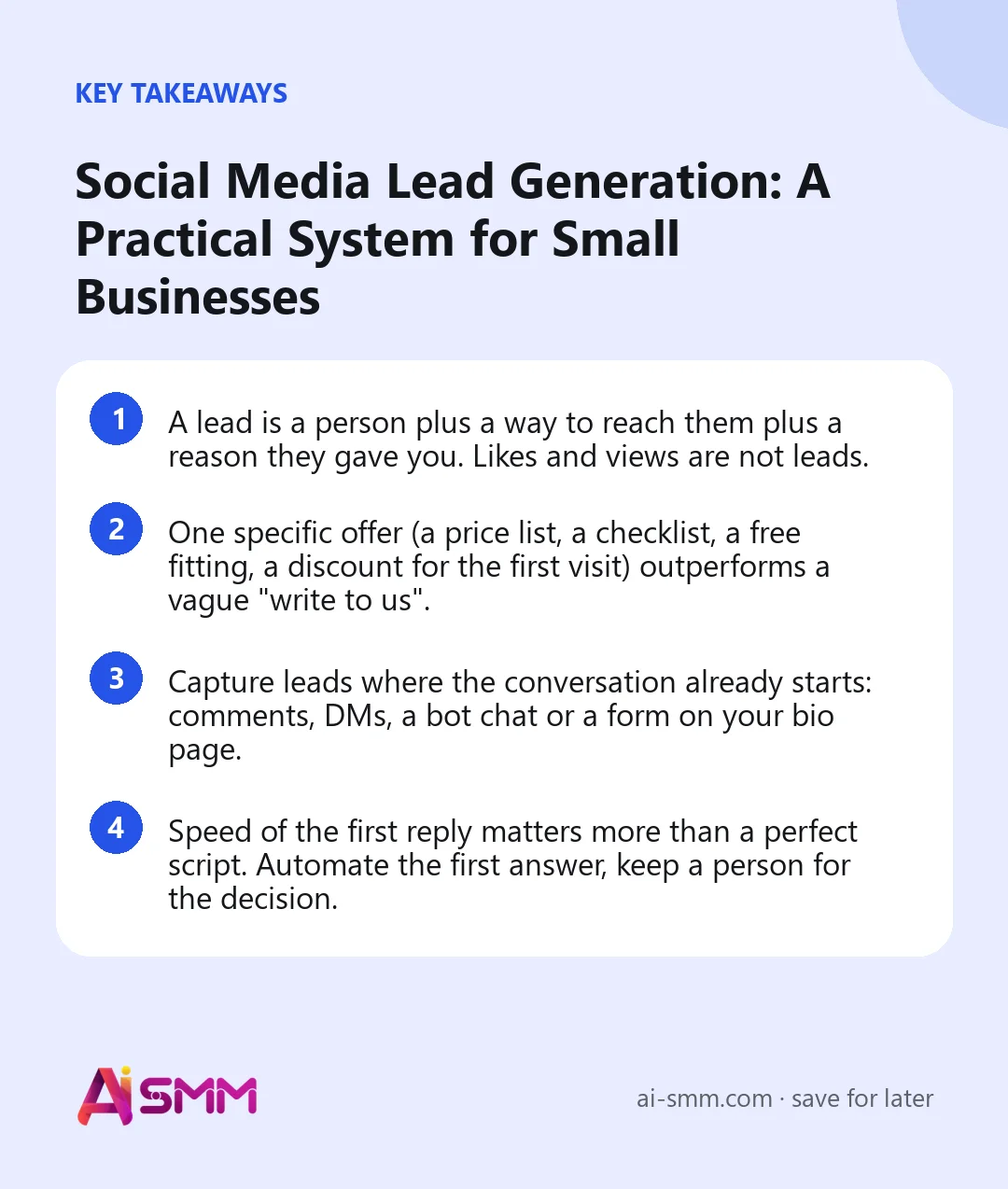
- A lead is a person plus a way to reach them plus a reason they gave you. Likes and views are not leads.
- One specific offer (a price list, a checklist, a free fitting, a discount for the first visit) outperforms a vague “write to us”.
- Capture leads where the conversation already starts: comments, DMs, a bot chat or a form on your bio page.
- Speed of the first reply matters more than a perfect script. Automate the first answer, keep a person for the decision.
1. What social media lead generation actually means
A follower is someone who might see your next post. A lead is someone who has told you, directly or through an action, that they are interested in what you sell, and whom you can contact again. The difference matters because the tactics are different. Growing followers is about reach. Social media lead generation is about the moment after reach: giving a person a reason to step forward and making that step take seconds.
For a small business, a good working definition is: a lead is a contact record with a source and an interest. “Anna, came from the Reel about balayage, asked about prices for long hair, prefers Saturdays.” Anything less specific is just traffic. Keeping that definition in mind stops you from celebrating a viral post that brought two thousand views and zero conversations.
2. Start with one offer worth a contact
People do not leave their details because you asked politely. They leave them in exchange for something that is useful now. The offer does not need to be big, it needs to be specific to your customer’s next question.
| Business | Offer that earns a contact | Why it works |
|---|---|---|
| Beauty studio | Price list with photos of real results | Answers the first question every client asks |
| Online clothing store | Size guide plus first-order discount | Removes the fear of the wrong size |
| Consultant or coach | Short checklist or self-assessment quiz | Shows expertise before any sales talk |
| Café or delivery kitchen | Free dessert with the first order | Low cost, immediate reason to order |
| B2B service | A one-page audit or estimate template | Useful even if they do not buy today |
Pick one offer per season and push it consistently. Rotating five lead magnets at once splits your attention and makes it impossible to see which one works.
3. Turn your profile into a landing page
Most people who find you through a post or a Reel go to your profile next. That profile has about five seconds to answer three questions: what you do, who it is for, and what to do next. A bio that says “Love what we do” answers none of them.
- First line: what you do and where. “Hair coloring studio in Riga, natural blondes.”
- Second line: the offer. “Price list with real photos: comment PRICE on any post.”
- Link: one link to a page that holds your booking, store, contacts and a short form, not a random website homepage.
- Pinned posts or highlights: results, prices, how to order. The three things people check before they write.
The link matters most. A bio page with a form sends the contact straight into your list instead of asking the visitor to find an email address and write a message from scratch.
4. Create content that invites a response
Lead generation content is not a separate content type. It is your usual content with a clear next step built in. A few formats that reliably produce conversations:
- “Comment a word” posts. “Comment GUIDE and I’ll send you the checklist.” The comment is public proof of interest and gives you a reason to message.
- Before and after, with the price range. Showing a result plus “from 80 to 120 depending on length” filters in people who can afford it.
- Mistake posts. “Three mistakes people make when choosing a kitchen countertop.” The reader who recognizes their situation is already a warm lead.
- Polls and quizzes in stories or Telegram. A tap is a small commitment, and people who answer are more likely to reply to a follow-up.
- Limited slots. “Four fitting slots left for next week.” Honest scarcity works when it is true.
Every post does not need a call to action. A useful rule of thumb in our experience: about one in three posts with an explicit next step keeps the feed helpful rather than pushy.
5. Capture leads where the conversation starts
The biggest leak in social lead generation is the gap between interest and contact. Someone comments “price?” at 10 pm, you reply the next afternoon, and by then they have booked elsewhere. Close the gap at each entry point:
Comments
Reply publicly so others see you are responsive, then move the conversation to DMs where you can send the offer. On Instagram and Facebook this can be automated: a comment with a keyword triggers a public reply and a DM with the promised item.
Direct messages
A welcome message with two or three buttons (“Prices”, “Book”, “Ask a question”) routes the person immediately instead of leaving them staring at an empty chat.
Telegram
A bot linked from your channel can hand out the lead magnet and, if you want, check that the person is subscribed to the channel first. The contact stays in the bot chat for future messages.
Your bio page and website
A short form (name, contact, one question) is enough. Long forms scare people away. On a website, a popup offering the same lead magnet catches visitors who came from social links and are about to leave.
6. Qualify before you sell
Not every lead deserves the same effort. A person asking about a wedding makeup package for next month is a different conversation from someone “just curious about prices”. Qualification sorts them without sounding like an interrogation.
The easiest way is a short quiz in the chat: two to four questions with buttons. “What are you looking for? When? What budget range?” Each answer adds points or a tag. High scores get a direct offer and a quick human reply, lower scores get useful content and a softer follow-up. The person experiences a helpful conversation, you get a sorted list.
Keep the tags simple and consistent: source (which post or channel), interest (which service or product), and temperature (ready now, later, just browsing). Three tags are enough to decide who to call first.
7. Reach people who already showed interest
Inbound is not the only path. The people who comment on posts of similar businesses, or who engage with topics in your niche, have already shown interest in what you sell. Reaching them thoughtfully is legitimate outbound lead generation, as long as it stays human.
- Start with a relevant source: a competitor’s account, a local community, a hashtag or a LinkedIn search for a specific job title.
- Filter before you act. A hundred well-chosen people beat a thousand random ones.
- Engage before you pitch: a meaningful comment on their post or a like on their recent work comes before any message.
- Stay well inside each network’s limits. Rapid, repetitive actions put the account you built at risk.
A browser assistant can do the collecting and filtering: it gathers the people who commented on a given account, AI marks who fits your audience, and comments are drafted for you to approve before anything is posted.
8. Follow up fast, and then again
A lead’s interest decays quickly. The first reply within minutes rather than hours is often the single biggest improvement a small business can make. That is where automation earns its place: an AI answer drawn from your own price list and policies handles the first question immediately, and a person joins when a decision or a custom quote is needed.
After the first reply, plan a short sequence rather than hoping they come back:
| When | What to send |
|---|---|
| Immediately | The promised offer plus one question (“Which service are you considering?”) |
| Next day | A relevant example or result, not a sales pitch |
| Day 3–4 | A concrete proposal with a time or a link to book or buy |
| Day 7–10 | A light check-in, then move them to a newsletter if they stay quiet |
People who do not buy now are not lost. Moving them into an email list or a Telegram channel keeps you present until the timing is right.
9. Measure leads, not just engagement
Three numbers tell you whether your social media lead generation works:
- Leads per week by source. Which posts, networks and entry points actually produce contacts.
- Lead-to-customer rate. Of those contacts, how many bought. A source with fewer leads but a higher rate is often the better one.
- First response time. If it grows, conversion usually drops soon after.
Review them monthly, cut the entry points that bring nothing and double down on the offer and format that brought the best customers, not the most likes.
10. Doing this in AI SMM
AI SMM keeps the whole path in one workspace. A link in bio page holds your contacts, booking, products and a form that sends leads straight to Contacts. Chat automation covers the comment-to-DM template for Instagram and Facebook, welcome buttons, and Telegram bots with subscription checks, while quizzes with scoring from gamification split hot leads from curious ones. The AI knowledge base answers first questions from your own prices and policies, and anything that needs a decision goes to a person. For outbound, the assistant in your browser collects commenters from a competitor’s account on Instagram, LinkedIn, X or Threads, lets AI mark who fits and drafts comments that are posted only after you approve them, within each network’s limits.
FAQ
What is the best social network for lead generation?
The one where your customers already ask questions. For local services and consumer products it is usually Instagram and a messenger such as Telegram or WhatsApp; for B2B it is usually LinkedIn. Start with one network, get the capture and follow-up working, then add a second.
How many leads should a small business expect from social media?
It depends heavily on the niche, the offer and the price point, so any fixed number would be misleading. A better benchmark is your own trend: track leads per week for a month, change one thing (the offer, the bio, the reply speed) and compare.
Is it okay to message people who commented on a competitor’s post?
Yes, if you do it like a person: engage with their content first, keep the message relevant, and never send the same template to hundreds of people. Staying within each network’s limits protects your account as well.
Should I automate replies to leads?
Automate the first answer and the routing, not the whole relationship. Instant answers to common questions keep the lead warm; a person should still handle custom requests, objections and the final offer.
Ready to stop losing interested people between a comment and a reply? Set up your first comment-to-DM flow with chat automation in AI SMM and see which posts actually bring leads.
Posts, chats, video and sales in one workspace. 7 days free.
Start free