
 AI SMM team
A gym, a dental clinic and a phone repair shop have the same problem on social media: they do not need millions of views, they need the few thousand people who live or work nearby to remember them, trust them and book when the moment comes. Most marketing advice is written for brands chasing reach, so local owners end up posting trends that bring likes from other cities and no new clients. This guide is a practical plan for the other kind of social media, the kind that fills a schedule within a few kilometers of your door.
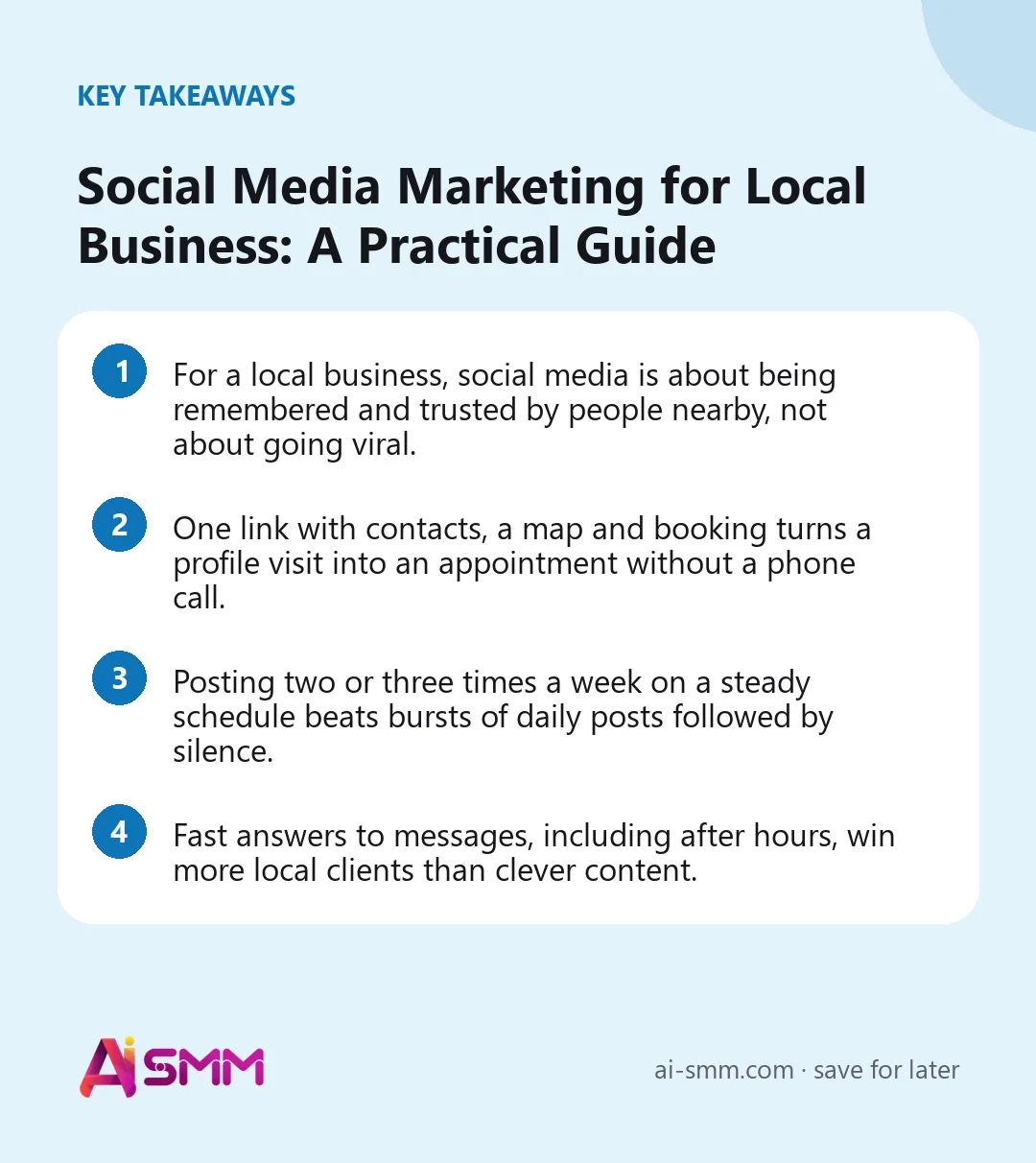
- For a local business, social media is about being remembered and trusted by people nearby, not about going viral.
- One link with contacts, a map and booking turns a profile visit into an appointment without a phone call.
- Posting two or three times a week on a steady schedule beats bursts of daily posts followed by silence.
- Fast answers to messages, including after hours, win more local clients than clever content.
1. Decide what social media should do for your business
Before choosing networks or post ideas, write down what a good month would look like. For a local business, it is almost never “more followers”. It is usually one of these:
- More bookings or visits: trial sessions at the gym, check-ups at the clinic, repairs dropped off at the shop.
- More repeat clients: people coming back for the next service instead of trying a competitor.
- Fewer routine calls: prices, hours and “do you fix this model?” answered before anyone picks up the phone.
Pick one goal for the next three months. It decides what you post, what you measure and what you can safely ignore.
2. Get the basics right before posting anything
A new visitor to your profile decides in a few seconds whether you are open, nearby and worth contacting. The basics do more work than any single post.
Profile checklist
- The same name, address and hours everywhere. If your profile says you close at 19:00 and your website says 20:00, people trust neither.
- A bio that says what, where and for whom. “Family dental clinic in the city center. Check-ups, cleaning, implants. Booking online.”
- One link with everything. Address with a map, phone, prices, and a booking button, on a single page, instead of a bio that sends people hunting.
- Real photos. The entrance, the team, the room. People want to know what they are walking into.
- Highlights or pinned posts with prices, reviews and how to find you.
3. Choose networks by where your neighbors spend time
You do not need every network. Choose one main network and, at most, one supporting channel.
| Business | Main network | Supporting channel | Why |
|---|---|---|---|
| Gym or fitness studio | Telegram channel | Reels of workouts reach new people; a channel keeps members updated on the schedule | |
| Dental or medical clinic | Instagram or Facebook | Link in bio with booking | Educational posts build trust; booking removes the call |
| Repair shop | Facebook or Instagram | WhatsApp for quotes | Before/after photos show skill; quotes happen in chat |
| Beauty or wellness studio | Visual results plus quick booking questions |
If most of your clients are older, Facebook often still matters more than newer networks. If you serve a Russian-speaking community, a Telegram channel may reach them more reliably than a feed algorithm.
4. Build your content on five local pillars
Local content works when it is specific: your street, your team, your clients’ questions. Generic motivational quotes or stock photos could come from anyone, so they earn nothing. Rotate through five pillars and you will never stare at a blank screen.
- People. The trainer, the dentist, the technician. A short intro post per team member makes a first visit feel less like visiting strangers.
- Proof. Before/after of a repaired screen, a member’s progress (with permission), a review from a patient.
- Practical tips. “Three signs your battery needs replacing”, “How often should you really get a check-up?”, “A 10-minute warm-up before running”. These get saved and shared.
- Local life. A local event you support, the new bike racks outside, the view from your window in the first snow.
- Offers and news. A free slot this week, a trial class, new opening hours. Keep these to one in four or five posts.
Examples for three businesses
- Gym: Monday, a 20-second Reel of a coach demonstrating one exercise; Wednesday, a member story; Friday, next week’s class schedule.
- Dental clinic: a carousel answering a common question, a team intro, a reminder that check-up slots are open this month.
- Repair shop: a before/after photo of a cracked screen, a tip on protecting a phone in winter, a price list for popular repairs.
5. Make posting sustainable for a busy owner
The biggest threat to local social media is not a bad post, it is no post for six weeks because the owner got busy. A steady rhythm of two or three posts a week is enough for most local businesses, as long as it does not stop.
- Describe your brand once: who you serve, your tone, words you never use. Every draft should start from that description instead of a blank page.
- Batch the photos. Spend 30 minutes once a week taking pictures: the team, a finished job, a detail of the room.
- Let AI draft the captions, then edit them for accuracy. You know your clients; AI saves you the typing.
- Schedule the week in one sitting so posts go out while you are with clients.
6. Answer every message quickly, including after hours
For local businesses, the message inbox is where social media turns into money. Someone who writes “how much for a screen replacement on this model?” at 21:00 is comparing you with two other shops right now. The one that answers first often gets the visit.
- Collect the answers to repeat questions in one place: prices, hours, what to bring, parking, which models you repair.
- Let AI answer those questions from that source in chats, so evenings and weekends are covered.
- Hand anything sensitive to a person. A clinic should never let an automated reply give medical advice; the right answer is a booking link and a human follow-up.
- Keep all messages in one inbox so nothing is lost between Instagram, WhatsApp and the website chat.
7. Let people book without calling
Many people, especially younger clients, will not phone a business they have never visited. A booking page where they pick a service, a specialist and a time removes that barrier. Put the link in your bio, in Stories and in chat replies.
- Gym: a free trial class or an intro session with a coach.
- Clinic: a first consultation or a check-up with the chosen doctor.
- Repair shop: a diagnostic slot so the client does not queue.
Automatic confirmations and reminders cut no-shows, and a waiting list fills slots that open up after cancellations.
8. Be found by people who are searching, not just scrolling
Social media reaches people who already follow you or stumble across a post. People who need you right now usually search: “emergency dentist near me”, “iPhone battery replacement price”, “gym with a sauna in my area”. Short, useful articles on your website that answer these local questions bring in people who have never heard of you, and each article can be shared on social media too.
9. Measure what matters locally
Track a handful of numbers once a month: messages received, bookings made, how many came through the link in your bio, and which posts were followed by questions or bookings. Reach and followers are useful context, but a month with fewer likes and more booked appointments is a good month. Check when your own audience is online and move your schedule toward those hours.
10. Borrow trust from reviews and neighbors
People trust other people more than they trust a business talking about itself. Ask happy clients for a short review at the moment they are happiest: right after a repair works, after a first pain-free check-up, after a member hits a goal. Share the best ones as posts or Stories, with permission. Then look around your street. A gym and a healthy café, a clinic and a pharmacy, a repair shop and a phone accessories store share the same neighbors. A joint post, a small shared offer or simply mentioning each other introduces you to an audience that already lives nearby and already trusts the business next door.
Worked example: a neighborhood gym gets back on schedule
Say a small gym with two coaches posts in bursts: ten posts in January, nothing in February, a few in March. Messages about prices go unanswered on weekends. The owner sets up the brand profile once, shoots photos every Monday during a quiet hour, and lets AI draft three posts a week, a coach tip Reel, a member story and the schedule, which she approves and schedules on Monday evening.
The bio link now holds the address with a map, prices and a button to book a free trial class. Questions about prices and hours on weekends are answered from a short knowledge base, and anything about injuries goes to a coach. After a couple of months, the owner notices that coach tip Reels bring the most trial bookings, so she makes them the core of the plan.
Common mistakes local businesses make
- Chasing viral trends that bring views from other cities and no local clients.
- Posting in bursts and disappearing for weeks.
- No booking link, so every interested person has to call.
- Slow answers to messages, especially evenings and weekends.
- Only offers and discounts, with no people or proof that build trust.
- Different hours or addresses on different pages.
How this works in AI SMM
Set your brand profile once, and AI content studio drafts posts in that voice for you to approve and schedule across your networks. A link in bio page holds contacts, a map and a booking button, and online booking handles specialists, services, reminders and a waiting list. Messages from different channels come into the inbox, where AI answers routine questions from your knowledge base and passes the rest to you. SEO suggests articles on topics people nearby search for. The local business page shows how the pieces work together.
FAQ
How often should a local business post?
Two or three times a week on one main network is enough for most local businesses, as long as the rhythm holds month after month.
Do I need a website?
Not to start. A link in bio page with contacts, a map and booking can be your only web presence; articles for search can come once you have a site.
Is it safe to let AI answer patients or clients?
For routine questions like prices, hours and directions, yes, when answers come from materials you wrote. Anything personal or medical should go to a person, and you choose where AI replies itself and where it only drafts.
Which network is best for a local business?
The one your clients already use. For visual services that is often Instagram; for older audiences, Facebook; for Russian-speaking communities, a Telegram channel.
If you want people nearby to find you, trust you and book without a phone call, start with one page: set up a link in bio with booking and build your weekly plan around it.
Posts, chats, video and sales in one workspace. 7 days free.
Start free