
 AI SMM team
Followers on Instagram, TikTok or Telegram feel like an audience, but they are rented. The network decides how many of them see your post, and a change in the algorithm or a blocked account can cut you off overnight. An email list and web push subscribers are different: they are contacts you can reach directly, on your own schedule. The good news is that social media is one of the best places to build that owned audience, if you give people a real reason to subscribe.
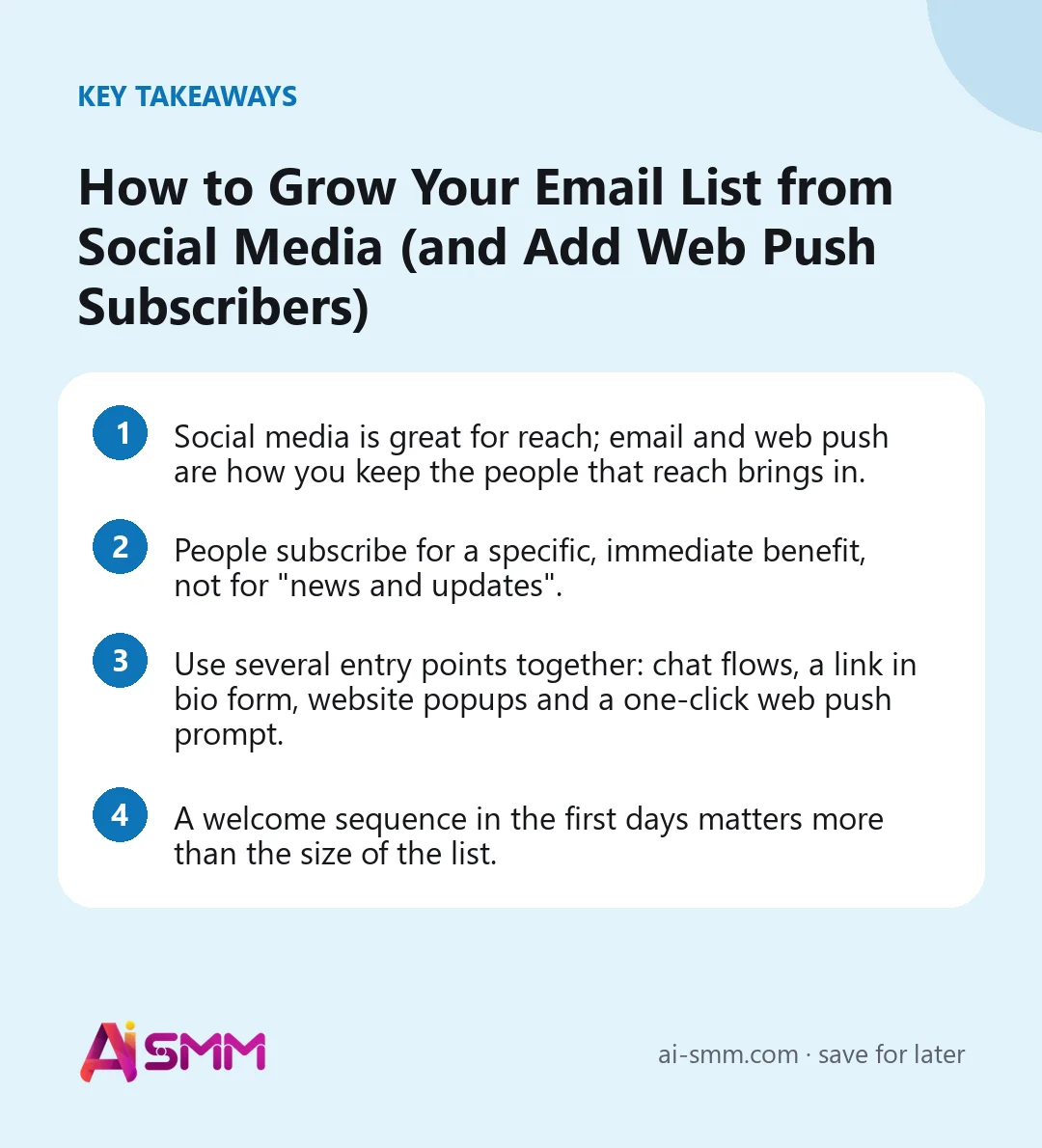
- Social media is great for reach; email and web push are how you keep the people that reach brings in.
- People subscribe for a specific, immediate benefit, not for “news and updates”.
- Use several entry points together: chat flows, a link in bio form, website popups and a one-click web push prompt.
- A welcome sequence in the first days matters more than the size of the list.
Why an owned audience matters
Organic reach on most social networks is unpredictable. A post can reach a large part of your followers one week and a small fraction the next, for reasons you do not control. If all your customer relationships live inside one network, your sales depend on decisions made by someone else.
Email and web push reduce that risk. An email reaches the subscriber’s inbox whether or not an algorithm favours you today. A web push notification appears on their screen in the browser, without an app and without them giving you an email address. Neither replaces social media; they catch the interest social media creates and keep it available for the next launch, sale or booking window.
There is also a practical sales argument. People on your list have already raised their hand once. A message to them usually converts better than a post shown to a cold audience, which makes the list one of the most valuable assets a small business can build.
Email vs web push: what each is good for
Email and web push are often discussed as alternatives, but they do different jobs. Most businesses benefit from both.
| Web push | ||
|---|---|---|
| What the subscriber gives | An email address | One click in the browser, no contact details |
| Best for | Longer content, stories, guides, receipts, newsletters | Short, time-sensitive alerts: sale ending, back in stock, new article |
| Barrier to subscribe | Higher: people think twice before sharing an address | Low: one click |
| Where it arrives | Inbox, read when convenient | Screen, noticed right away |
In short: email builds the relationship, web push brings people back at the right moment. A visitor who is not ready to give an email address may still accept push notifications, and that is better than losing them completely.
1. Create a lead magnet people actually want
Nobody subscribes to “our newsletter”. People subscribe to get something specific, now. A lead magnet is that something: a small, genuinely useful item offered in exchange for an email address.
Lead magnet ideas by business type
- Beauty salon: a home-care checklist for the week after a treatment, or a first-visit discount.
- Café or bakery: a seasonal recipe card or a free drink with the first order.
- Online store: a size guide, a gift guide for the holidays, early access to a new collection.
- Expert or coach: a short checklist, a template, a mini-course delivered over five days.
- Local service: a price calculator result, a seasonal maintenance reminder list.
A good lead magnet is quick to consume, clearly related to what you sell and delivered immediately. A 60-page ebook sounds impressive but often stays unopened; a one-page checklist that solves a small problem today builds more trust.
2. Collect subscribers through chat flows
The lowest-friction way to turn a follower into a subscriber is often a chat. Instead of sending people to a form, you ask them to comment a keyword or send a message, and the conversation does the rest.
A typical flow looks like this:
- A post or Stories promise: “Comment GUIDE and we will send you the checklist.”
- The person comments; a public reply confirms and a DM arrives with a short question.
- The chat asks for their email to send the full guide, explaining why in one sentence.
- The lead magnet is delivered, and the contact is saved with a tag showing where they came from.
Chats work because they feel like a conversation, not a form. They also let you ask one or two qualifying questions along the way, such as what the person is most interested in, so later emails can be more relevant. In Telegram, a flow can also check that someone joined your channel before giving a gift, which combines two goals in one step.
3. Put a form on your link in bio page
The link in your profile is one of the few clickable spots on networks like Instagram and TikTok. Many businesses use it only for a list of links, but a simple form there can quietly collect subscribers every day.
Keep the form short: an email field, maybe a name, and one sentence about what the person gets. Place it near the top, not below eight other buttons. Mention the offer in your bio text and in Stories from time to time, because people rarely scroll a link page carefully unless something tells them what to look for.
4. Use website popups for visitors who come from social
When social media sends people to your website or store, many of them leave without buying and without leaving a trace. A well-targeted popup gives them one more chance to stay in touch.
- Match the offer to the page. A first-order discount on product pages, a free guide on blog articles.
- Mind the timing. Show the popup after the visitor has had time to look around, or when they are about to leave, rather than the second they arrive.
- Do not show the same offer to everyone. A returning customer should not see a “first order” discount again.
- Test two versions. A different headline or offer can change results noticeably; an A/B test settles it with real numbers.
- Measure sales, not only sign-ups. A popup that collects many addresses but no buyers may be attracting the wrong people.
5. Offer web push to people who will not share an email
Some visitors will never type their email address into a form, especially on a phone. For them, a web push prompt is a lighter ask: one click to get notified about new arrivals, sales or new articles. No app to install, no personal details.
Ask at a meaningful moment. “Get notified when this is back in stock” on a sold-out product page is far more convincing than a generic prompt on the home page. Once people subscribe, a short welcome series introduces your business, and segments keep later messages relevant: someone who only browses one category should not receive alerts about another.
6. Make the first week count with a welcome sequence
New subscribers are most attentive in the first few days. That is when they remember why they signed up and are most likely to open, read and buy. A welcome sequence uses that window:
- Immediately: deliver what you promised, the guide, the discount, the checklist.
- Day 2–3: tell your story briefly and show what makes you different.
- Day 4–6: share your most useful content or your best-selling product with honest reasons to choose it.
- Day 7–10: make a clear, time-limited offer for the first purchase or booking.
After that, subscribers move into your regular emails. Keep a steady rhythm that you can sustain, whether that is weekly or twice a month; consistency matters more than frequency.
7. Keep the list healthy and legal
A big list is not the goal; a list of people who want to hear from you is. A few habits protect both your results and your reputation:
- Ask clearly and explain what people will receive and how often.
- Never add people who did not subscribe, such as everyone who once sent you a DM.
- Make unsubscribing easy; an unhappy subscriber who cannot leave will mark you as spam.
- Send through a reputable provider and check deliverability before large campaigns.
- Clean out addresses that have not opened anything for a long time, after a last “do you still want these emails?” message.
Rules about consent differ between countries, so check what applies to you. The safe principle everywhere is simple: people should know they subscribed and be able to stop at any time.
How to measure whether it is working
Look at the path, not just the list size:
- Sign-ups by source: chat flows, link in bio, popups, web push prompts. Put your effort into the sources that grow.
- Welcome sequence results: how many new subscribers open, click and make a first purchase within two weeks.
- Revenue per campaign: which emails and pushes actually lead to orders, not only opens.
- Unsubscribes and spam complaints: a sudden rise means the message, the frequency or the audience is off.
Building your list with AI SMM
In AI SMM, all the entry points and the follow-up live in one workspace. Chat flows include ready funnels such as a lead magnet and “subscribe and get a gift” with a subscription check in Telegram, and a comment on Instagram can start a DM that delivers the promised item. Forms on your link in bio page send leads straight to your contacts and can start a chat flow.
On your website, popups offer templates for lead forms, social proof and urgency widgets, with targeting by when and to whom they show, A/B tests, and conversion tracking and attribution down to the sale; webhooks pass leads on to your other tools. Web push collects subscribers in one click without an email address and sends campaigns, segmented messages, a welcome series and new articles from RSS automatically. Email marketing handles lists, segments, templates and automations through your own SMTP provider, with deliverability checks, RSS campaigns and revenue attribution, and you can import an existing list of subscribers.
FAQ
How many email subscribers do I need before sending newsletters?
There is no minimum. Start writing as soon as you have your first subscribers; a welcome sequence works the same for ten people as for ten thousand, and early readers give you the most honest feedback.
Should I ask for a phone number or an email?
It depends on how you plan to follow up. If most of your sales happen in messengers, a phone number or a chat contact may be more useful; if you plan newsletters and longer content, ask for email. Asking for both at once usually lowers sign-ups.
Is web push annoying for visitors?
Only when the prompt appears too early or the messages are too frequent. Ask at a moment that makes sense, like a sold-out product, and keep notifications short and relevant.
Can I bring my existing subscribers into a new tool?
Usually yes. Existing lists can be imported and split into segments, so you do not have to start from zero.
Social media brings people in; an email list and push subscribers keep them close. Start building your own audience with email marketing in AI SMM.
Posts, chats, video and sales in one workspace. 7 days free.
Start free