
 AI SMM team
Influencer marketing for small business works best at a small scale: a handful of local or niche creators with a few thousand engaged followers, a clear offer for their audience and a way to see who actually bought. You do not need a celebrity or an agency. You need creators whose followers look like your customers, a fair deal, a short brief and a tracking method set up before the first post goes out. This guide walks through each step with examples you can adapt this month.
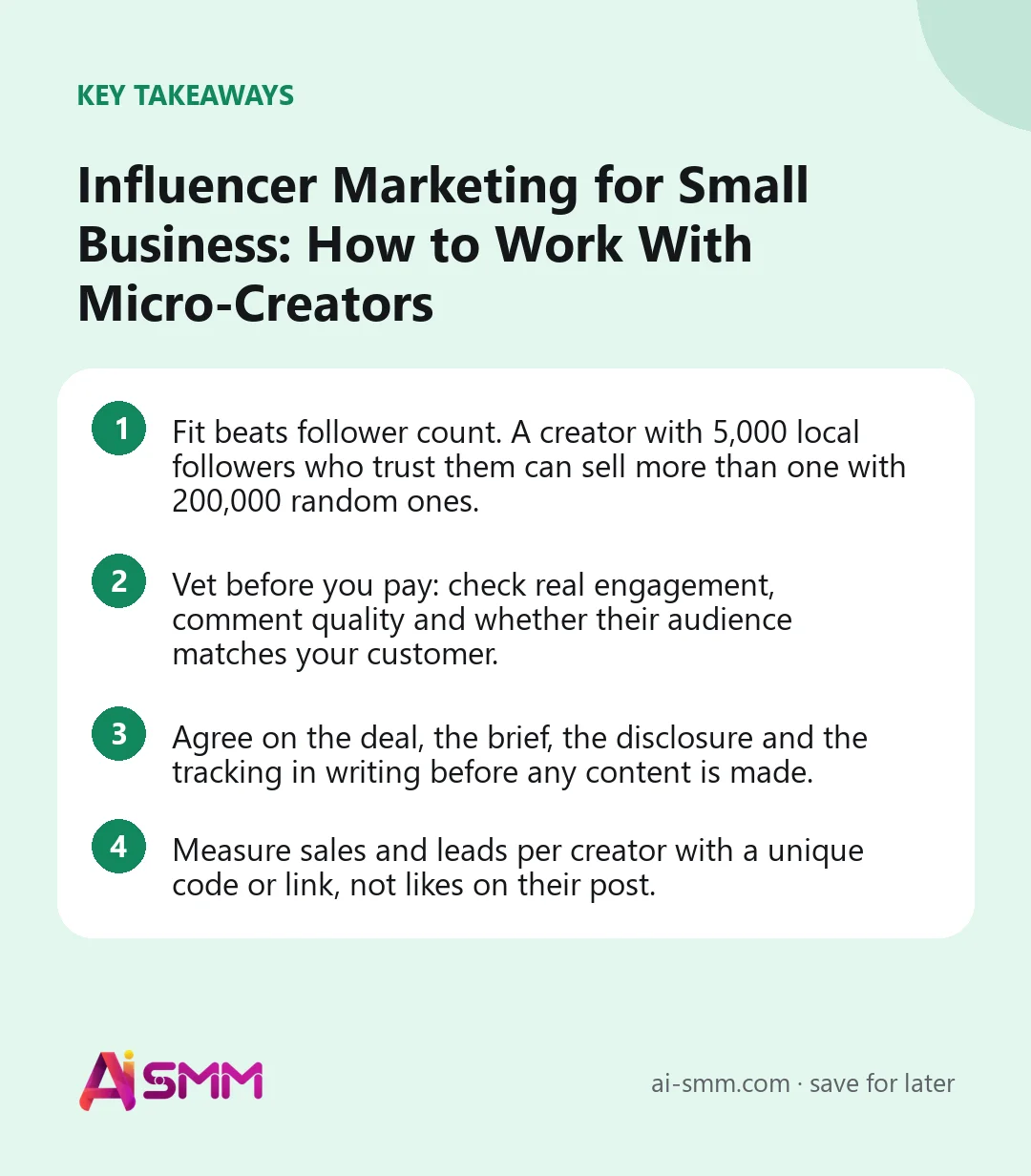
- Fit beats follower count. A creator with 5,000 local followers who trust them can sell more than one with 200,000 random ones.
- Vet before you pay: check real engagement, comment quality and whether their audience matches your customer.
- Agree on the deal, the brief, the disclosure and the tracking in writing before any content is made.
- Measure sales and leads per creator with a unique code or link, not likes on their post.
1. Why influencer marketing for small business is different
Large brands buy reach. Small businesses need trust in a specific place or niche. That changes everything about how you choose and pay creators. A neighborhood café does not benefit from a travel blogger with a global audience; it benefits from the three people in town whose restaurant tips everyone follows. A handmade jewelry brand does not need a fashion star; it needs a few creators whose followers buy small, thoughtful gifts.
The creators that fit small businesses usually fall into two groups:
- Nano-creators (roughly 1,000–10,000 followers): often personal accounts with high trust, open to product exchanges, great for local businesses.
- Micro-creators (roughly 10,000–100,000 followers): more consistent content, usually charge a fee, good for niche products sold online.
These ranges are rough conventions, not rules. What matters is how engaged the audience is and whether it matches your customer.
2. Set a goal before you look for creators
“Get more awareness” is too vague to measure. Pick one goal per campaign:
| Goal | Good for | How to measure |
|---|---|---|
| Sales | Products with a clear price, online stores | Orders with the creator’s promo code |
| Bookings or visits | Salons, cafés, studios, clinics | Bookings mentioning the creator or using their code |
| Leads | Services, courses, higher-priced offers | Contacts from the creator’s link or keyword |
| Content | Brands that need authentic photos and videos | Number of usable pieces with rights to reuse |
The goal decides the deal. For sales, a commission or code-based bonus makes sense. For content, a fixed fee or product exchange with clear usage rights is fairer.
3. Find creators who already talk to your customers
The best candidates are often already close to you:
- Your own followers and customers. Check who tags you, comments often or already posted your product. They like you without being paid.
- Local and niche hashtags or places. Look at recent posts tagged at locations near you or under hashtags your customers use.
- Competitors’ and neighbors’ collaborations. Creators who worked with similar businesses know the format, but make sure they are not tied to a direct rival.
- Telegram channels and YouTube in your niche. Authors with an engaged audience often accept native mentions or reviews.
Keep a simple shortlist: name, network, audience size, niche, contact and a note on why they fit. Ten candidates are enough to end up with three good partners.
4. Vet before you pay
Follower counts can be inflated, and engagement can be bought. A 15-minute check saves money:
- Engagement relative to size. Compare typical likes, comments and views to follower count across their last 10–15 posts. A sudden drop from 50,000 followers to 30 likes per post is a warning sign.
- Comment quality. Real questions and conversations are good. Rows of emoji and “nice pic” from unrelated accounts are not.
- Audience fit. Ask for audience demographics (city, age, gender) from their insights. A local business needs followers in its city.
- Past collaborations. How did sponsored posts perform compared with regular ones? Did followers react well or roll their eyes?
- Values and tone. Would you be comfortable if their last ten posts appeared next to your brand?
5. Reach out like a person, not a campaign
Creators get many copy-pasted messages. A short, specific first message stands out:
Hi Lena, I run a small ceramics studio in your area. Your post about weekend workshops for couples was great, and many of your followers asked where to find something similar. We’d love to invite you and a friend to a free workshop and talk about a paid collaboration if it’s a fit. Would you be open to that?
It shows you know their content, explains why their audience fits and makes a concrete offer. Engage with a few of their posts before writing, and do not send the same message to twenty people at once.
6. Choose a fair deal structure
| Deal type | How it works | Works best when |
|---|---|---|
| Product or service exchange | Creator gets the product or a free visit, posts an honest review | Nano-creators, local services, first collaborations |
| Fixed fee | A set price for an agreed number of posts or Stories | Micro-creators, predictable content needs |
| Commission | A percentage of sales with their code or link | Online stores with trackable orders |
| Hybrid | A small fee plus a commission | Longer partnerships where both sides share the risk |
Start small: one or two posts or Stories, see the result, then offer a longer partnership to the creators who performed. Ongoing partnerships usually outperform one-off posts, because the audience sees the product repeatedly from someone they trust.
7. Write a brief that leaves room for the creator
A good brief fits on one page and includes:
- What to show: the product or service and the key thing to highlight (“the glaze colors”, “how quick the booking is”).
- The offer: the promo code, the link, what the audience gets and until when.
- Must-haves: tag your account, mention the code, clear disclosure of the partnership.
- Must-avoids: claims you cannot back up (medical, financial, “best in the city”), competitors’ products in frame.
- Format and timing: Reel, Stories, a post in a Telegram channel; dates and whether you review before publishing.
- Usage rights: whether and for how long you may repost the content or use it in ads.
Do not script every word. Creators know how their audience talks; a sponsored post that sounds like your ad copy performs worse than one in their own voice.
8. Disclose partnerships clearly
Paid and gifted collaborations must be labeled. Consumer protection and advertising regulators in many countries expect clear disclosure, and the major networks have built-in paid partnership labels. The exact requirements depend on the country, so check the current rules where you and the creator operate. Clear disclosure also protects trust: audiences forgive an ad, not a hidden one.
9. Track results per creator
Likes on the creator’s post tell you little about your business. Before the campaign starts, set up a way to count what each creator brought:
- A unique promo code per creator for your store or booking. The simplest and most reliable method.
- A dedicated link or keyword. “Write LENA to our bot to get the discount” shows exactly how many people came from that creator.
- Your own account’s numbers in the days after the post: new followers, profile visits, DMs.
Then compare the cost of each collaboration (fee plus product) with the orders or leads it brought. Keep the creators whose audience buys; thank and part ways with the ones whose audience only likes.
10. Doing this in AI SMM
AI SMM helps with the parts of influencer marketing that happen on your side. Give each creator their own promo code in your online store so orders are counted per partner. A keyword flow in chat automation greets people who arrive from a creator’s post, sends the promised discount and adds them to Contacts, and your conversations with creators and their followers on Instagram and other channels stay in one inbox. In analytics, you can see how your own followers, reach and engagement moved in the days after each collaboration, with an AI hint on what changed.
11. An example: a small campaign for a local business
Say a family-run bakery wants more weekend orders for celebration cakes. A realistic first campaign looks like this:
- Goal: cake orders for the next four weekends, measured by promo code.
- Shortlist: eight local accounts found through the bakery’s own tagged posts and city food hashtags; three pass the vetting.
- Deal: a cake for each creator’s own family occasion in exchange for an honest post and two Stories, plus 10% of orders with their code for a month.
- Brief: show the cake at a real celebration, mention that orders need 48 hours’ notice, use the code and the partnership label.
- Tracking: each creator gets a personal code for a small discount on the first order; orders with the code are counted weekly.
After a month, the bakery compares orders per code with what each collaboration cost. One creator usually stands out; that is the one to offer a regular monthly partnership.
12. Mistakes to avoid
- Choosing by follower count alone. Big numbers with a mismatched audience bring likes, not customers.
- No tracking set up in advance. Without a code or link you will only have a feeling about whether it worked.
- Over-scripting. A creator reading your ad copy sounds like an ad; their own words sound like a recommendation.
- One post and done. Trust builds through repetition; plan at least two or three touches per creator.
- Ignoring the audience that arrives. People who come from a creator often write with questions. Slow answers waste the whole campaign.
FAQ
How much should a small business pay an influencer?
Rates vary widely by niche, country and format, so there is no universal price. Nano-creators often accept a product or service exchange; micro-creators usually charge a fee. Start with a small test, measure the result and pay more to the creators whose audience actually buys.
Are micro-influencers better than big influencers for small businesses?
Usually yes. Their audiences are smaller but more engaged and often local or niche, which fits small businesses better. They are also easier to reach, more flexible on deals and more willing to build a long-term partnership.
How do I know if an influencer’s followers are real?
Compare engagement to follower count across recent posts, read the comments for real conversations, and ask for audience insights. Very high follower counts with little genuine interaction are a warning sign.
Do I have to label gifted products as advertising?
In many countries, yes: a free product in exchange for a post is usually treated as a commercial relationship. Check the current rules in your country and ask creators to use the network’s partnership label.
Want to know which creator actually brought you customers? Set up a promo code per partner in your online store in AI SMM and count orders, not likes.
Posts, chats, video and sales in one workspace. 7 days free.
Start free