
 AI SMM team
Customer retention on social media means using your profiles, chats and channels to bring people who already bought from you back for a second, third and tenth time. For a small business, it usually comes down to four habits: following up after a purchase, staying useful between purchases, rewarding people who return, and noticing when a regular goes quiet. Most social media advice is about attracting new followers; this guide is about the customers you already paid to win, and the ten most practical ways to keep them.
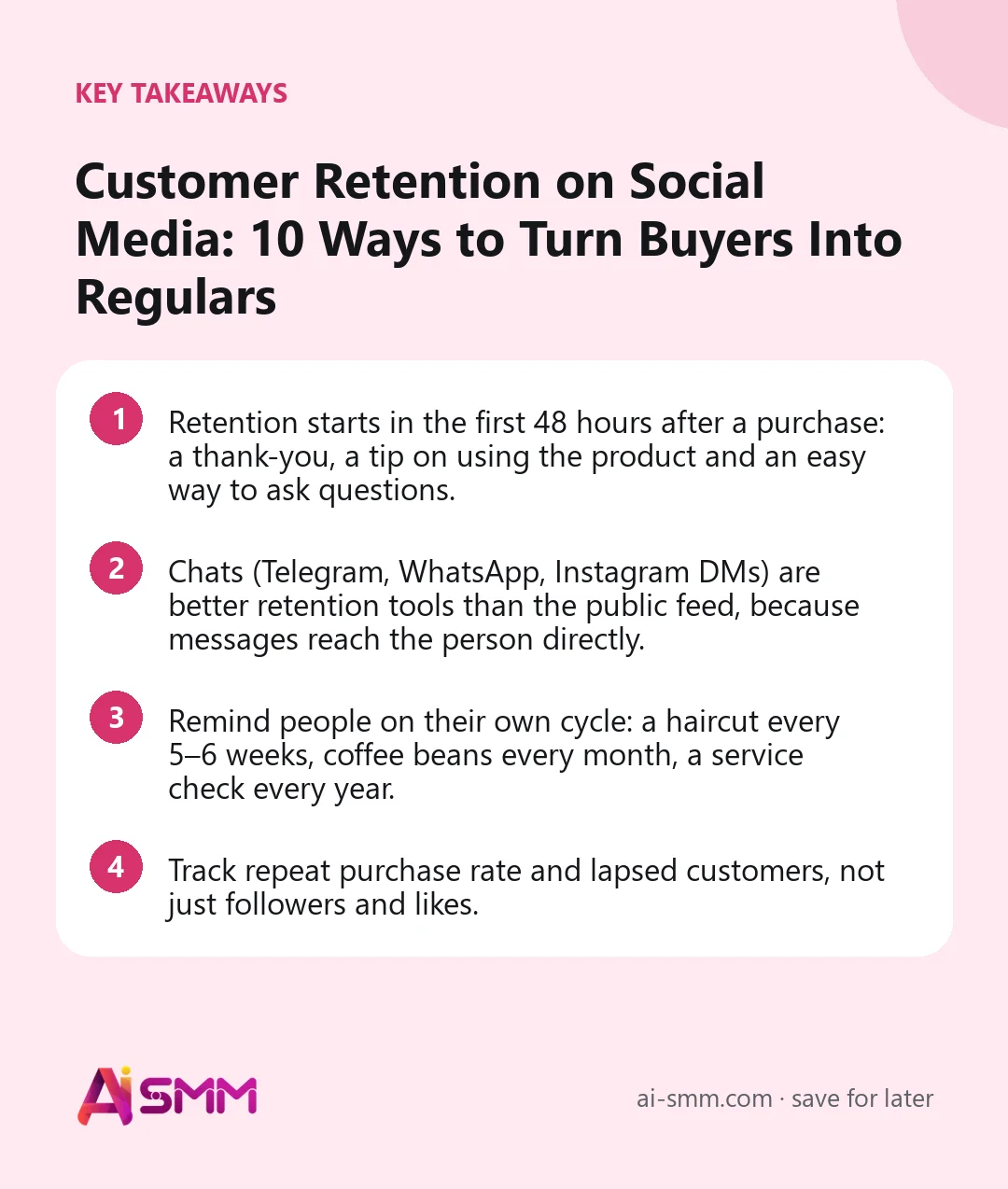
- Retention starts in the first 48 hours after a purchase: a thank-you, a tip on using the product and an easy way to ask questions.
- Chats (Telegram, WhatsApp, Instagram DMs) are better retention tools than the public feed, because messages reach the person directly.
- Remind people on their own cycle: a haircut every 5–6 weeks, coffee beans every month, a service check every year.
- Track repeat purchase rate and lapsed customers, not just followers and likes.
Why customer retention on social media matters for a small business
Winning a new customer takes ads, content, time and often a discount. Bringing back someone who already trusts you usually takes one well-timed message. Marketers widely agree that keeping a customer is cheaper than finding a new one, and for small businesses the effect is easy to see in the numbers.
Take an illustrative example. A studio gets 100 new clients a month. If 30 of them come back, it needs to keep finding 70 new people just to stay level. If 50 come back, the same marketing effort produces steady growth. Retention does not replace attracting new clients; it makes every new client worth more.
Social media is a natural place for this because your clients already spend time there. The trick is to use it for relationships, not just announcements.
Retention metrics worth tracking
| Metric | How to calculate | What it shows |
|---|---|---|
| Repeat purchase rate | Customers with 2+ purchases ÷ all customers in a period | How many come back at all |
| Time between purchases | Average days from one purchase to the next | When to send reminders |
| Lapsed customers | Customers with no purchase for 2× their usual cycle | Who needs a win-back message |
| Chat reply rate | Replies ÷ messages you sent to existing customers | Whether follow-ups feel welcome |
| Returning commenters | People who comment or react more than once a month | Your core community |
You do not need software for the first three; a spreadsheet of orders or appointments is enough. The key is to look at customers, not followers.
After the first purchase
1. Send a personal follow-up within 48 hours
A short message a day or two after the purchase does more for retention than a month of posts. Thank the person, ask how it went, and give one useful tip: how to care for the product, what to expect after the procedure, how to reach you with questions. Send it in the channel where the conversation started, whether that is Instagram DMs, Telegram or WhatsApp.
2. Publish aftercare and how-to content
Many customers never return because the product disappointed them through wrong use, not poor quality. Posts and short videos on “how to get the most out of…” reduce disappointment and give existing customers a reason to follow you. Pin the most important ones or save them in highlights.
3. Ask for feedback and act on it
A simple question like “What could we do better?” in a chat, or a poll in stories, shows that you care and warns you about problems before people quietly leave. Respond to feedback publicly when it is fair (“You asked for evening slots, we added them”): it shows every customer that their voice matters.
Between purchases
4. Give customers a place to stay close
A Telegram channel, a WhatsApp broadcast list or a close-friends list on Instagram for regulars turns a one-off buyer into someone who hears from you every week. Offer something specific in exchange: first access to free slots, new arrivals a day early, prices for regulars. Invite people at the moment of purchase, when they are most satisfied.
5. Remind people on their own cycle
Every business has a natural rhythm: hair grows, coffee runs out, cars need servicing, skin care ends. A reminder timed to that cycle feels like service, not spam. “It has been five weeks since your last visit, shall we book?” is one of the most effective messages a salon can send. Store the date of the last purchase and send the reminder a few days before the typical return date.
6. Offer perks only customers get
Discounts for everyone train people to wait for sales. Perks for existing customers reward loyalty: a birthday gift, a members-only preview, a free add-on on the third visit. Announce them in chats or in a customer channel, not in the public feed, so they feel exclusive.
Rewarding loyalty
7. Run a points and referral programme in chats
Points for each order and a gift for bringing a friend are the oldest loyalty mechanics, and chats make them easy: the customer sees their balance, gets a personal referral link and receives rewards without a plastic card or an app. Set thresholds that are reachable (“every fifth coffee free”) rather than distant.
8. Celebrate your customers publicly
Share customer photos, reviews and results with permission, and thank people by name when they agree. People who see themselves featured tend to stay loyal and tell friends. It also shows new visitors that real customers come back.
Winning back and keeping trust
9. Send a win-back message to lapsed customers
When someone has not bought for about twice their usual cycle, send a personal message: “We have not seen you for a while, is everything okay?”, optionally with a small reason to return. Some will not answer, but those who do often explain why they left, which is useful even when they do not come back.
10. Answer comments and messages fast
Nothing loses a regular faster than an unanswered question about their order. Treat comments and DMs from existing customers as priority. Aim to reply within a few hours during working time, and use automatic replies for common questions outside it, with a clear way to reach a person.
A simple retention calendar
| When | What to send | Where |
|---|---|---|
| Day 0 | Thank-you and invitation to the customer channel | Chat where they ordered |
| Day 1–2 | How did it go? One usage tip | Same chat |
| Day 7 | Feedback question or request for a review | Chat or email |
| Before the usual cycle ends | Reminder with a link to book or reorder | Chat |
| Birthday | Small gift or bonus points | Chat or email |
| 2× the cycle with no purchase | Personal win-back message | Chat |
Adjust the timing to your business: a florist might use holidays and anniversaries, a B2B service quarterly check-ins.
Segment customers before you message them
The same message does not fit everyone. A regular who visits every month and a person who bought once a year ago need different words. Five simple segments cover most small businesses:
| Segment | Who | What they need from you |
|---|---|---|
| New | First purchase in the last 30 days | Care, tips, a reason for a second visit |
| Regular | Buys on a steady cycle | Timely reminders, recognition, small perks |
| Top customers | Most frequent or highest spend | Early access, personal thanks, referral rewards |
| At risk | Past their usual cycle, not yet lost | A friendly reminder with a reason to come back |
| Lapsed | No purchase for 2× the cycle or longer | A personal win-back message and a question |
Tag contacts with their segment and review it once a month. Even a rough split is far better than one list for everyone.
An example: a coffee shop that fills its quiet days
An illustrative case. A neighbourhood coffee shop has plenty of first-time visitors from Instagram, but few of them turn into regulars. The owner starts inviting guests at the counter to a Telegram channel and a chat bot, promising “every fifth coffee free” and the weekly pastry menu a day early.
Points are counted in the chat, so nobody needs a paper card. Guests who have not visited for three weeks get a short message: “We miss you, your next cappuccino comes with a free croissant this week.” On slow Tuesday afternoons, the channel announces a small deal for subscribers only. None of these steps is complicated; together they give first-time guests several reasons to come back, and give the owner a list of people to talk to instead of an anonymous crowd.
How to do it in AI SMM
Retention depends on knowing who your customers are, and in AI SMM every conversation in the shared inbox creates a contact card with tags and history, whether the person wrote from Telegram, WhatsApp, Instagram or your website chat. From there, chat automation can run the calendar above: flows can start on a schedule, after an order, after a period of inactivity or for a segment of contacts, so follow-ups and win-back messages go out on time without manual lists.
Loyalty points, thresholds and referral links live in gamification blocks, with activity points saved on each contact card. Service businesses can rely on reminders and a waiting list in online booking, and email campaigns from the same workspace cover customers who prefer the inbox to chats. The cafes and delivery page shows how points for orders and a gift for a friend fit together.
Retention mistakes to avoid
- Messaging every customer every week with promotions. Relevance matters more than frequency.
- Sending the same reminder to everyone, regardless of what they bought.
- Offering bigger discounts to new clients than to regulars.
- Ignoring negative feedback in comments instead of answering it calmly.
- Measuring success by follower count instead of repeat purchases.
FAQ
What is a good repeat purchase rate for a small business?
It varies widely by niche: a coffee shop or salon can expect many repeat visits, a furniture store far fewer. Compare yourself with your own previous months and aim to improve the trend.
Is it spam to message customers in chats?
Not if the message is relevant, expected and easy to stop. A follow-up after a purchase or a reminder on their cycle is service. Weekly promotions with no personal relevance are spam.
Which social network is best for retention?
The one where your customers already talk to you. For many small businesses that is Instagram DMs, Telegram or WhatsApp. Chats reach people directly, which makes them better for retention than the public feed.
Do I need a loyalty app?
Not necessarily. Points, referral links and rewards can live in the chat itself, which avoids asking customers to install anything.
Start with the simplest step: set up a follow-up message after each order with chat automation in AI SMM, and build the rest of the calendar from there.
Posts, chats, video and sales in one workspace. 7 days free.
Start free