
 AI SMM team
The best time to post on Instagram is when your own followers are online and in the mood for your kind of content, and that differs between a neighbourhood bakery and an online course. There is no universal hour. There are, however, sensible starting points for each type of business and a simple way to find your own best time in about three weeks. This article gives you both, without made-up statistics.
Timing matters because Instagram tests every new post on a small part of your audience first. If those people are asleep, at work or busy with dinner, the post collects fewer early reactions and is shown to fewer people afterwards. Posting at the right time does not rescue a weak post, but it gives a good one a fair start.
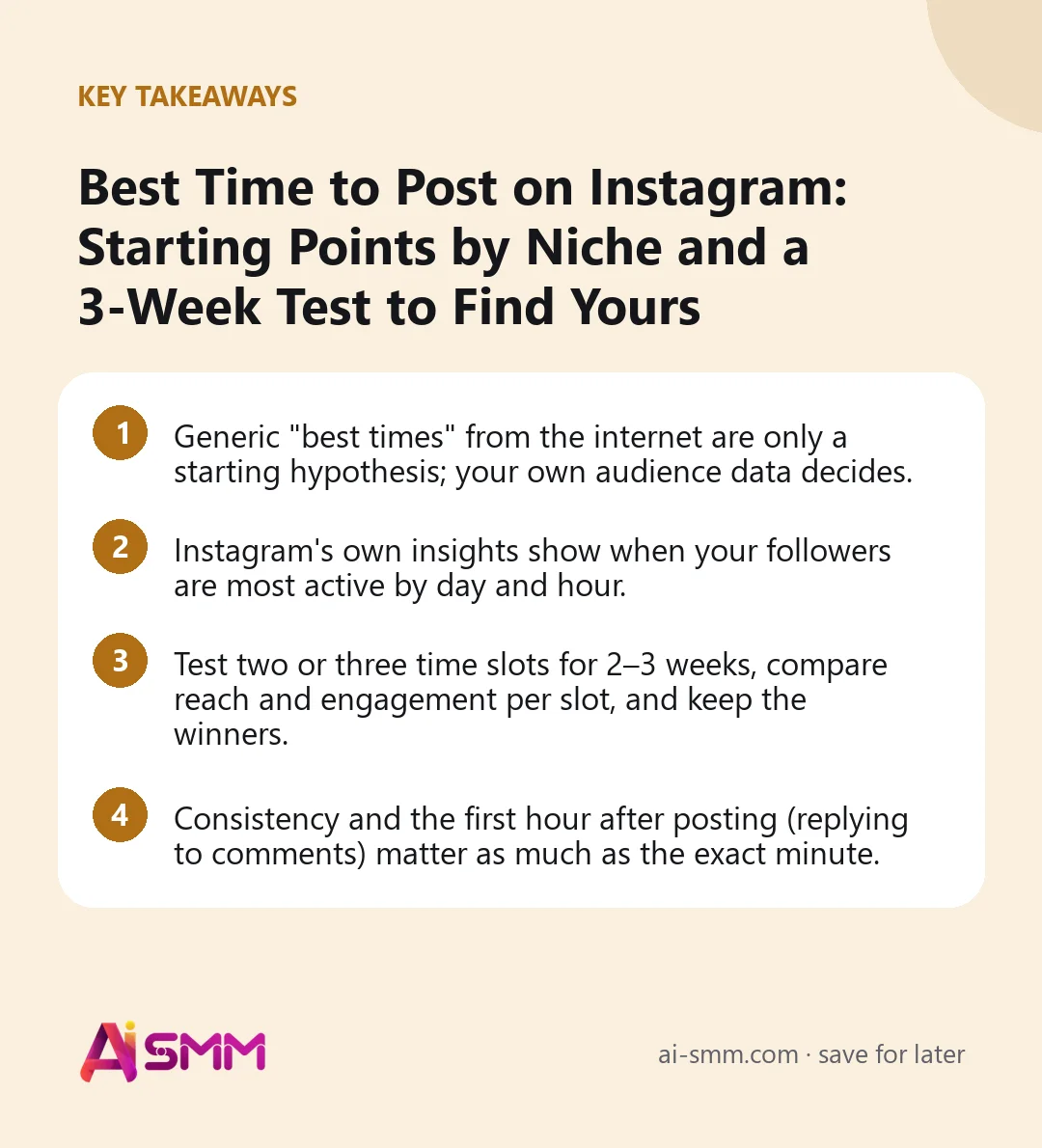
- Generic “best times” from the internet are only a starting hypothesis; your own audience data decides.
- Instagram’s own insights show when your followers are most active by day and hour.
- Test two or three time slots for 2–3 weeks, compare reach and engagement per slot, and keep the winners.
- Consistency and the first hour after posting (replying to comments) matter as much as the exact minute.
Is there one best time to post on Instagram?
No. Published “best time” studies average millions of accounts across countries, industries and audiences. Your account is not an average. A salon whose clients are office workers and a cafe whose regulars are students and freelancers can have completely different peaks, even in the same street.
What you can rely on are general patterns of daily life. People check their phones when they wake up, on the commute, at lunch and in the evening after work or after putting children to bed. Late at night and during the working morning, attention is usually lower. Your job is to find which of these moments your particular audience uses for Instagram.
Starting points by type of business
Use this table as a first hypothesis, not a rule. Times are local time for your audience.
| Business | Windows worth testing first | Why |
|---|---|---|
| Beauty salon, studio | Lunchtime (12–14) and evening (19–21) on weekdays; Sunday evening | Clients plan appointments during breaks and in the evening; Sunday is when people plan their week |
| Cafe, bakery, restaurant | Morning (7–9), before lunch (11–12), late afternoon (16–18) | People decide where to eat shortly before they eat; show food before the decision |
| Online shop | Evening (19–22), weekend mornings | Browsing and buying happen in free time, often on the sofa |
| Expert, coach, consultant | Early morning (7–9) and evening (20–22) | Educational content is consumed on the commute and when people have time to think |
| B2B services | Weekday mornings and lunch | Decision-makers scroll during working hours and breaks |
For time-sensitive content the logic is different: a “free slot today at 16:00” story should go out early in the day, and a lunch special must be seen before lunch, whatever your analytics say about evenings.
Where to see when your followers are online
With a professional (business or creator) account, Instagram’s insights include an audience section that shows when your followers are most active, by day of the week and by hour. This is the most direct signal you have, because it describes your people rather than an industry average. Two things to keep in mind:
- The data needs enough followers to be meaningful. Very small accounts may see noisy or empty charts; in that case lean on the table above and on testing.
- “Online” is not the same as “engaged”. Your followers may be online all evening but only interact with longer content on weekends. That is why a test beats reading one chart.
A 3-week test to find your best time to post
This method works for any account that posts at least three times a week.
- Pick two or three candidate slots from your insights and the table above, for example 8:00, 13:00 and 20:00.
- Rotate them evenly for 2–3 weeks, so each slot gets several posts of similar types. Do not put all your best content in one slot.
- Record the results for each post after 48 hours: reach, likes, comments, saves, shares, and for Reels, plays. A simple spreadsheet is enough.
- Compare averages per slot, not individual posts. One viral post can distort everything; look at the typical result.
- Keep the best one or two slots as your default schedule and retest every few months, or after a big change in your audience or season.
When comparing, focus on the metric that matches your goal. For awareness, reach and shares matter most. For sales and bookings, comments, saves and DMs after the post say more than likes.
A simple tracking sheet for the test
You do not need a special tool to run the test, only a table with one row per post. Fill it in two days after publishing, when most of the reaction has arrived.
| Date | Slot | Format | Topic | Reach | Saves + shares | Comments + DMs |
|---|---|---|---|---|---|---|
| Mon | 08:00 | Carousel | Aftercare tips | … | … | … |
| Wed | 13:00 | Reel | Transformation | … | … | … |
| Fri | 20:00 | Photo | New design | … | … | … |
After three weeks, sort by slot and calculate the average for each column. Add a note column for anything unusual: a holiday, a post shared by a bigger account, a technical problem. Those notes explain outliers you should exclude from the comparison.
Example: how a nail studio might run the test
Say a small nail studio posts four times a week and has always published “whenever there is a gap between clients”, usually around 15:00. Its insights suggest followers are most active in the evening. The owner picks three slots to test: 8:00 (before work), 13:00 (lunch break) and 20:30 (evening), and rotates them for three weeks with a similar mix of photos, carousels and Reels in each.
At the end, she compares averages rather than single posts. Suppose the evening slot shows the highest reach and the most DMs asking about free slots, while the morning slot collects saves on aftercare carousels but few messages. The conclusion is not “always post at 20:30”; it is “post selling content and free-slot Reels in the evening, and keep useful carousels in the morning”. That is the kind of practical answer a generic best-time chart cannot give. Because the studio is busy at 20:30, the posts are scheduled in advance rather than published by hand.
Does the best time differ for Reels, carousels and Stories?
Often, yes, because each format behaves differently:
- Reels keep being shown to new people for days, so the exact posting minute matters somewhat less. Still, early reactions from followers help, so post when your core audience is awake.
- Carousels and feed posts depend more on the first hours. Post them in your strongest slot.
- Stories last 24 hours and are viewed throughout the day. Post the most important story (an offer, free slots) in the morning so it has the full day, and add live frames later.
Time zones and audiences in several cities
If your customers live in one city, use that city’s time and ignore everything else. If you sell online across several time zones, check where most of your followers are in the audience section of your insights and schedule for the largest group. For important launches, you can repeat the key message later, for instance a Story or a second post aimed at another region, instead of hoping one time suits everyone.
When to retest your posting times
Your best time is not fixed forever. Audiences change, and so do their routines. Run a shorter version of the test again when you notice any of these signals:
- Reach per post has dropped for several weeks although content quality has not changed.
- Your audience has shifted, for example after a collaboration brought many followers from another city or age group.
- The season has changed: summer holidays, the start of the school year or the weeks before major holidays.
- You have added a new format, such as regular Reels, and want to know whether it behaves differently from your photos.
- Your business hours or offer changed, for instance a cafe that started serving dinners.
Timing mistakes to avoid (checklist)
- Copying a “best time” from an article about a different country or industry and never checking it.
- Posting at a perfect hour and then disappearing, leaving the first comments unanswered for half a day.
- Judging a slot on one post instead of an average across several.
- Changing the time, the format and the topic at once, so you cannot tell what made the difference.
- Posting whenever you have a free minute, which usually means late at night after work.
- Ignoring seasons: holidays, summer and school terms shift your audience’s routine.
What matters more than the exact minute
Timing is one factor among several. A strong hook, a useful or emotional idea and a clear call to action affect results far more than posting at 19:00 instead of 19:30. Consistency matters too: followers get used to a rhythm, and a predictable schedule makes planning easier for you. Finally, the first hour after posting is when you can help most: answer comments quickly, reply to DMs the post generates and share it to your Stories. That kind of activity sends the right signals regardless of the clock.
How to find and use your best time in AI SMM
In AI SMM, the Best time tab in Pulse analytics looks at when your own audience is active and suggests time windows for each account, so a local bakery and an online brand get different recommendations. The same analytics show reach and engagement for every Instagram post, which is exactly the data the 3-week test needs. You then place posts, carousels, Reels and Stories on the content calendar in those windows, and they publish automatically, even when your best slot is 7:30 in the morning and you are opening the salon. Testing more slots also gets cheaper when the AI content studio drafts the caption in a minute. And because people react in the first hour, the shared inbox keeps new comments and DMs from every post in one place so you can answer while the post is still fresh.
FAQ
What is the best day to post on Instagram?
It depends on your audience. Many local service businesses see good results early in the week and on Sunday evenings, when people plan; shops often do well at weekends. Check the days in your own insights and test before deciding.
How many times a week should I post on Instagram?
For most small businesses, three to five feed posts or Reels a week plus regular Stories is a sustainable rhythm. A schedule you can keep matters more than a high number you abandon.
Does posting at the wrong time hurt my account?
Not permanently. A post published at a weak time may simply reach fewer people. Your account is not penalised, and the next post starts fresh.
Should I post at the same time every day?
A consistent default schedule is useful, but it does not have to be the same minute every day. Keep one or two proven slots and adjust for time-sensitive content like same-day offers.
Start with the windows for your niche, run the three-week test and let AI SMM analytics tell you when your own audience is listening.
Posts, chats, video and sales in one workspace. 7 days free.
Start free