
 AI SMM team
Social media marketing (SMM) is the use of social networks and messengers to attract customers, talk to them and sell to them: publishing content, answering comments and messages, running ads, and measuring which of it brings in money. For a small business, it is often the cheapest way to be seen by local or niche buyers every day. The catch is that “posting sometimes” is not social media marketing, and that gap is where most owners lose time without getting customers. This guide explains what SMM actually includes, how it makes money, what it costs and how to start.
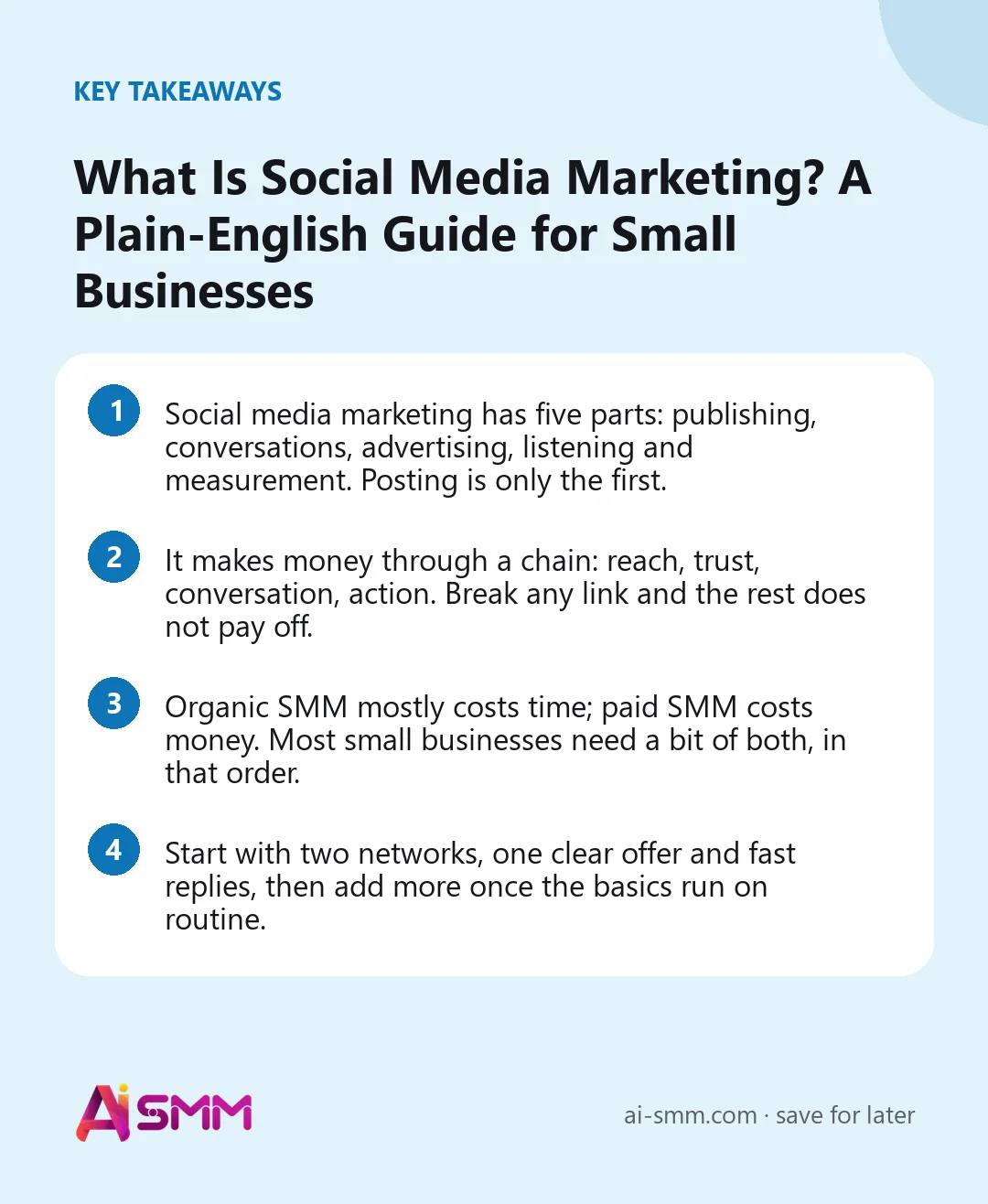
- Social media marketing has five parts: publishing, conversations, advertising, listening and measurement. Posting is only the first.
- It makes money through a chain: reach, trust, conversation, action. Break any link and the rest does not pay off.
- Organic SMM mostly costs time; paid SMM costs money. Most small businesses need a bit of both, in that order.
- Start with two networks, one clear offer and fast replies, then add more once the basics run on routine.
What is social media marketing, in one paragraph
Social media marketing is everything a business does on social platforms to reach a commercial goal. That includes the content it publishes, the way it replies to people, the ads it runs, the conversations it starts in direct messages and the numbers it checks afterwards. The goal can be sales, bookings, leads, repeat purchases or simply being known in a new area. What separates marketing from a personal account is intent: every activity is meant to move someone one step closer to buying, even if a particular post is just a funny behind-the-scenes clip.
The five parts of social media marketing
When people say “we do SMM”, they often mean only the first item on this list. A business that covers all five gets far more out of the same number of posts.
| Part | What it means | Typical tasks |
|---|---|---|
| Publishing | Creating and scheduling content for each network | Posts, Reels, Shorts, carousels, Stories, channel posts |
| Conversations | Replying to comments, DMs and mentions, and starting chats | Answering questions, handling objections, sending prices, booking |
| Advertising | Paying to show content to chosen audiences | Boosted posts, ad campaigns, retargeting |
| Listening | Watching what customers and competitors say and do | Tracking mentions, reading reviews, checking competitor formats |
| Measurement | Checking what works and changing the plan | Reach, engagement, conversations, sales, monthly review |
Why conversations matter more than most people think
On many networks, the moment of sale does not happen on a checkout page. It happens in a direct message: “How much is it?”, “Do you have Saturday?”, “Will it fit a size 38?” A business that answers in ten minutes often wins the customer; one that answers the next day often has already lost them to a competitor. That is why customer conversations are a core part of SMM, not an afterthought.
How social media marketing turns posts into customers
Think of SMM as a chain. Each link has its own job, and the whole chain is only as strong as the weakest link.
- Reach: new people see your content, through recommendations, hashtags, search, shares or ads.
- Interest: they stop scrolling, watch, like, save or visit your profile.
- Trust: over several touches, they see proof: results, reviews, the people behind the brand.
- Conversation: they ask a question in comments or DMs, or respond to a call to action.
- Action: they buy, book, order or leave contact details.
- Return: they follow a channel or newsletter, come back and recommend you.
A cafe with beautiful photos but a two-day reply time has a broken conversation link. A consultant who answers instantly but posts once a month has a weak reach link. Diagnosing which link is weakest is often the fastest way to improve results.
Organic vs paid social media marketing
There are two ways to get in front of people: earn attention with content, or buy it with ads.
| Organic SMM | Paid SMM | |
|---|---|---|
| Main cost | Time and creativity | Ad budget plus time for creatives |
| Speed | Slow build, usually months | Results within days if the offer is right |
| Durability | Content keeps working, audience stays | Stops when the budget stops |
| Targeting | Limited to who the algorithm shows you to | Precise by location, interests, behavior |
| Best for | Trust, community, testing messages | Scaling what already works, launches, local reach |
For most small businesses the sensible order is: organic first, to learn what people respond to, then a modest ad budget behind the posts and offers that have already proven themselves.
Main types of social media content
Social media marketing is not limited to one kind of post. Formats differ by network, but most fall into these groups:
- Short vertical video: Reels, TikTok videos, YouTube Shorts. Usually the strongest format for reaching new people.
- Carousels and image posts: step-by-step tips, before/after, product sets. Good for saves and shares.
- Stories: daily, informal, disappearing content. Good for keeping existing followers warm and for quick polls.
- Text posts: on Threads, LinkedIn, Telegram channels, Bluesky. Good for opinions, expertise and discussions.
- Long video: YouTube. Good for search and deep trust; a source for many short clips.
- Live sessions: Q&A, launches, workshops. Good for direct connection.
- User-generated content: photos and reviews from customers. Among the most convincing proof you can publish.
Which networks are used for social media marketing
You do not need to be everywhere. Each network has its own audience and mood. A short overview:
| Network | Typical strengths for small business |
|---|---|
| Visual services and products, local businesses, DM-based sales | |
| Local communities, events, older audiences, Messenger | |
| TikTok | Reaching new people fast with short video, product demos |
| YouTube | Search, tutorials, reviews, long-term trust |
| Telegram | Channels for loyal audiences, bots for orders, strong in Russian-speaking markets |
| B2B services, consultants, personal brands of founders | |
| Inspiration-driven niches: home, weddings, food, fashion | |
| Threads, X, Bluesky | Conversation, opinions, fast news |
| Not a publishing network, but a key chat channel for questions and orders |
What social media marketing costs
The honest answer is “time or money, usually both”. Here is how the budget typically splits for a small business. Ranges are from our experience and vary a lot by country and niche.
- Your own time: roughly 3–8 hours a week for two networks done properly, including replies. Tools and AI drafts can bring this down noticeably.
- Tools: a planner, design and AI tools. Many offer a free tier; paid plans for small teams usually cost tens of euros a month.
- Content production: photos, video editing, sometimes a freelancer. Can be close to zero if you film on a phone.
- Ads: optional at the start; a test budget can be small, for example what you would spend on a few printed flyers.
- Outsourcing: a freelancer or agency if you have no time at all. Costs more, but you still need to supply real material and answer customers fast.
Who does social media marketing: the roles
In a large company, each of these is a separate job. In a small business, one or two people usually cover all of them, which is exactly why it helps to know what the roles are: you can see which one gets neglected.
| Role | Responsible for | In a small business, often done by |
|---|---|---|
| Strategist | Goals, networks, offers, KPIs | The owner |
| Content creator | Photos, videos, captions, design | The owner or a team member, with AI drafts |
| Community manager | Replies to comments and DMs, moderation | An administrator or whoever is on shift |
| Ads specialist | Paid campaigns, targeting, budgets | A freelancer, occasionally |
| Analyst | Reports, conclusions, next steps | The owner, once a month |
The role most often left empty is the community manager. Posts get published, but messages wait for hours. If you can delegate only one role, delegating replies usually has the fastest effect on sales.
Social media marketing vs other marketing channels
| Channel | Strength | Weakness compared with SMM |
|---|---|---|
| Search ads | Catches people actively looking for a solution | Pays per click, no ongoing relationship |
| SEO and a website | Long-term traffic from search | Slow to build, little direct conversation |
| Email marketing | An audience you own, high return on repeat sales | You need contacts first, often collected through social |
| Marketplaces | Ready traffic of buyers | Commissions, price competition, customer belongs to the platform |
| Offline (flyers, signage) | Local visibility | Hard to measure, no two-way contact |
SMM rarely replaces these channels; it connects them. A post brings someone to your website, a chat turns a marketplace buyer into a direct customer, a lead magnet in DMs grows your email list.
Benefits of social media marketing for a small business
- Low entry cost: you can start with a phone and a free account.
- Direct line to customers: questions, feedback and complaints reach you without intermediaries.
- Proof in public: results, reviews and real people behind the brand build trust faster than an ad.
- Local reach: people nearby discover you through recommendations and location tags.
- Fast testing: you can see within days whether a new offer or message gets any reaction.
- Repeat sales: channels and followers are a cheap way to bring customers back.
The downsides are real too: algorithms change, reach can drop without warning, and the work never really ends. That is why smart businesses also collect contacts they own, such as email subscribers or chat contacts, instead of relying only on followers.
Common misconceptions about SMM
- “More followers means more sales.” Not necessarily. A small, local, engaged audience often sells more than a large random one.
- “We need to post every day on every network.” Consistency matters more than frequency. Three strong posts a week beat seven weak ones.
- “Social media is free.” Your time has a price. Count it.
- “SMM is just nice pictures.” Pictures get attention; conversations and clear offers make sales.
- “AI will do it all.” AI speeds up drafts, planning and replies, but someone still has to know the business and approve what goes out.
How to start social media marketing in 30 days
Week 1: foundation
- Write down one goal with a number, for example “10 bookings a month from Instagram”.
- Describe your buyer in four lines: who, what problem, what stops them, where they spend time.
- Pick two networks. Fill in the profile: clear name, what you do, where, and a link to a page where people can book, order or write.
Week 2: content system
- Choose three to five recurring topics: proof, tips, behind the scenes, offer, community.
- Create two weeks of posts in one sitting and schedule them.
- Film one longer video you can later cut into short clips.
Week 3: conversations
- Set a rule for response time, for example within one hour during working hours.
- Write short answers to the five questions you get most often.
- Add a call to action to offer posts: “comment PRICE and we’ll send the price list”.
Week 4: measure and adjust
- Note reach, engagement, number of conversations and number of sales or bookings from social.
- Find the three best posts and plan more like them.
- Decide on one change for next month, and only one.
How AI SMM covers the parts of social media marketing
AI SMM is built around the same five parts. For publishing, a single calendar schedules posts to 14 networks, including Instagram, Facebook, TikTok, YouTube, Telegram, LinkedIn and Threads, and the AI content studio writes captions and creates images in your brand’s tone from a brief. Long videos turn into vertical clips with subtitles through video clipping.
For conversations, comments and DMs from supported networks, plus WhatsApp, email and your website chat, come into one inbox where AI suggests replies based on your own materials. For measurement, analytics compares 12 networks on one screen and tracks competitors next to your accounts; X and Telegram are not part of analytics, so their numbers stay in each network’s own statistics. For listening and outreach, the assistant in your browser collects people who comment on a competitor’s posts and drafts comments that go out only after you approve them. If you are an expert or creator, the experts and creators page shows how these pieces fit together.
FAQ
What is the difference between social media marketing and social media management?
Social media management usually means the day-to-day work: scheduling posts, replying, keeping accounts in order. Social media marketing is broader: it includes the strategy, the offers, the ads and the measurement that tie that daily work to business results.
Is social media marketing worth it for a very small business?
Usually yes, if your customers use social networks and you can commit a few hours a week. It is especially effective for local services, visual products and experts, where trust and quick answers decide the sale.
Can I do social media marketing without ads?
Yes. Many small businesses grow on organic content and fast replies alone. Ads become useful once you know which posts and offers work and want to show them to more people.
How do I know if social media marketing is working?
Look beyond likes. Check whether reach among new people is growing, whether more people start conversations and, most importantly, how many bookings, orders or leads came from social media this month compared with last.
If you want to try all five parts of SMM in one place, start with the free plan of AI SMM and connect your first two networks.
Posts, chats, video and sales in one workspace. 7 days free.
Start free