
 AI SMM team
A social media portfolio is what a client looks at when they decide whether to trust you with their accounts, and most portfolios fail the same way: a grid of nice-looking posts with no context. The client cannot tell what the problem was, what you did or whether it helped the business. A portfolio that wins work reads more like a set of short stories: here was the situation, here is what I changed, here is what happened. This guide explains what to include, gives you a case study template, shows how to build a portfolio before you have clients and where to host it.
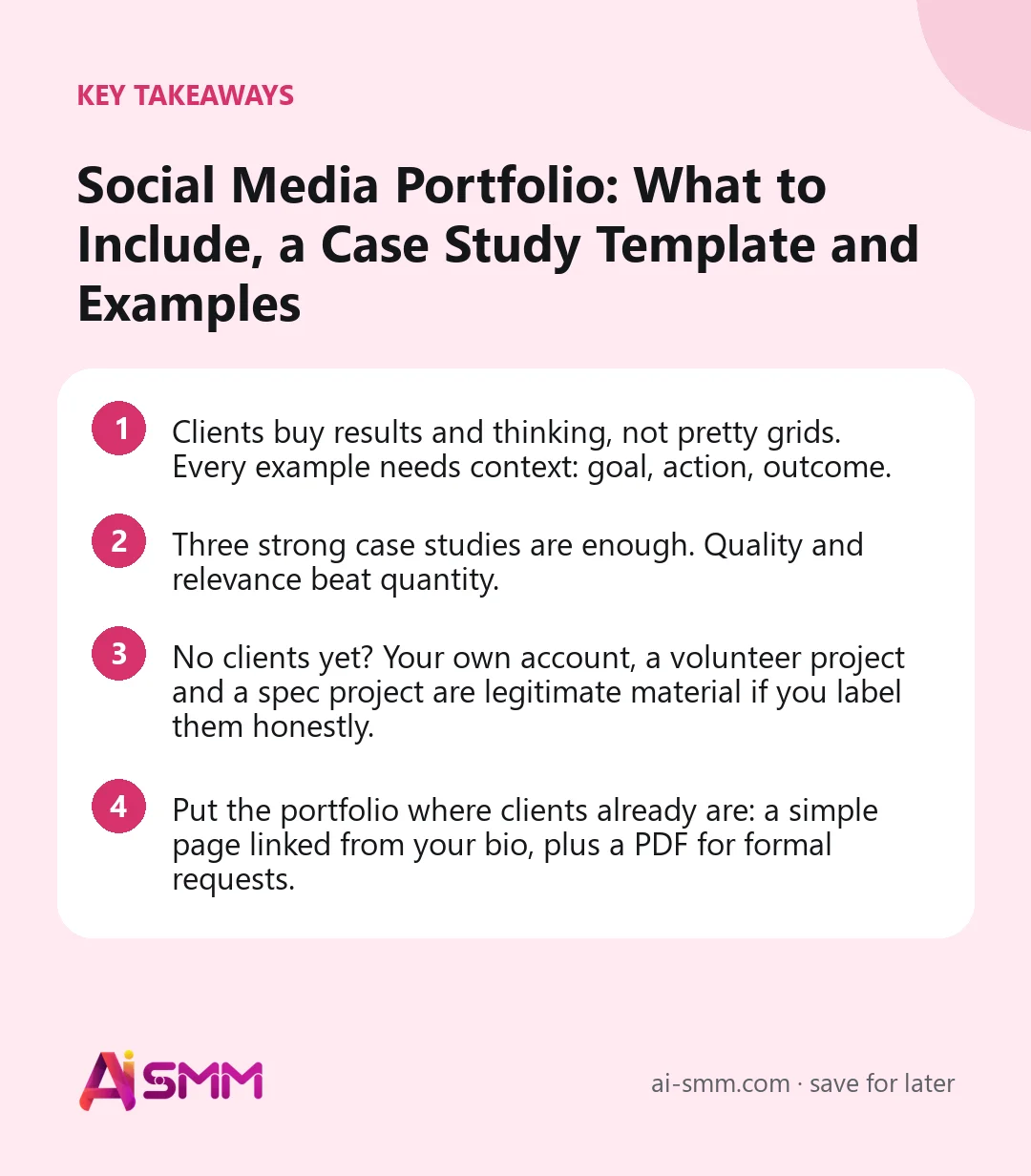
- Clients buy results and thinking, not pretty grids. Every example needs context: goal, action, outcome.
- Three strong case studies are enough. Quality and relevance beat quantity.
- No clients yet? Your own account, a volunteer project and a spec project are legitimate material if you label them honestly.
- Put the portfolio where clients already are: a simple page linked from your bio, plus a PDF for formal requests.
What a social media portfolio is for
A social media portfolio answers three questions a prospective client has but rarely asks out loud: “Have you solved a problem like mine?”, “How do you think?” and “Can I trust you not to embarrass my brand?” A CV lists what you did. A portfolio proves it and shows the reasoning behind it.
That is why the same work can be presented well or badly. “Managed Instagram for a coffee shop” says little. “A coffee shop with an empty weekday afternoon: we built a weekly ‘afternoon offer’ series in Stories and Reels, and messages asking about it became a regular part of the week” tells a client exactly what you can do for them.
What to include: the checklist
- A one-line positioning. Who you help and with what. “Social media for beauty studios and clinics: content, replies, bookings.”
- Three to five case studies. Each with goal, starting point, what you did, examples of content and the outcome.
- Work samples by format. A few carousels, short videos, captions, a content plan page, a report page. Enough to show range, not everything you ever made.
- Your process. A simple diagram or list: brief, audit, plan, production, approval, publishing, replies, report.
- Services and starting prices or packages. Even a “from” price saves both sides time.
- Testimonials. Short quotes from real clients with their permission, name and business.
- A clear next step. How to contact you and what happens after: “Send your account link and I will reply with three quick observations within two days.”
A case study template you can copy
Keep every case study to one screen or one page. Clients skim; structure helps them find the part they care about.
| Block | What to write | Example |
|---|---|---|
| Client and context | Business type, city or market, networks (name only with permission) | Small nail studio, two masters, Instagram and a messenger for bookings |
| Problem | What was wrong or missing, in business terms | Free slots on weekdays, posts once a month, messages answered late |
| Starting point | The “before” numbers and screenshots | Typical reach per post, response time, how the profile looked |
| What you did | 3–5 concrete actions, not a list of services | New bio and highlights, weekly “free slots” Stories, two Reels a week with before/after, reply templates |
| Content examples | 2–4 pieces with one line on why they worked | A Reel that became the most-saved post, and why |
| Outcome | What changed, with the period and honest caveats | More booking requests through messages over three months; weekday slots filled more often |
| What you learned | One insight you would reuse | Showing real free slots worked better than generic promos |
Write outcomes precisely but honestly. If you have exact numbers and permission to show them, use them with the time period. If the business will not share sales, describe what you can see (messages, bookings, clicks) and say what you cannot. A careful claim builds more trust than a big one.
How to build a social media portfolio with no clients
Everyone starts without clients. Here are legitimate sources of first material, from strongest to weakest.
| Source | What it proves | How to label it |
|---|---|---|
| Your own professional account | Consistency, writing, video, growth you caused | “My account, results over N months” |
| Volunteer or pro bono project | Working with a real organisation and real constraints | “Pro bono for a local animal shelter” |
| Friends’ or family business | Real results, approvals, community work | “Project for a family bakery” (no need to hide it, just be accurate) |
| Small paid test | That someone paid for your work | “One-month content package for…” |
| Spec project for a real brand | Thinking and craft, not results | “Concept, not commissioned by the brand” |
| Audit of a public account | Analytical thinking | “Independent audit based on public data” |
Spec work is useful but never present it as client work. A client who finds out later will doubt everything else in the portfolio. For the full starting path, see how to become a social media manager.
Organise by problem, not by network
Beginners often group work by network: “Instagram”, “TikTok”, “LinkedIn”. Clients think in problems: “I need bookings”, “Nobody answers our messages”, “We look outdated”, “We have videos but no time to cut them”. Grouping case studies by problem makes each client find themselves faster.
- More enquiries and bookings. Content and profile changes that led to messages.
- Faster customer replies. Reply templates, response routine, chat automation.
- Brand refresh. New visual style, style guide, profile redesign.
- Video content. Series of short videos, repurposing long recordings.
- Launches and promotions. A product launch, a giveaway, a seasonal campaign.
If you work in one niche, add niche-specific language. A dental clinic owner reads “patients” and “consultations”, not “users” and “conversions”.
What a strong portfolio looks like in different niches
The structure stays the same, but the evidence clients look for changes with the niche. Here are illustrative examples of what to put first.
| Niche | What clients look for | What to show first |
|---|---|---|
| Beauty salons and studios | Bookings, filled slots, trust in the masters | Before/after content, a booking path from Stories to messages, reply templates |
| Cafés and restaurants | Visits, orders, local reach | Menu and offer content, local campaigns, handling reviews |
| Experts and online schools | Leads for consultations or courses, authority | Content series, a lead magnet flow, a channel growth story |
| B2B and consultants | Credibility, conversations with decision-makers | LinkedIn posts with discussions, a thought-leadership plan |
| Online stores | Clicks to the store, sales, repeat buyers | Product content, launch campaigns, questions answered in chats |
If you want to move into a new niche, one spec project or audit in that niche, clearly labelled, is often enough to start conversations there.
Where to host your portfolio
| Format | Good for | Keep in mind |
|---|---|---|
| Link-in-bio page | Clients who find you on social media; quick overview and contact buttons | Keep it short, link to full cases |
| Formal requests, email, tenders | Update the date; keep under 10–12 pages | |
| Simple website or page builder | Search traffic, larger clients, detailed cases | Needs updating; do not let it go stale |
| Pinned posts or highlights | Showing work inside the network where you sell | Short versions only, link to the rest |
| Channel with case breakdowns | Building trust over time, showing your thinking | Needs regular posting |
Most freelancers do well with a link-in-bio page for quick visitors and a PDF for formal requests. Everything else is optional.
Permissions, privacy and honesty
- Ask clients before naming them or showing their numbers. Many agree if you ask right after a good result.
- If a client says no, anonymise: “a beauty studio in a city of 500,000 people” still works.
- Hide personal data in screenshots: names, photos and messages of customers.
- Do not claim team results as solo work. “I was responsible for content and replies; the ads were run by another contractor” is honest and still strong.
- Date your case studies. Results from three years ago are fine, but label them.
Common portfolio mistakes
- Only visuals. A grid without goals and outcomes looks like a designer’s portfolio, not a manager’s.
- Too much. Twenty weak examples hide three strong ones.
- Vanity metrics only. Likes without any link to enquiries or sales do not impress owners.
- Unclear role. The client cannot tell what you did personally.
- No next step. The reader is interested and does not know how to start.
- Outdated work. A portfolio last updated two years ago suggests you stopped growing.
Collecting portfolio material with AI SMM
The best time to build a case study is while the work is happening, not six months later. In AI SMM, analytics tracks followers, reach and engagement for connected networks and builds monthly client reports with AI conclusions. Save each month’s report, and your “before” and “after” for case studies is ready without hunting for old screenshots. Remember that X and Telegram are not covered by analytics in AI SMM, so capture those numbers from the networks directly.
For the portfolio itself, a link-in-bio page is a simple place to show your positioning, services and case links, with contact buttons. If short video is one of your strengths, video clipping turns long recordings into shorts that you can show as format examples. And when you run several clients, keeping each one in a separate project on the agency setup means every case study has its own clean trail of posts, approvals and reports.
FAQ
How many case studies should a social media portfolio have?
Three to five is enough for most freelancers and small agencies. Choose the ones closest to the clients you want next, and replace older cases as better ones appear.
Can I include work done at a previous job?
Yes, if it is public and you describe your role accurately. Do not share internal numbers or documents without permission from the former employer.
What if my results were not impressive?
Show the thinking and the progress. “Response time went from days to hours” or “the profile now explains the service in one screen” are real improvements. Also show what you learned and what you would do differently.
Should I put prices in my portfolio?
A starting price or a “from” figure is useful: it filters out clients who cannot afford you and saves time for both sides. Detailed packages can go into a proposal after the first call; see how to price social media services.
Pick your three best projects this week and rewrite them in the case study format above. If you want the numbers and reports for future cases collected as you work, try AI SMM analytics on your current accounts.
Posts, chats, video and sales in one workspace. 7 days free.
Start free