
 AI SMM team
If you want to know how to become a social media manager, the honest answer is that nobody will ask for your diploma, but everybody will ask what you have already done. The field is open to career changers, students and people who have been running a friend’s shop page for fun; what separates them from paid professionals is proof of results and a way of working that clients trust. This guide lays out the path from zero: what the job really involves, which skills to learn first, a 90-day practice plan, how to build a small portfolio and how to land the first paid work.
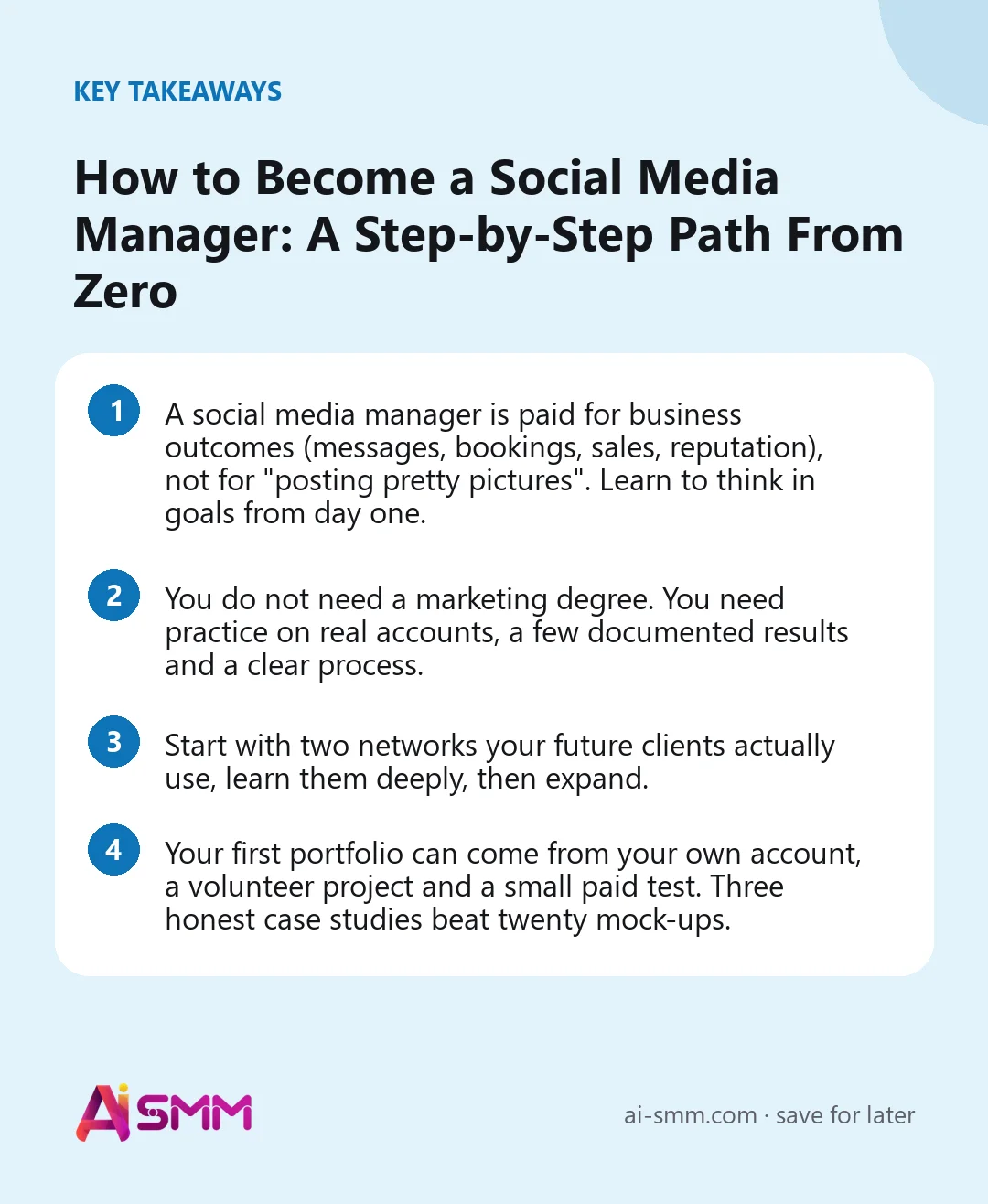
- A social media manager is paid for business outcomes (messages, bookings, sales, reputation), not for “posting pretty pictures”. Learn to think in goals from day one.
- You do not need a marketing degree. You need practice on real accounts, a few documented results and a clear process.
- Start with two networks your future clients actually use, learn them deeply, then expand.
- Your first portfolio can come from your own account, a volunteer project and a small paid test. Three honest case studies beat twenty mock-ups.
What a social media manager actually does
From the outside the job looks like writing captions. In practice, writing is a third of the work at most. A typical week mixes planning, production, publishing, conversations with followers, analysis and client communication. Knowing this upfront helps you learn the right things instead of polishing one skill that clients value least.
| Area | What it includes | Share of a typical week |
|---|---|---|
| Strategy and planning | Goals, audience, content pillars, monthly content plan | Around 10–15% |
| Content production | Captions, simple visuals, short videos, stories, adapting one idea to several networks | Around 30–40% |
| Publishing | Scheduling, checking formats and links, fixing what broke | Around 5–10% |
| Community management | Answering comments and DMs, moderating, passing leads to the client | Around 15–25% |
| Analytics and reporting | Reading metrics, finding what worked, monthly report with conclusions | Around 10% |
| Client communication | Approvals, calls, briefs, expectations | Around 10–15% |
These shares are illustrative, based on how a common “full management” package is usually split; your own week will depend on the client and the niche. The point is the mix: if you only train your writing, you will struggle with the other two thirds.
Do you need a degree or a course?
No employer or client will reject you for not having a marketing diploma. Many working specialists came from journalism, design, sales, hospitality or customer support, and those backgrounds are useful: journalists write fast, salespeople understand objections, support staff know how to calm an angry customer in a comment thread.
A course can help if it gives you structure, homework on real accounts and feedback from a practitioner. It will not help if it only gives you a certificate. Before paying, ask to see what graduates actually produced and whether you will work on a live project. Free resources from the networks themselves (help centres, creator hubs, their own blogs) cover the platform mechanics well; what they cannot give you is practice, so plan that yourself.
How to become a social media manager in 7 steps
The order matters: each step creates material for the next one, so by step six you have something to show.
1. Learn the fundamentals of marketing, not just of platforms
Platforms change their features every few months; the fundamentals do not. Understand the basics: who the target audience is and what problem they have, what a value proposition is, how a person moves from “noticed the brand” to “bought”, and why different content serves different stages. If you can explain how a post leads to a sale for a specific business, you already think like a professional.
2. Pick two networks and go deep
Choose based on the clients you want. Local services such as salons, cafés and clinics usually live on Instagram and in messengers; B2B clients care about LinkedIn; creators and online schools lean on YouTube, TikTok and Telegram. Learn each network’s formats, how its feed decides what to show, what its analytics mean and what the rules are for automation and promotions. Two networks known well are worth more than eight known superficially.
3. Practise on real accounts
Run your own professional account as a lab: post consistently for at least eight weeks, test hooks and formats, answer every comment and keep notes on what worked. Then find one more real account to practise on: a relative’s business, a local non-profit, a friend’s side project. Real practice teaches you what theory never does: slow approvals, missing photos, a sudden negative review.
4. Document everything as future case studies
Before you touch an account, screenshot the starting point: followers, typical reach, response time, what the profile looked like. Write down the goal. Every month, note what you changed and what happened. Without a “before”, even a great result is just a claim. This habit is the core of a social media portfolio that actually convinces.
5. Learn the tools of the trade
You need four groups of tools: a planner that publishes to several networks, a simple design tool, a video editor for vertical clips and a place to track metrics. Add AI assistants for drafts and ideas, but learn to edit their output into a real brand voice. Clients do not pay for tool knowledge alone; they pay for the fact that you deliver on time, and tools are how you do it.
6. Get the first paid work
Start with small, clearly defined offers: an audit of an account, a month of content for one network, setting up auto-replies and a link in bio. Small projects are easier for a client to say yes to and easier for you to deliver well. Sources of first clients are usually close: people you know, local businesses you already buy from, freelance marketplaces, and posts about your own work in your professional account.
7. Keep learning in public
Share what you test and learn: a breakdown of a campaign, a mistake you fixed, a template you use. It is the cheapest marketing a new specialist has, and it shows clients how you think.
Three career paths: in-house, agency or freelance
The skills overlap, but the day-to-day is very different. Many people start in one and move to another after a year or two.
| Path | What it looks like | Pros | Cons |
|---|---|---|---|
| In-house | One brand, you are part of the marketing team | Deep knowledge of one product, stable income, colleagues to learn from | Less variety, slower portfolio growth |
| Agency | Several clients, a team with a lead and designers | Fast learning, processes already set up, many niches | High pace, less control over which clients you get |
| Freelance | Your own clients, your own prices | Freedom, income ceiling set by you | Sales, admin and irregular income are your problem |
If you are drawn to the last option, read our guide on becoming a freelance social media manager for the business side: finding clients, contracts and packages.
A 90-day plan for beginners
This plan assumes 8–10 hours a week alongside a job or studies. It is a template; adjust the pace to your time.
| Weeks | Focus | Result by the end |
|---|---|---|
| 1–2 | Marketing basics, choose two networks, set up your professional account | A clear profile, bio and a first content plan for yourself |
| 3–4 | Formats and hooks, first ten posts, daily comments on accounts in your niche | Ten published posts, notes on what got a response |
| 5–6 | Find a practice account, run an audit, agree a goal | Audit document with a “before” snapshot |
| 7–8 | Content plan and publishing for the practice account, community management | A month of content scheduled, response routine in place |
| 9–10 | Analytics: read the numbers, write your first report | A one-page report with conclusions and next steps |
| 11–12 | Package the results, write two case studies, prepare an offer | Portfolio page and a first paid offer sent to five prospects |
Skills checklist for your first job or client
Use this as a self-check before you start applying. For the detailed version with how to learn each skill, see the skills a social media manager needs.
- I can explain a client’s audience and goal in two sentences.
- I can build a monthly content plan with pillars and formats.
- I can write captions in different tones and adapt one idea to three networks.
- I can make a simple carousel and edit a vertical video with subtitles.
- I can schedule posts and check that they published correctly.
- I know how to answer a negative comment calmly and when to move it to private messages.
- I can read reach, engagement and clicks and explain what they mean for the business.
- I can write a short report that ends with “what we do next”.
Mistakes beginners make
- Chasing followers as the main goal. Clients pay for enquiries and sales. Reach matters only if it leads somewhere.
- Saying yes to everything. Eight networks, daily stories and ads for the price of one network is how burnout starts.
- Working without a written scope. Even a friend’s project deserves a one-page agreement on what is included.
- Skipping the “before” snapshot. Without it, your results cannot become a case study.
- Copying trends blindly. A trend works when it fits the brand and the audience, not because it is everywhere this week.
- Disappearing between tasks. Clients forgive a slow week; they do not forgive silence.
Where AI SMM fits in your first year
When you move from one practice account to several real ones, the hard part stops being content and becomes organisation. In AI SMM each client can live in a separate project with their own channels and brand settings, so voices and calendars do not get mixed up. The planner publishes to many networks from one calendar, and the AI content studio drafts posts and images in each brand’s style, which you then edit and approve. Comments and messages from connected networks arrive in one inbox, which makes community management manageable even with a handful of clients.
Clients approve posts in Telegram without logging into anything, and monthly analytics reports come with AI conclusions you can edit into your own words. The Free plan covers two social accounts, enough to practise on your own profile and one project. When you start recommending the tool to clients who run their own accounts, the partner program pays 45% of their payments for their first six months; the agency workspace page shows how the multi-client setup works.
FAQ
How long does it take to become a social media manager?
With steady practice, many people are ready for small paid projects in three to six months. Being able to run full management for a demanding client usually takes a year of real work. The speed depends less on courses and more on how many real accounts you have practised on.
Can I become a social media manager with no experience?
Yes, but you have to create the experience yourself: your own account, a volunteer or family project, then a small paid test. Clients hire the beginner who shows a documented result over the one who shows a certificate.
Do I need to be good at design and video?
You need a solid basic level: clean carousels, simple branded templates, short vertical videos with subtitles. Complex design and filming can be outsourced or offered in higher packages, but you should be able to produce everyday content on your own.
Is it better to start in an agency or as a freelancer?
An agency teaches processes quickly and gives you variety without the burden of sales. Freelancing gives freedom but adds client acquisition and admin. If you are unsure, a year in a team followed by freelancing is a common and sensible route.
Start small, document everything and build a process you can repeat for every new client. When you are ready for more than one account, try the AI SMM planner on the Free plan and see how it fits your workflow.
Posts, chats, video and sales in one workspace. 7 days free.
Start free