
 AI SMM team
Working as a freelance social media manager sounds like freedom: your own clients, your own hours, your own prices. In reality, the first year often feels like three jobs at once, because besides doing the work you also have to sell it, manage it and chase payments. The freelancers who last are not always the most creative ones; they are the ones who pick a clear niche, package their services so clients understand them, and run a process that does not collapse when the fifth client arrives. This guide covers that business side, step by step.
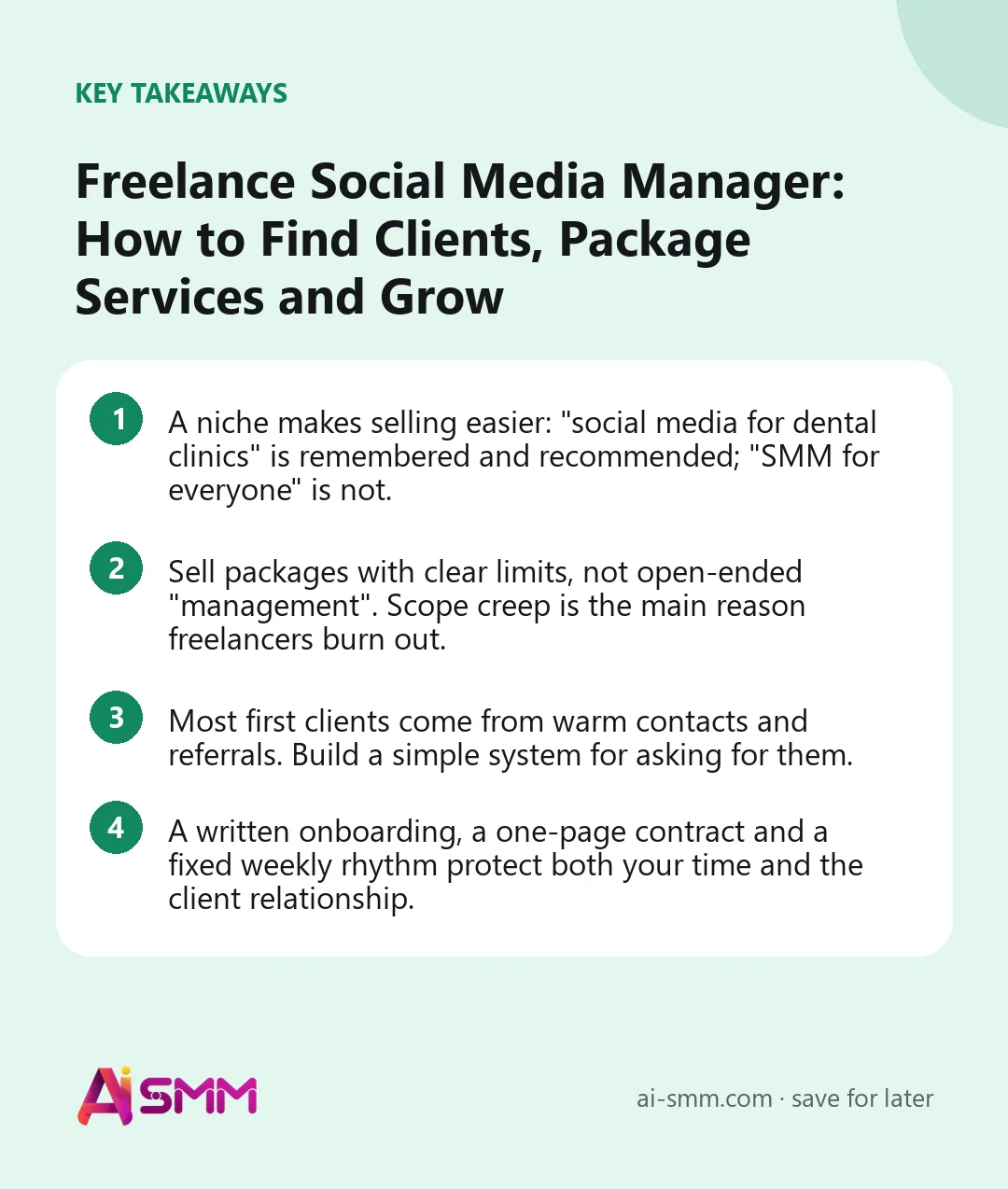
- A niche makes selling easier: “social media for dental clinics” is remembered and recommended; “SMM for everyone” is not.
- Sell packages with clear limits, not open-ended “management”. Scope creep is the main reason freelancers burn out.
- Most first clients come from warm contacts and referrals. Build a simple system for asking for them.
- A written onboarding, a one-page contract and a fixed weekly rhythm protect both your time and the client relationship.
What a freelance social media manager sells
Clients rarely buy “posts”. They buy a result they cannot get alone: a steady flow of enquiries, a page that looks alive, someone who answers customers quickly, or simply one less thing on the owner’s mind. Your offer should name that result and then list the work that leads to it.
Typical freelance services fall into four groups:
- Ongoing management. Content plan, production, publishing, community management and a monthly report.
- Content only. You produce posts and videos; the client or their team publishes and answers.
- One-off projects. Account audit, strategy, style guide, profile redesign, launch campaign, setting up chat automations.
- Consulting and training. Sessions with an owner or in-house employee who does the work themselves.
Most freelancers combine one ongoing service with one or two projects that act as an entry point. An audit, for example, is an easy first purchase that often turns into a retainer.
Choose a niche you can explain in one sentence
A niche can be an industry (beauty, restaurants, real estate, online education), a network (LinkedIn for consultants, Telegram channels for experts) or a type of work (short video, community management). The narrower it is, the faster you learn the typical problems, the easier it is to reuse templates and the more referrals you get, because clients in one industry talk to each other.
How to choose:
- List industries where you already have contacts or personal experience.
- Check that businesses there actually pay for social media and have a reason to be online (bookings, orders, trust).
- Look at how their accounts are run now. If most look abandoned, there is demand.
- Test with two or three clients before rewriting your whole profile around the niche.
A niche is not a prison. You can take other work; you just do not advertise it.
Package your services
Packages make the decision simple for the client and protect you from “can you also quickly do…”. Each package should state networks, number of posts by format, community management hours, revision rounds and reporting. Here is an example structure; the content is illustrative, adapt it to your niche.
| Start | Growth | Full care | |
|---|---|---|---|
| Networks | 1 | 2 | Up to 3 |
| Feed posts / carousels per month | 8 | 12 | 16 |
| Short videos per month | 2 | 4 | 8 |
| Stories | Weekly set | 3 days a week | Daily |
| Comments and DMs | Not included | Weekdays, once a day | Weekdays, twice a day |
| Report | Short monthly summary | Monthly report | Monthly report and a call |
| Revision rounds per post | 1 | 2 | 2 |
For how to put numbers on each package, see our guide on how to price social media services. For turning packages into a document the client can sign, use the social media proposal template.
Where a freelance social media manager finds clients
There is no single best channel; what matters is doing one or two consistently. Here is how the common ones compare.
| Channel | How it works | Best for | Effort |
|---|---|---|---|
| Warm contacts | Tell people you know what you do and who you help | First two or three clients | Low |
| Referrals | Ask happy clients to introduce you, make it easy | Steady flow after the first results | Low |
| Your own content | Case studies, breakdowns and tips in your professional account | Long-term inbound leads | Medium, ongoing |
| Direct outreach | Personal messages to businesses in your niche with a specific observation | Filling the pipeline quickly | High |
| Freelance marketplaces | Apply to posted projects | Early experience and reviews | Medium, price pressure |
| Partnerships | Web designers, photographers, accountants who serve the same clients | Warm introductions | Low to medium |
How to do outreach without being spam
Outreach works when the message is about the business, not about you. Look at the account first and lead with one specific observation: “Your Reels about the new menu get far more views than the photo posts, but the last one was a month ago.” Offer something small and concrete, such as a free five-minute audit video or three post ideas. Send a few thoughtful messages a day rather than dozens of copies, stay inside each network’s limits and never keep writing to someone who said no.
Make referrals a habit
After a good month, when the client is pleased with a result, ask directly: “Do you know another business owner who struggles with their social media?” Offer a simple thank-you, such as a discount on the next month for both sides. Most referrals are lost simply because nobody asked.
Onboarding: the first two weeks with a new client
A clear start prevents most later conflicts. Use a checklist and send it to the client the day they say yes.
- Signed agreement and first payment received.
- Access to accounts through the network’s own team or partner features where possible, not a shared password.
- Brand materials: logo, colours, fonts, photos, product list, prices, frequently asked questions.
- A short brief: audience, goals, tone of voice, topics to avoid, competitors.
- Who approves posts, how and within what time.
- Where leads from comments and DMs should go: phone, CRM, messenger, a specific person.
- A “before” snapshot of every account for future reports.
- A first content plan agreed before anything is published.
Write a one-page style guide during onboarding. It saves hours of revisions later and makes it possible to hand work to an assistant when you grow.
Contracts, payments and boundaries
You do not need a long legal document, but you need something in writing. A one-page agreement should cover the scope (link to the package), price and payment date, prepayment rules, the minimum term and notice period, revision limits, the approval deadline and what happens if it is missed, who owns the content, and what is excluded (ad budget, shoots, influencer fees).
Three rules that save freelancers a lot of stress:
- Work on prepayment. Monthly management is usually paid at the start of the month. It is normal practice and filters out difficult clients.
- Set working hours for messages. “I answer on weekdays from 10:00 to 18:00; urgent issues with published content, any time.” Put it in the agreement.
- Price extra work before doing it. “Sure, an extra promo video is X, I can have it by Thursday.” Saying the price out loud stops most scope creep on its own.
Tax and legal registration depends on your country; check the rules for self-employed people where you live before your first invoice.
A weekly rhythm that scales
Freelancers get overwhelmed when every client runs on a different schedule. A shared rhythm across all clients keeps the load predictable.
| Day | Focus |
|---|---|
| Monday | Review last week’s numbers, plan the week, send the week’s posts for approval |
| Tuesday–Wednesday | Content production in batches, one client at a time |
| Thursday | Short video editing, scheduling, admin and invoices |
| Friday | Your own marketing, outreach, learning, buffer for the unexpected |
| Every day | Two fixed windows for comments and DMs across all clients |
A more detailed version with morning and afternoon blocks is in our social media manager daily routine.
How to grow beyond yourself
At some point your calendar is full and the only way to earn more is to raise prices or add people. Both are fine; the order usually is: raise prices for new clients first, then bring in a part-time assistant for community management or design, then a second content maker. Before hiring, make sure your process is written down: the style guide, the onboarding checklist, the approval rules and the report template. Without them, a new person copies your habits rather than your standards.
Running several clients in AI SMM
For a freelancer, the most expensive thing is switching: another login, another spreadsheet, another chat where the client sends edits. In AI SMM each client is a separate project with its own channels, brand voice and calendar, and team roles decide who can publish or only draft for each client, which matters once an assistant joins. The calendar shows every client’s posts, and clients approve posts in Telegram without logging in; if a post is rejected, it stays a draft and you see the rejection. Comments and messages come to one inbox, and monthly analytics reports with AI conclusions save the evening you would spend assembling screenshots.
For your own client search, the assistant in your browser helps find prospects on LinkedIn and Instagram and drafts comments that are posted only after you approve them, within each network’s limits. The Agency plan covers 10 companies and 40 social accounts. And if some clients prefer to own their tool, the partner program pays 45% of their payments for six months, and they get 10% off their first payment. More on the multi-client setup is on the agency and freelancer page.
FAQ
How many clients can one freelance social media manager handle?
It depends on the package. With full management including community management, many freelancers find four to six clients the comfortable limit; with content-only packages, more. Track your hours per client for two months and you will see your real capacity.
Should I work with clients outside my niche?
You can, especially early on. Just do not let side work fill your calendar so much that you have no time to build expertise and case studies in the niche you want to be known for.
What if a client does not approve posts on time?
Agree a deadline in the contract, for example 48 hours, and what happens after it: either the post goes out as planned or it moves to the next free slot. Making approval easy, such as one tap in a messenger, solves most delays before they start.
Do I need a website as a freelancer?
Not at the start. A professional social profile, a link in bio with your services and a short portfolio are enough. A website becomes useful when you want search traffic or a more formal presence for larger clients.
Freelancing gets easier once the business side runs on a system. See how the AI SMM multi-client workspace keeps projects, approvals and reports in one place.
Posts, chats, video and sales in one workspace. 7 days free.
Start free