
 AI SMM team
A social media proposal template gives freelancers and agencies a repeatable way to turn a promising discovery call into a signed client: it shows that you understood the business, explains what you will do and what it will cost, and makes saying yes easy. Most proposals that lose are not too expensive; they are too generic, a list of services and a price with nothing that proves you listened. Below is a ten-section template you can copy, the questions to ask before you write it, three pricing models and the mistakes that quietly kill deals.
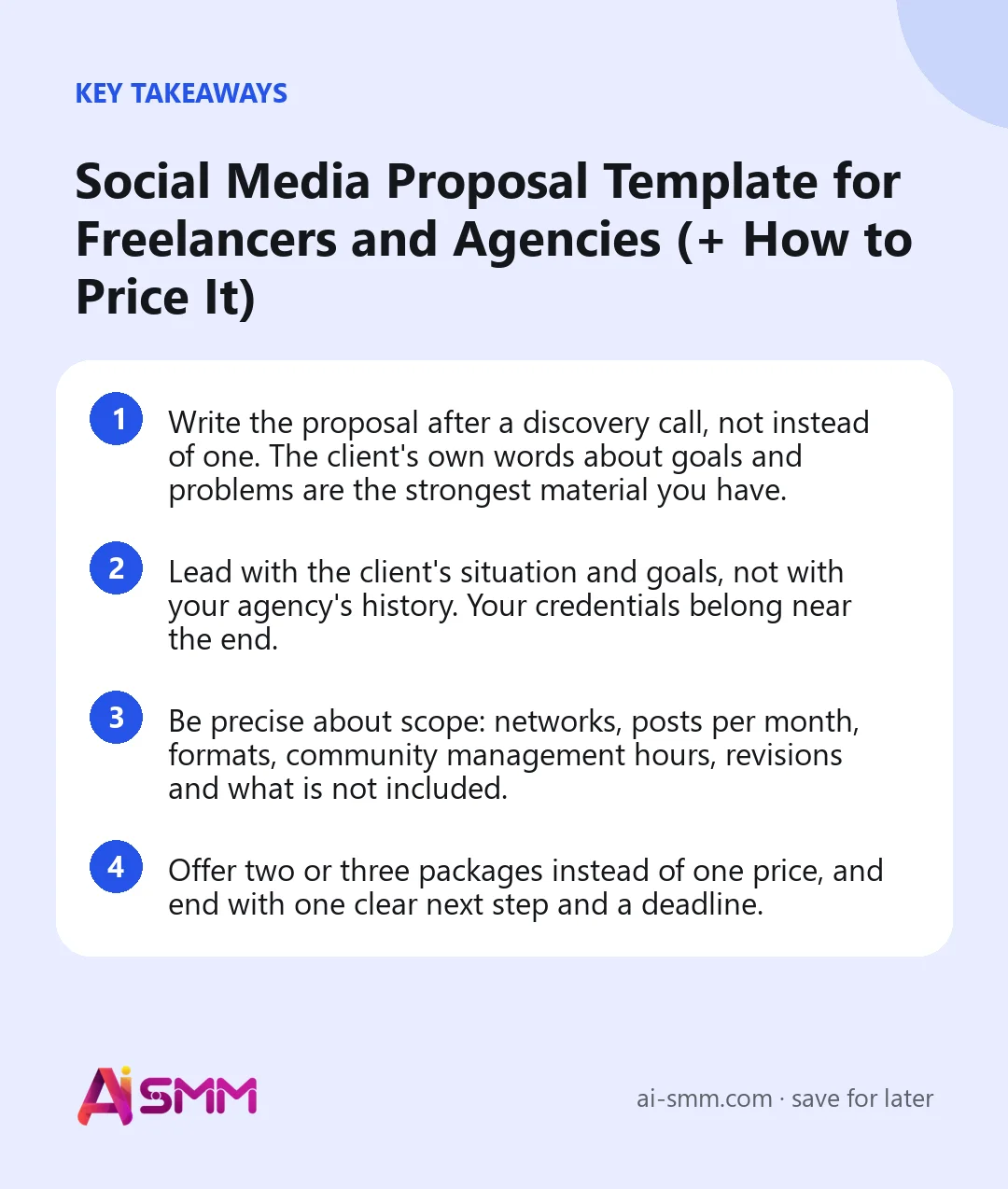
- Write the proposal after a discovery call, not instead of one. The client’s own words about goals and problems are the strongest material you have.
- Lead with the client’s situation and goals, not with your agency’s history. Your credentials belong near the end.
- Be precise about scope: networks, posts per month, formats, community management hours, revisions and what is not included.
- Offer two or three packages instead of one price, and end with one clear next step and a deadline.
What is a social media proposal?
A social media proposal is a document you send a prospective client after the first conversation. It sets out what you learned about their business, what you recommend, exactly what you will deliver, how success will be measured, the timeline and the price. For a freelancer it may be four pages; for an agency pitching a larger account, ten or more.
It is different from a contract. The proposal sells the plan; the contract, signed after, fixes the legal terms. Many freelancers combine them with a short “terms” section and an acceptance line, which is fine for smaller projects, but keep the proposal readable. A client should understand what they are buying in five minutes.
Before you write: the discovery call questions
A proposal is only as good as the call before it. Ask these questions and write down the answers in the client’s own words:
- What made you look for help with social media now?
- What does a good result look like in six months: more bookings, more messages, more store visits, a stronger reputation?
- Who are your best customers, and where do they come from today?
- Which networks are you on, and who posts now? What happens to comments and DMs?
- What has worked before, and what has not? Have you worked with an agency or freelancer before, and why did it end?
- Who approves posts, and how fast can they usually respond?
- What materials exist: photos, videos, brand guidelines, product information?
- What budget range have you planned for this?
The last question feels awkward, but skipping it leads to proposals that are either far above what the client can pay or so cautious that you underprice your work.
Social media proposal template: 10 sections
The table gives the structure at a glance. Below it, each section is explained with what to write.
| # | Section | Purpose | Length |
|---|---|---|---|
| 1 | Cover and summary | The whole proposal in five sentences | Half a page |
| 2 | Where you are now | Prove you understood the situation | Half a page to a page |
| 3 | Goals and KPIs | Agree what success means | A short table |
| 4 | Strategy and approach | How you will reach the goals | One page |
| 5 | Scope and deliverables | Exactly what the client gets | A table |
| 6 | Workflow and approvals | How you work together week to week | Half a page |
| 7 | Timeline | The first 90 days | A short list |
| 8 | Reporting | What they see and when | A few lines |
| 9 | Packages and pricing | Options, price, terms | A table |
| 10 | About us and next steps | Credentials and how to start | Half a page |
1. Cover and summary
Client name, your name, date and a proposal validity date. Then an executive summary in five sentences: their goal, the main problem you found, what you recommend, the expected outcome and the investment. Busy owners often read only this part, so it has to stand on its own.
2. Where you are now
A short audit of their current accounts: which networks, how often they post, what gets engagement, what is missing, how quickly comments and messages get answered, and one or two competitors for comparison. Use real observations, not insults. “Your Reels get three times the reach of your photo posts, but you publish one a month” is useful; “your feed looks outdated” is not.
3. Goals and KPIs
Translate the client’s words into two to four measurable goals. Tie each to a metric and a realistic direction, not an invented promise.
| Business goal | What we measure | How often |
|---|---|---|
| More bookings from social | Messages and booking link clicks from social profiles | Monthly |
| Grow a local audience | Followers from the city, reach of local posts | Monthly |
| Faster customer service | Average reply time to comments and DMs | Weekly |
| Better content engagement | Saves, shares and comments per post | Monthly |
Avoid promising follower counts or sales figures you do not control. Promise the work and the measurement; describe the results you aim for as targets.
4. Strategy and approach
Which networks you will focus on and why, the content pillars, the posting frequency, the mix of formats and how you will handle community management. Keep it specific to this client: “Two Reels a week showing before/after transformations, because that is what already works for you” beats a paragraph about “engaging, high-quality content”.
5. Scope and deliverables
This is where most disputes start later, so be precise:
- Networks and accounts included.
- Number of posts per month by format (feed, carousel, Reels, Stories, text posts).
- Who provides photos and videos, and how many shoot days, if any, are included.
- Community management: hours per week, response time, which channels.
- Number of revision rounds per post.
- What is not included: paid ads budget, influencer fees, website changes, printing.
6. Workflow and approvals
Explain the weekly rhythm: when the content plan is sent, how the client approves posts, how long they have to respond and what happens if they do not. Clients who have been burned before care about this more than about any creative idea.
7. Timeline
Describe the first 90 days: week one onboarding and access, weeks two to three style guide and first content plan, month one publishing starts, end of month three first quarterly review. A visible plan makes the start feel less risky.
8. Reporting
What the monthly report contains, when it arrives and whether there is a call to discuss it. Promise a short report with conclusions and next steps, not a dump of numbers.
9. Packages and pricing
Offer two or three packages with clear differences in scope. List what is in each, the monthly price, the minimum term, payment terms and what extra work costs.
10. About us and next steps
A short paragraph about you, one or two relevant examples of work, and the exact next step: “Reply to confirm the package, and we will send the agreement and an onboarding form. This proposal is valid until [date].”
How to price social media services
There is no single market rate; prices depend on the country, the niche and your experience. What matters in the proposal is that the model is clear and the client can compare options.
| Model | How it works | Good for | Watch out for |
|---|---|---|---|
| Monthly retainer | Fixed monthly fee for a defined scope | Ongoing management | Scope creep if deliverables are vague |
| Packages (tiers) | Two or three bundles at different prices | Letting clients choose their level | Too many options slow the decision |
| Per project | One price for a defined result | Audits, launches, strategy, style guides | Clear end point and deliverables |
| Hourly | Paid for time spent | Consulting, irregular tasks | Clients focus on hours, not value |
A simple way to set your own price: estimate hours per month for each deliverable (planning, writing, design, publishing, community management, reporting), multiply by your target hourly rate, then add a margin for revisions and communication. Round the result into packages rather than showing the calculation.
Mistakes that lose the deal
- Starting with yourself. Two pages about your agency before a word about the client’s business signals that the proposal is a template.
- Vague scope. “Social media management” without numbers invites disappointment on both sides.
- Promises you cannot control. “10,000 followers in three months” sounds good until month three.
- One price, take it or leave it. Without options, the client’s only choices are yes or no.
- No next step or deadline. Proposals without a clear action tend to sit in inboxes for weeks.
- Sending and waiting. Book a short call to walk through the proposal; questions answered live close more deals than a PDF alone.
Following up after sending
Send the proposal within two working days of the call, while the conversation is fresh. If you hear nothing, follow up after three to five days with something useful rather than “just checking in”: a quick idea for their next campaign or an answer to a question they raised. A second follow-up a week later, with a reminder of the validity date, is usually enough; after that, move on politely and leave the door open.
Delivering what you promised with AI SMM
A good proposal is easier to write when the delivery side is already organised. On the agency setup each client lives in a separate project with its own channels, team roles limit who can touch which client, and clients approve posts in Telegram without logging in, which is a strong point to include in the “workflow and approvals” section. The calendar shows drafts, approvals and campaigns for every account in one place.
For the audit and reporting sections, analytics compares networks side by side and includes a Competitors tab, and monthly client reports come with AI conclusions. If the client has long videos or podcasts, video clipping turns them into shorts, a deliverable that is easy to add to a higher package. The Agency plan covers 10 companies and 40 social accounts with a team of up to 15 people.
FAQ
How long should a social media proposal be?
Long enough to cover the ten sections, short enough to read in ten minutes. For a small business client that is usually four to eight pages. The summary on the first page should work even if nothing else is read.
Should I include the price in the proposal?
Yes. Hiding the price until a second call frustrates owners who want to decide. Showing two or three packages lets them choose instead of judging one number.
Can I send the same proposal to every client?
Reuse the structure, the pricing table and the “about us” section, but rewrite the summary, the audit, the goals and the strategy for every client. Those parts show you listened.
Should I do free work, like sample posts, in a proposal?
A small sample, such as three post ideas or one hook rewrite, can show your thinking. A full free content plan usually devalues your work. Keep samples small and specific to the client.
Win the client with a clear proposal, then keep them with smooth delivery. See how the AI SMM agency workspace handles projects, approvals and reports.
Posts, chats, video and sales in one workspace. 7 days free.
Start free