

 AI SMM team
Knowing how to price social media services is the skill that decides whether freelancing feels like a business or like an underpaid job. Most specialists start by copying a number they saw in a forum, then discover three months later that a “cheap” client takes twenty hours a week. There is no universal market rate: prices depend on your country, niche, experience and what exactly is included. What you can do is choose a pricing model that fits the service, calculate your price from real hours and costs, and present it as packages a client can compare. This guide walks through all three.
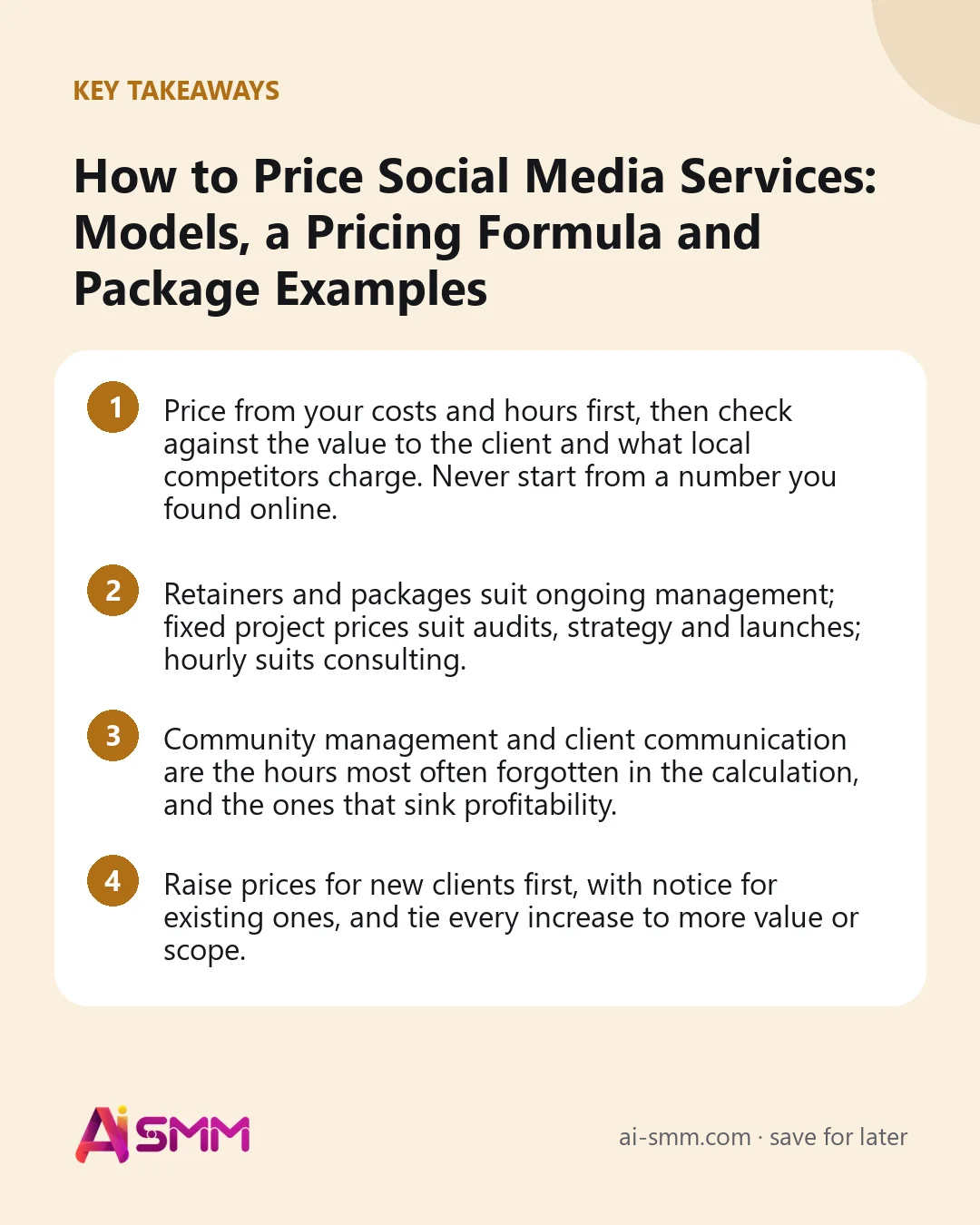
- Price from your costs and hours first, then check against the value to the client and what local competitors charge. Never start from a number you found online.
- Retainers and packages suit ongoing management; fixed project prices suit audits, strategy and launches; hourly suits consulting.
- Community management and client communication are the hours most often forgotten in the calculation, and the ones that sink profitability.
- Raise prices for new clients first, with notice for existing ones, and tie every increase to more value or scope.
Why “what is the market rate?” is the wrong first question
Ask ten specialists what social media management costs and you will get ten answers that differ several times over. They are all right for their situation: one works with local cafés in a small city, another with software companies, a third includes video production, a fourth only schedules posts. Published “average rates” mix all of these together and are rarely comparable to your offer.
A more useful order is: first know your floor (the price below which you lose money), then estimate the value for this client, then look at what similar specialists in your market and niche charge. Your price sits somewhere between the floor and the value, and competitors tell you where in that range you can realistically land.
7 pricing models compared
| Model | How it works | Best for | Risk |
|---|---|---|---|
| Hourly | Client pays for time spent | Consulting, training, irregular tasks | Income capped by hours; clients watch the clock |
| Monthly retainer | Fixed monthly fee for a defined scope | Ongoing management | Scope creep if the scope is vague |
| Tiered packages | Two or three retainers with different scope | Letting the client choose a level | Too many tiers slow the decision |
| Per deliverable | Price per post, video or carousel | Content-only work, top-ups to a package | Planning and communication hours stay unpaid |
| Fixed project | One price for a defined result | Audit, strategy, style guide, launch, automation setup | Underestimating hours; needs a clear end |
| Performance bonus | Base fee plus a bonus tied to an agreed metric | Clients with clear tracking (bookings, leads) | Results depend on things you do not control |
| Value-based | Price tied to the value of the outcome for the client | Experienced specialists, larger clients | Hard to justify without case studies |
For most freelancers the practical combination is packages for ongoing work, fixed prices for projects and an hourly rate for everything outside the scope. Performance bonuses can work, but always on top of a base fee that covers your costs, and only on metrics you can both see.
How to price social media services: a 5-step formula
Step 1. Set your target hourly rate
Start with what you need to earn per month (personal income, taxes, savings, time off), add your business costs (software, equipment, courses, accounting), and divide by the hours you can actually bill. Billable hours are fewer than working hours: sales, admin, learning and your own marketing take a large share of a freelancer’s week. Many plan for billable time to be around half to two thirds of their working time; track yours for a month to know your own figure.
Formula: target hourly rate = (desired monthly income + taxes + business costs) ÷ billable hours per month.
Step 2. List every task in the scope
Break the service into tasks and estimate hours per month for each. Be honest; the first estimate is almost always too low.
- Planning: content plan, calendar, briefs.
- Writing: captions, hooks, replies to briefs.
- Design: carousels, covers, story templates.
- Video: planning, filming or sourcing, editing, subtitles.
- Publishing: scheduling, checking, fixing.
- Community management: comments, messages, passing leads.
- Reporting: collecting numbers, writing conclusions.
- Communication: approvals, calls, revisions, messages.
Step 3. Multiply and add a buffer
Multiply hours by your target rate and add 10–20% for revisions, unexpected requests and the time new clients always need in the first months.
Step 4. Add direct costs
Software, stock content, freelancers you subcontract (designers, videographers) and any paid tools used only for this client. You can include them in the package price or bill them separately; either way, do not absorb them silently.
Step 5. Round into packages and check against value
Round the result into clean numbers and compare with the value to the client. If one extra booking a week covers your monthly fee several times over, the price is easy to justify. If your price is higher than anything the client could plausibly gain, rethink the scope rather than just cutting the price.
A worked example
The figures below are illustrative, not market data: they show the method, and your own rate and hours will differ. Say a freelancer sets a target rate of €30 per hour and prices a “Growth” package for one local business on two networks.
| Task | Hours per month |
|---|---|
| Planning and briefs | 3 |
| Writing 12 posts and stories text | 6 |
| Design: carousels and covers | 6 |
| 4 short videos: planning and editing | 8 |
| Scheduling and checks | 1 |
| Comments and messages (weekdays) | 8 |
| Monthly report | 2 |
| Approvals, calls, revisions | 3 |
| Total | 37 |
37 hours × €30 = €1,110. With a 15% buffer that is about €1,275, which the freelancer rounds to €1,300 per month. Note how community management and communication together are 11 of the 37 hours; leave them out and the package quietly loses almost a third of its value.
Illustrative package ladder
Here is how the same method produces a set of packages. Hours are rough estimates for a single local business; prices use the same illustrative €30 rate plus buffer. They are examples of structure, not recommended prices.
| Package | Scope | Approx. hours / month | Illustrative price at €30/h |
|---|---|---|---|
| Content only | 1 network, 8 posts, 2 short videos, no replies | 15–20 | €520–690 |
| Growth | 2 networks, 12 posts, 4 videos, weekday replies, report | 35–40 | €1,200–1,380 |
| Full care | Up to 3 networks, 16 posts, 8 videos, replies twice a day, report and call | 55–65 | €1,900–2,250 |
One-off projects are priced the same way. An account audit might take 4–8 hours, a strategy with content pillars 10–20, a style guide 6–12 and setting up chat automations 5–15, depending on complexity. Multiply by your rate and state exactly what the client receives at the end.
Add-ons and extras
Add-ons let clients grow the scope without renegotiating the whole package, and they stop “small favours” from becoming unpaid work.
- Extra short video or carousel.
- An additional network.
- Weekend community management.
- A photo or video shoot day.
- Giveaway or contest setup.
- Chat automation or a quiz funnel.
- Repurposing a long video or podcast into shorts.
- Rush delivery (less than 48 hours).
Keep an add-on price list and share it at the start. Clients accept a known price much more easily than a surprise invoice.
Discounts, minimum terms and payment rules
- Minimum term. Social media results take time; a three-month minimum for management packages protects both sides from judging too early.
- Prepayment. Monthly fees are usually paid at the start of the month; projects often 50% upfront and 50% on delivery.
- Discounts for commitment, not for asking. A small discount for paying a quarter upfront is reasonable. A discount because the client “has a small budget” usually means reducing scope instead.
- Ad budgets are separate. Always separate your fee from money spent on ads, influencers or production.
How and when to raise your prices
Signals that it is time: your calendar is full, most prospects accept your proposal without negotiation, your case studies have improved, or your costs went up. Raise prices for new clients first; it is the lowest-risk test. For existing clients, give notice of one to two months, explain what they get (new formats, better reporting, faster replies) and consider keeping the old price for a longtime client in exchange for a longer commitment. Increases tied to more value are rarely questioned; increases without explanation often are.
Pricing mistakes to avoid
- Pricing per post only. It hides planning, replies and communication, which are real work.
- Unlimited revisions. One or two rounds per post, then extra time is billed.
- Including “a bit of everything”. Vague scope makes any price feel too high to the client and too low to you.
- Competing on price. There is always someone cheaper. Compete on niche, process and results.
- Forgetting software costs. Tools for several clients add up; include them in the package.
- Never revisiting prices. Review them at least once a year.
Where tools fit into your pricing
Your tools are part of your cost, and a good tool can also be the reason you can handle more clients at the same quality. In AI SMM, the Agency plan (€199 per month) covers 10 companies and 40 social accounts with a team of up to 15, which is roughly €20 per client if you run ten; the Start plan (€50) covers five accounts for someone just beginning. Each client has a separate project, clients approve posts in Telegram without logging in, and monthly analytics reports come with AI conclusions, which cuts the reporting and approval hours from the example above. The AI content studio drafts posts and images in each brand’s voice, and video clipping turns long recordings into shorts, a natural add-on for higher packages.
There is also another income line. If a client prefers to have their own AI SMM account, you can refer them: the partner program pays 45% of their payments for their first six months, and they get 10% off their first payment. Be open with the client that it is a partner link. See how the multi-client setup works on the agency page.
FAQ
Should I show my prices publicly?
A starting price (“packages from…”) on your profile or portfolio filters out clients who cannot afford you and saves time. Full packages work better in a proposal after a call, when you know the client’s needs; our social media proposal template shows how to present them.
Is hourly or monthly pricing better for social media management?
For ongoing management, a monthly retainer or packages is usually better: the client knows the budget, and you are rewarded for working efficiently. Hourly makes sense for consulting and irregular tasks.
How do I price if I am a beginner?
Use the same formula with a lower target rate, and limit the scope so you can deliver well. Raise the rate after every two or three successful projects. Very low prices often attract the most demanding clients, so do not go below your floor.
Should the client pay for my tools?
Either include tool costs in your package price or pass them through as a separate line. The one thing to avoid is paying for them yourself without accounting for it; with several clients the amount becomes significant.
Take your current packages and recalculate them with the five-step formula this week; most specialists find at least one package that is quietly unprofitable. If you want to cut the hours spent on approvals and reports, look at the AI SMM setup for agencies and freelancers.
Posts, chats, video and sales in one workspace. 7 days free.
Start free