
 AI SMM team
A social media marketing strategy is a short written plan that answers five questions: which business goal social media serves, who you are talking to, on which networks, with what content, and how you will know it works. Most small businesses skip the plan and go straight to posting, which is why a year later they have a feed full of posts and no idea whether any of them brought a customer. This guide walks through the nine steps we use to build a strategy that fits on one page and still tells you what to post on Tuesday.
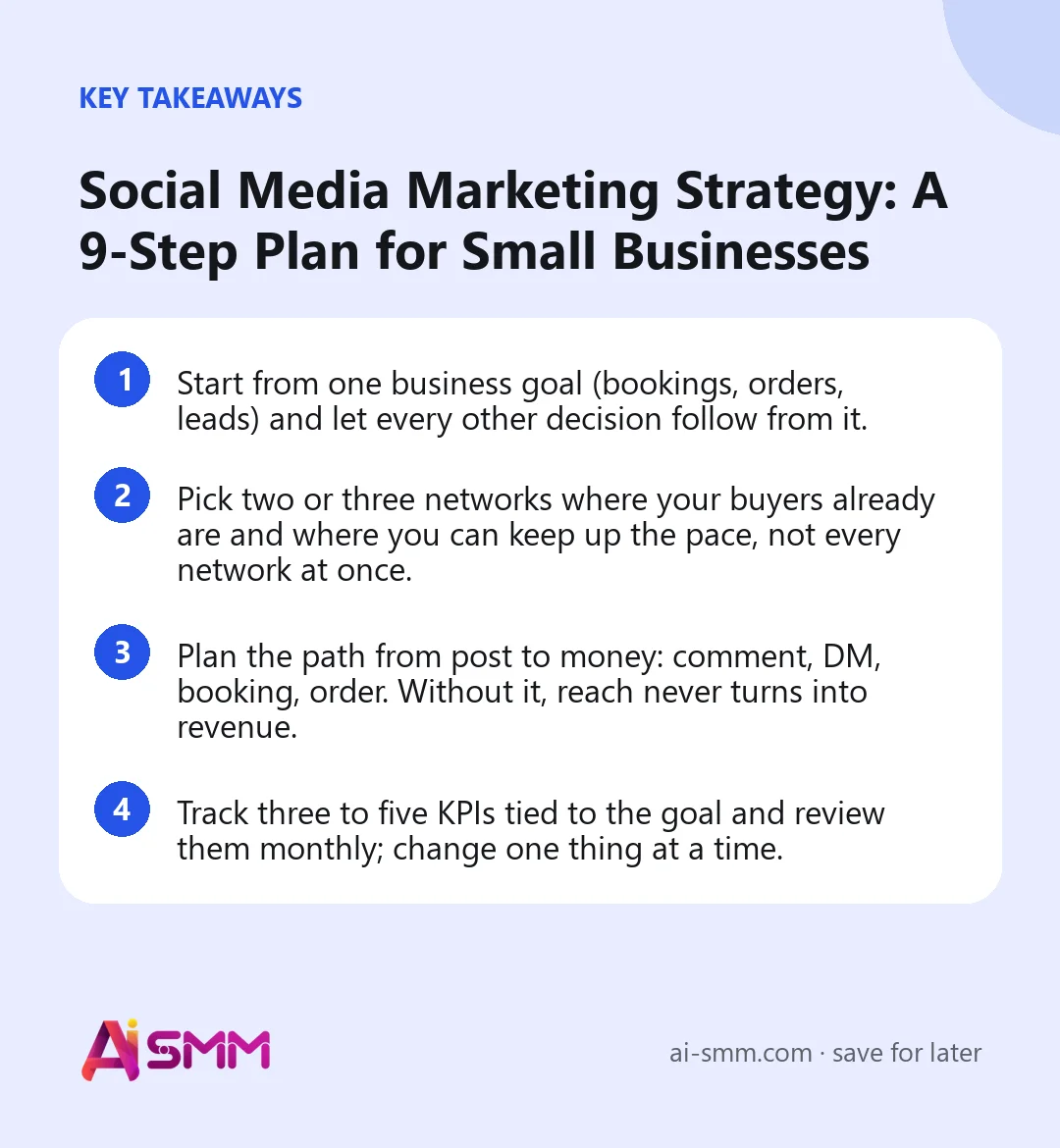
- Start from one business goal (bookings, orders, leads) and let every other decision follow from it.
- Pick two or three networks where your buyers already are and where you can keep up the pace, not every network at once.
- Plan the path from post to money: comment, DM, booking, order. Without it, reach never turns into revenue.
- Track three to five KPIs tied to the goal and review them monthly; change one thing at a time.
What a social media marketing strategy is (and what it is not)
People use “strategy”, “content plan” and “calendar” as if they meant the same thing. They are three different layers, and mixing them up is the reason many strategies are either too vague to act on or too detailed to survive a busy month.
| Layer | Answers | Changes how often | Example |
|---|---|---|---|
| Strategy | Why we are on social media, for whom, where, and how we measure it | Once or twice a year | “Instagram and Telegram bring 20–30 bookings a month from women 25–45 within 5 km” |
| Content plan | Which topics and formats we use to get there | Monthly | “Before/after on Mondays, a tip carousel on Wednesdays, a client story on Fridays” |
| Calendar | What exactly goes out, where and when | Weekly | “Tuesday 18:30, Reel about a lash lift, Instagram + TikTok” |
A strategy that fits on one page is better than a 30-slide deck nobody opens. The goal is a document you can reread in five minutes before planning each month.
How to build a social media marketing strategy in 9 steps
The steps below go in order on purpose: each one narrows the choices for the next. If you already have a working account, do not skip the audit in step 3; it saves you from repeating what has already failed.
Step 1. Tie social media to one business goal
“Grow on Instagram” is not a goal, it is a wish. A goal is something the business would notice in its bank account or its booking diary. Choose one primary goal for the next three to six months and, at most, one secondary goal.
| Business goal | What social media does for it | Main KPI |
|---|---|---|
| More bookings for a service | Shows results, answers questions, sends people to booking | Bookings from social per month |
| More online orders | Shows products in use, handles objections in DMs | Orders and revenue from social |
| Leads for a B2B or expert service | Builds trust through expertise, starts conversations | Qualified leads per month |
| Awareness in a new area or niche | Gets the brand in front of new people often | Reach among new audiences, follower growth |
| Retention and repeat purchases | Keeps existing clients engaged and informed | Repeat purchases, channel subscribers |
| Lighter support load | Answers common questions publicly and in chats | Response time, share of questions answered automatically |
Write the goal as a sentence with a number and a deadline: “By March, social media brings 25 bookings a month, up from about 10 now.” The number can be rough; what matters is that you can check it.
Step 2. Describe the customer who actually buys
The most common mistake is writing for “everyone who might be interested”. Look at your last 20–30 paying customers instead and write down what they have in common. Four lines are enough:
- Who they are: age range, location, situation (“new mothers within 10 minutes’ drive”, “owners of online shops with 1–5 staff”).
- What problem brings them to you, in their words, not yours.
- What stops them from buying: price doubts, fear of a bad result, not knowing how the process works.
- Where they spend time: which networks and messengers they actually open every day.
If you sell to two very different groups, pick the one that brings more money for the first months. You can add the second later with its own content pillar.
Step 3. Audit where you stand today
Spend half an hour looking at what you already have before planning anything new. You are looking for three things: what works, what is dead weight, and where people get lost on the way to buying.
- List every account you own, including forgotten ones, and note the last post date.
- For each active account, find the five best and five worst posts of the last three months. What do the best ones have in common: format, topic, time?
- Count how many DMs and comments came in last month and how many got an answer within a few hours.
- Check the bio link: does it lead somewhere a person can book, order or ask a question in two taps?
- Look at two or three competitors: which formats and topics get them the most comments?
Step 4. Choose networks by buyers and capacity, not by trend
Every network you add costs time every week. For most small businesses, two or three networks done well beat seven done badly. Choose by two filters: are your buyers there, and can you produce what that network rewards?
| Network | Good fit for | What it rewards | Weekly effort |
|---|---|---|---|
| Local services, beauty, food, visual products | Reels, carousels, Stories, fast DM replies | Medium–high | |
| TikTok | Products with a “wow” moment, younger audiences, experts who can talk to camera | Frequent short videos with a strong first second | High |
| Telegram | Experts, communities, Russian-speaking audiences, repeat buyers | Useful, regular channel posts; bots for orders and questions | Low–medium |
| B2B services, consultants, hiring | Personal posts with a point of view, comments on others’ posts | Medium | |
| YouTube | Education, reviews, anything people search for | Longer videos plus Shorts cut from them | High (lower if you already film) |
| Local communities, older audiences, events | Community posts, video, Messenger replies | Low–medium | |
| Home, wedding, food, fashion, DIY | Evergreen pins that lead to a page | Low | |
| Threads | Brands with a conversational voice | Short text, replies, discussions | Low |
Give each chosen network a job. For example: Instagram attracts and converts, Telegram keeps existing clients warm, YouTube gives depth that later becomes short clips. When a network has no job, it is a candidate for cutting.
Step 5. Define three to five content pillars and the mix
Content pillars are the recurring topics you will talk about. They stop the “what do I post today” panic and keep the feed from turning into an endless sale. A simple structure that works for most small businesses:
- Proof: results, before/after, reviews, case stories.
- Expertise: tips, mistakes to avoid, how to choose.
- Behind the scenes: the team, the process, how things are made.
- Offer: products, services, promotions, free slots.
- Community: questions to the audience, client content, local news.
A mix of roughly 70–80% useful or relationship content and 20–30% direct offers is a reasonable starting point. Adjust it by what your audience responds to, not by a rule.
Step 6. Plan the path from post to money
This is the step most strategies miss. A post can be seen by thousands of people, but a sale happens only when someone takes the next step. Map that path for each network and remove friction from it.
- See: the post or video reaches someone new.
- React: they comment, save, or tap the profile.
- Talk: they write a DM, or a keyword in the comments triggers an automatic message.
- Act: they book a slot, place an order or leave contact details.
- Return: they join a channel, newsletter or loyalty flow and buy again.
Practical fixes that usually pay off quickly: answer DMs within an hour during working time, add a clear call to action to each offer post (“write LASH in the comments and we’ll send free slots”), and make sure the bio link opens a page with booking, a catalog or a contact form rather than a generic homepage.
Step 7. Set a cadence you can keep for a year
Consistency beats volume. Three good posts a week for twelve months will do more than daily posting for three weeks followed by silence. Decide on a minimum pace per network and build a production routine around it: one planning session a month, one batch-creation session a week, and short daily windows for replies.
A trick that saves hours: create one “anchor” piece a week (a video, a long post, a live session) and cut it into smaller pieces for each network. A ten-minute video can become three short clips, a carousel and a channel post.
Step 8. Pick three to five KPIs and a review rhythm
Measure what connects to the goal from step 1. A typical set for a service business:
- Reach among non-followers (are new people seeing us?)
- Engagement rate by reach (do they care?)
- Number of DMs and comment conversations started (do they talk to us?)
- Bookings or orders from social (does it make money?)
- Median response time in chats (do we lose people by being slow?)
Look at the numbers weekly for anomalies and monthly for decisions. At the monthly review, answer three questions: what worked, what did not, and which one thing we change next month.
Step 9. Budget time and money honestly
A strategy that needs 20 hours a week from an owner who has four will fail by week three. Put real numbers against the plan.
| Task | Without tools | With planning, AI drafts and automation |
|---|---|---|
| Monthly planning | 3–4 hours | about 1 hour |
| Writing and designing posts (12–15 a month) | 6–10 hours | 2–4 hours of review and edits |
| Short videos | 4–8 hours | 1–3 hours if cut from one long video |
| Replies to comments and DMs | 30–60 min a day | 15–30 min a day with drafts and auto-replies to FAQs |
| Monthly review | 1–2 hours | 20–30 minutes |
These are ranges from our experience with small teams, not guarantees. Add paid promotion only after organic content shows which posts people respond to; boosting a post nobody engages with just buys more indifference.
A one-page strategy template
Copy this into a document and fill it in. If a line takes more than two sentences, it is probably too vague.
- Goal: [number] [bookings / orders / leads] a month from social media by [date].
- Buyer: who, what problem, what stops them, where they spend time.
- Networks and their jobs: [network] to attract, [network] to convert, [network] to retain.
- Pillars: 3–5 recurring topics with a share for each.
- Path to money: post → comment/DM → booking/order page → channel or newsletter.
- Cadence: posts per week per network, one anchor piece a week.
- KPIs: 3–5 numbers with current baseline and target.
- Resources: who does what, hours per week, monthly budget.
- Review: date of the monthly review and what triggers a change of plan.
Worked example: a yoga studio’s strategy on one page
Say a small yoga studio with two instructors wants to fill its evening classes. Its one-page strategy might read like this.
Goal: 40 trial-class sign-ups a month from social media by the end of the quarter, up from about 15. Buyer: office workers aged 28–45 living or working nearby, with back pain or stress, who are afraid they are “not flexible enough”. Networks: Instagram to attract (Reels of short routines, carousels on posture), Telegram channel to retain (weekly schedule, short practices, member news), YouTube as the anchor (a 15-minute routine a week, cut into Shorts and Reels).
Path to money: every Reel ends with “comment TRIAL and we’ll send you the schedule”. The keyword starts an automatic DM with the timetable and a booking link; after the trial class, the person is invited to the Telegram channel. KPIs: reach among non-followers, number of TRIAL comments, trial bookings, trial-to-membership conversion. Resources: one instructor films on Monday, the owner reviews AI-drafted captions on Tuesday, replies twice a day.
Nothing in this plan is complicated. What makes it a strategy is that every piece points at the same number.
Common strategy mistakes
- No business goal, only follower targets. Followers are a means, not the result.
- Too many networks at once, each updated rarely and unevenly.
- Posting without a path: no call to action, no answer to DMs, a bio link to the homepage.
- Copy-pasting the same post everywhere instead of adapting format and length per network.
- Changing everything every month, so you never learn which change mattered.
- Measuring only what is easy (likes) and ignoring what is useful (conversations, bookings).
How to run this strategy in AI SMM
Most of the work in a strategy happens after the document is written, week after week. In AI SMM the pieces live in one place. The brand profile (tone, audience, words to avoid) is set once in the AI content studio, and the AI planner turns a monthly brief into a dated plan using 34 template categories. Posts for Instagram, TikTok, Telegram, LinkedIn, YouTube and other networks go into one calendar, where the owner or a client can approve them from Telegram.
The path to money is covered too: keyword comments on Instagram and Facebook can start an automatic DM through chat flows, conversations from supported networks, WhatsApp and your website chat land in one inbox, and people can book through online booking. For measurement, the Pulse analytics shows followers, reach, engagement and posts across 12 networks on one screen, with an AI hint on what changed. One honest limit: X and Telegram are not included in AI SMM analytics, so track those two in their own statistics. If you serve a local audience, the local business page shows how these parts fit a typical week.
FAQ
How long should a social media marketing strategy be?
One to two pages is enough for a small business. It should cover the goal, buyer, networks, content pillars, path to sales, cadence, KPIs and resources. Anything longer tends to go unread.
How often should I update my strategy?
Review results monthly and adjust the content plan, but change the strategy itself only once or twice a year, or when the business changes: a new service, a new audience, a new location.
How soon will a social media strategy show results?
Response-time and conversation improvements can show within weeks. Growth in reach and steady bookings from organic content usually takes two to four months of consistent posting. If nothing moves after three months, revisit the network choice and the path to money first.
Do I need paid ads in my strategy?
Not at the start. Use organic content to learn which posts and offers people respond to, then put a small budget behind the proven ones. Ads amplify what already works; they rarely fix what does not.
If you want the strategy to live somewhere other than a forgotten document, set up your first month in AI SMM’s planner and let the calendar keep you honest.
Posts, chats, video and sales in one workspace. 7 days free.
Start free