
 AI SMM team
A short-form video strategy is a plan for what vertical videos you publish, why, how often and how you judge them, so Reels, TikToks and Shorts bring enquiries instead of random views. Most small businesses skip the plan: they film whatever comes to mind, post it on one network, see 300 views and give up. Below is a simple system that fits into a few hours a week: one goal, three repeatable series, batch filming, a realistic cadence and a short review loop.
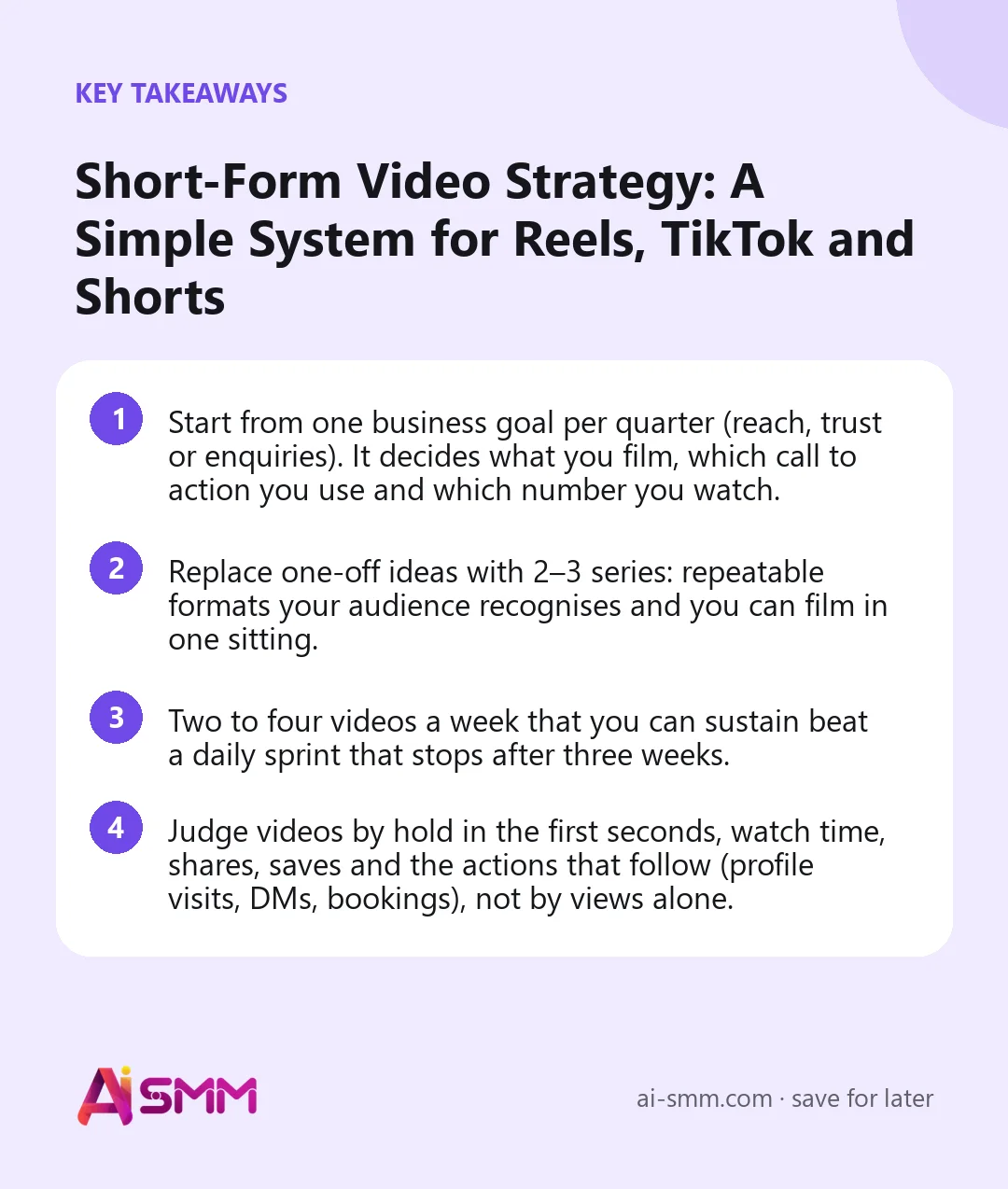
- Start from one business goal per quarter (reach, trust or enquiries). It decides what you film, which call to action you use and which number you watch.
- Replace one-off ideas with 2–3 series: repeatable formats your audience recognises and you can film in one sitting.
- Two to four videos a week that you can sustain beat a daily sprint that stops after three weeks.
- Judge videos by hold in the first seconds, watch time, shares, saves and the actions that follow (profile visits, DMs, bookings), not by views alone.
What a short-form video strategy is (and what it is not)
Short-form video is vertical video of up to a few minutes: Instagram Reels, TikTok, YouTube Shorts and Facebook Reels. A strategy for it answers five questions in writing:
- Why are we making videos this quarter: to be discovered, to be trusted or to get enquiries?
- Who exactly should watch: which customer, with which problem?
- What do we publish: which series and formats, with which hooks?
- How do we produce it: who films, when, with what, and how long it takes?
- How do we know it works: which numbers, reviewed how often, and what we change?
It is not a list of trending sounds, and it is not “post a Reel every day”. Trends can be one ingredient, but a business that relies only on them ends up with views from people who will never buy. The goal of a strategy is the opposite: fewer, more deliberate videos that the right people finish and act on.
Step 1. Pick one goal per quarter
Short videos can do three different jobs, and the same video rarely does all three well. Choose the main one for the next three months.
| Goal | What the videos look like | Call to action | Main signal to watch |
|---|---|---|---|
| Discovery (reach new people) | Broad, relatable problems, quick tips, satisfying process shots, local “did you know” | Follow for part 2, save this | Share of viewers who stay past the first seconds, shares, new followers |
| Trust (turn viewers into fans) | Behind the scenes, how you work, mistakes you fix, client results with permission, your opinions | Comment your question, watch the next episode | Average watch time, saves, comments, returning viewers |
| Enquiries (turn fans into clients) | Offers explained, “what’s included”, FAQs, objections answered, before/after, availability | Comment a keyword, DM us, book via the link in bio | Profile visits, link clicks, DMs, bookings and orders |
A new account usually needs discovery first; an account with a few thousand followers but no sales usually needs trust and enquiry content. Keep roughly two thirds of your videos on the main goal and the rest on the others, so the funnel does not dry up.
Step 2. Define the viewer in one sentence
Write a single sentence that anyone on the team can repeat: “Women 30–45 in our district who want low-maintenance hair and have no time for a salon every month.” Or: “Owners of small online shops who do their own bookkeeping and are scared of tax deadlines.”
This sentence filters ideas. “Top 5 hairstyles of 2026” is for everyone; “three cuts that still look good eight weeks later” is for your viewer. It also decides language and setting: a video filmed in your real studio, with your real accent and your real prices, will beat a polished but generic clip because it tells the viewer this is for them. If you have not done this work yet, the guide on defining a target audience is a good first step before filming.
Step 3. Build 2–3 repeatable series
The biggest time saver in short video is not an app, it is a series: a format with a fixed structure, a recognisable opening and a new topic each time. Viewers learn what to expect, you stop inventing from scratch and filming five episodes takes about as long as filming one.
| Series format | Structure | Example for a small business |
|---|---|---|
| Myth vs fact | State a myth, show why it is wrong, give the fix | A dental clinic: “Whitening ruins enamel? Here’s what actually happens” |
| One question, one answer | Read a real client question on screen, answer in under 40 seconds | An accountant: “Can I pay myself from the business account?” |
| Process from start to finish | Speeded-up process with 3–4 captions explaining key steps | A cake studio: a three-tier cake from bare sponge to delivery |
| Before / after | Show the problem, cut to the result, explain one thing that made the difference | A cleaning company: an oven after a year of use and after two hours |
| What X buys you | Show exactly what the client gets for a price | A café: what a €12 lunch set looks like today |
| Mistake of the week | A common mistake, the cost of it, the right way | A driving school: the parking mistake that fails most tests |
Pick two or three series that serve your goal and suit how comfortable you are on camera. Not everyone needs to talk: process and before/after series work with hands, products and on-screen text only. For more starting points, see the collection ofReels ideas by niche, which work just as well on TikTok and Shorts.
Step 4. Write the first two seconds first
In short video the opening decides whether anyone sees the rest. Plan it before you plan the middle. A good opening has three layers working together: something moving or a clear result in the first frame, a line of text on screen that states the promise, and a spoken first sentence without any greeting.
- Bad: “Hi everyone, welcome back, today I want to talk about…”
- Better: “This is why your gel polish chips on day four.” (with the chipped nail in close-up)
Keep a bank of openings per series so every episode starts strong. The article with 45 hook formulas gives ready templates you can adapt to each series.
Step 5. Set up a production routine you can keep
Most short-video plans fail on production, not ideas. A routine that works for a one- or two-person business:
- Monday, 20 minutes: plan. Pick 4–8 topics for the next two weeks from your series list and client questions. Write the opening line for each.
- One filming block of 60–90 minutes. Same place, same light, same outfit or several outfits. Film all the talking parts, then all the b-roll (hands, products, process, shopfront).
- Editing block. Rough cut, captions on screen, trim every pause. Aim for “nothing to cut” rather than a target length.
- Schedule everything at once for the next two weeks, with captions written for each network.
- Daily, 10 minutes: reply to comments and DMs from recent videos. This is where enquiries come from.
If you already record long material, such as webinars, lives, podcasts or client workshops, you have a second source of short videos. Cutting the best moments of a long recording can cover half of your weekly plan; the tutorial on turning a webinar into short clips shows how.
Step 6. Choose a cadence and where to publish
There is no magic number. In our experience, small businesses that keep going for months usually settle on 2–4 short videos a week, and consistency over twelve weeks matters more than the exact count. Start with what you can sustain for a quarter, then add one more video a week only if the routine feels easy.
The same vertical video can go to several networks, with small adjustments:
| Network | What tends to work | Adjust before posting |
|---|---|---|
| Instagram Reels | Local audience, visual results, people who already follow you | Caption with a clear CTA, cover frame that fits the grid, no other app’s watermark |
| TikTok | Discovery beyond your followers, faster pace, search-driven how-tos | Keywords in the on-screen text and caption, native sounds if they fit |
| YouTube Shorts | Evergreen how-tos and questions that people search for | A searchable title, a link to a related long video if you have one |
| Facebook Reels | Older and local audiences, community pages | A plainer caption, fewer niche slang words |
Export a clean file without on-screen watermarks from any single app and upload it natively to each network. Change the caption and the first line for each audience rather than pasting the same text everywhere.
Step 7. Connect videos to the next step
A video that gets views but gives the viewer nothing to do next is a missed enquiry. Give each goal its own path:
- Discovery videos: “follow for part 2” or “save this for later”. Do not push a sale on someone who met you ten seconds ago.
- Trust videos: invite a specific comment (“tell me your hair type and I’ll suggest a cut”), then answer every comment.
- Enquiry videos: a comment keyword that triggers a reply in DMs, a link in bio that leads straight to booking or the catalogue, or a clear “message us ‘price’ for the list”.
The fastest path is usually a DM: a viewer comments a word, gets a short message with the price list or a booking link, and can ask a question in the same thread. That conversation is where a view turns into a client.
Step 8. Review every two weeks and adjust
Views alone tell you little: they depend on luck, timing and the network’s mood that day. Look at a small set of signals, per video and per series.
| Signal | What it tells you | What to change if it is weak |
|---|---|---|
| Viewers still watching after the first seconds | Whether the opening works | Rewrite the first line and first frame; start later in the action |
| Average watch time / % watched | Whether the middle holds attention | Cut pauses, shorten, add a visual change every few seconds |
| Shares and saves | Whether the video is useful enough to keep or pass on | More specific advice, checklists on screen, a clear takeaway |
| Comments and DMs | Whether it starts conversations | Ask a concrete question; answer every comment quickly |
| Profile visits, link clicks, bookings | Whether it moves people to act | Stronger CTA, better link in bio, a keyword-to-DM flow |
Every two weeks, list your top three and bottom three videos. Ask what the winners share: a series, an opening type, a topic, a length. Make more of that and drop or rework the rest. After a quarter you will have a strategy built on your own data rather than someone else’s rules.
Common short-form video strategy mistakes
- Chasing trends that have nothing to do with your offer. A dance trend may bring views, but rarely clients. Use trends only when you can tie them to your viewer’s problem.
- Changing format every week. A series needs 6–10 episodes before you can judge it fairly.
- Long intros and logo animations. Every second before the promise costs viewers.
- No captions. Many people watch with the sound off; on-screen text and subtitles keep them.
- Posting and leaving. Comments in the first hours are both a ranking signal and your warmest leads.
- Measuring only views. A video with 800 views and five DMs beats one with 20,000 views and none.
Running your short-form video plan in AI SMM
If you record long videos, video clipping takes a link to a YouTube video, a webinar or a stream, finds the strongest moments and cuts them into vertical clips with subtitles, which you can restyle once to match your look. You choose a clipping template (educational, full repurpose, split screen or a faster TikTok style), review the clips and send the ones you like to the calendar. For videos made from scratch, the AI content studio writes captions in your brand voice and can generate a short video or a story from a product photo.
All clips then go into one calendar, where you plan two weeks of Reels, TikToks and Shorts at once and adjust the caption for each network. For enquiry videos, a chat flow can reply in DMs when someone comments a keyword under an Instagram or Facebook post. Every two weeks, open analytics to compare videos across Instagram, TikTok, YouTube and Facebook in one place.
FAQ
How long should short-form videos be for a business?
As long as the idea needs and not a second more. Most business videos land between 15 and 60 seconds; a quick tip can be 10 seconds, a clear explanation 60–90. All major networks accept longer vertical videos now, but a short video that people finish usually does better than a long one they leave halfway.
Should I post the same video on TikTok, Reels and Shorts?
Yes, as a rule, if you upload a clean file without another app’s watermark and adapt the caption to each network. Audiences overlap less than people think, so one good video can find different viewers on each network.
How many videos do I need before judging a strategy?
Give each series at least 6–10 episodes and the whole plan about a quarter. Single videos swing a lot; patterns across a series are what you can act on.
Do I need to show my face?
No. Process videos, hands-only tutorials, before/after and on-screen text formats work well for many businesses. A face does build trust faster, so if you are comfortable, add one talking series later.
A short-form video strategy is less about filming more and more about filming the right thing on a schedule you can keep. Plan your first two weeks of series in the AI SMM calendar and review what your viewers actually finish.
Posts, chats, video and sales in one workspace. 7 days free.
Start free