
 AI SMM team
Social media customer engagement is every two-way interaction between your business and the people who buy, or might buy, from you: a reply to a comment, a question in DMs, a vote in a poll, a photo a client tags you in. It matters because likes do not pay the rent; conversations do. For a small business, the goal is simple to state and hard to do consistently: move people one step at a time from scrolling past your posts to talking to you, and from talking to buying and coming back. This guide shows how to do that with the time you actually have.
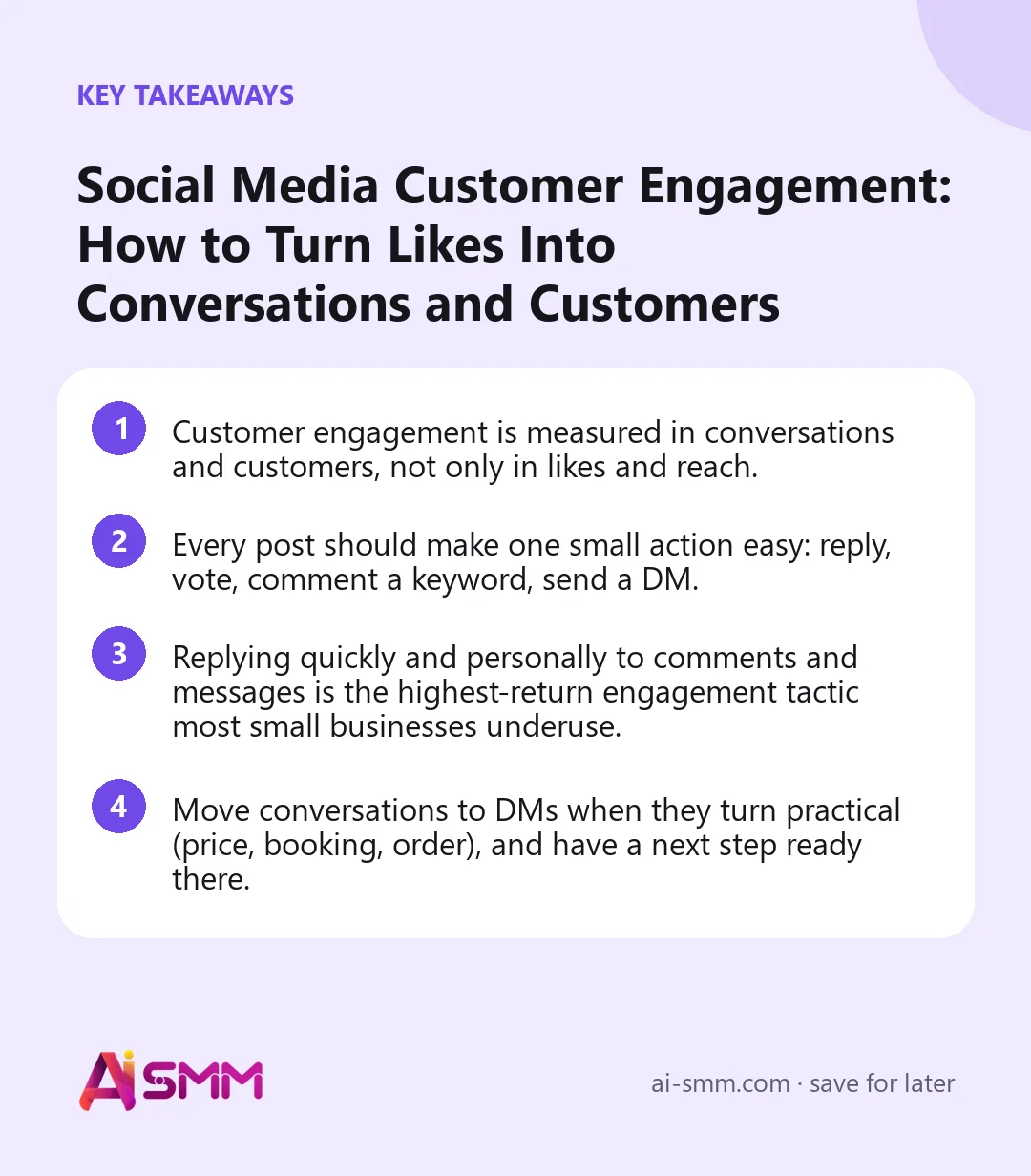
- Customer engagement is measured in conversations and customers, not only in likes and reach.
- Every post should make one small action easy: reply, vote, comment a keyword, send a DM.
- Replying quickly and personally to comments and messages is the highest-return engagement tactic most small businesses underuse.
- Move conversations to DMs when they turn practical (price, booking, order), and have a next step ready there.
What social media customer engagement really means
Engagement rate, the share of people who react to a post, is a useful number, but it measures attention, not relationships. Customer engagement looks at what happens between you and specific people. Compare the two views:
| Attention metrics | Customer engagement |
|---|---|
| Likes and reactions | Comments that you answered |
| Reach and views | Conversations started in DMs |
| Follower growth | Followers who became leads or buyers |
| Shares | Customers who recommend you to a friend |
Both matter. But a post with 40 likes and five real conversations about prices is often worth more to a local business than a post with 400 likes and none.
The customer engagement ladder
People rarely jump from a first view to a purchase. They climb, one small step at a time. Your job is to make the next step obvious at every level.
| Step | What the person does | What you do |
|---|---|---|
| 1. Notice | Sees a post, reel or story | Show something useful or recognisable |
| 2. React | Likes, votes, saves | Offer easy actions: polls, quizzes, questions |
| 3. Reply | Comments or answers a story | Answer quickly and personally, ask a follow-up |
| 4. Message | Writes in DMs or a chat | Give a clear next step: price, slot, link |
| 5. Buy | Books or orders | Make the process short, confirm in the chat |
| 6. Return | Buys again | Follow up, remind, reward |
| 7. Recommend | Tags you, shares, refers a friend | Thank them publicly, reward referrals |
Most businesses post content for step 1 and hope for step 5. The tactics below fill the gaps in between.
1. Write posts that invite a reply
A post that ends with a full stop gets likes. A post that ends with an easy question or action gets comments. The action must be effortless: one word, one emoji, one choice.
- Choice questions: “Autumn menu: pumpkin soup or mushroom risotto? Vote below.”
- Experience questions: “What is the one thing you wish you knew before your first renovation?”
- Keyword triggers: “Comment ‘LIST’ and we will send you the price list in DMs.”
- Fill in the blank: “My perfect Saturday starts with ___.”
- Help requests: “We are naming a new dessert. Suggestions?”
Keyword triggers are especially useful, because the comment is both engagement and a lead. The key is to deliver what you promised within minutes, not the next morning.
2. Answer every comment like a person
Comments are public conversations that other customers read. A good reply helps three people: the commenter, the next person with the same question, and your reputation. Some rules that work:
- Reply within a few hours during working time. Early replies also encourage more comments.
- Use the person’s name and refer to what they actually said.
- Answer the question in public, then offer details in DMs if needed.
- Ask a follow-up question when it is natural, to keep the conversation going.
- Answer criticism calmly and publicly, then solve the problem privately.
3. Move practical conversations into DMs
Once a conversation is about a price, a date, an address or an order, it belongs in private messages. On Instagram and Facebook, a comment can automatically trigger a private message with the details, so nobody waits. In DMs, always have a next step ready: a price list, free slots, a link to order, a question that helps you recommend the right option.
The weakest point for many businesses is here: DMs arrive in five different apps and some get lost. A single queue for all channels, with one person responsible, fixes most of that.
4. Use interactive formats
| Format | Where | Good for |
|---|---|---|
| Polls and quizzes in stories | Instagram, Facebook | Quick votes, product choices |
| Question stickers | Instagram stories | Collecting questions for future posts |
| Channel polls | Telegram | Feedback from subscribers |
| Conversation starters | Threads, X | Opinions and discussions |
| Quizzes in a chat | Telegram, WhatsApp, website chat | Recommendations that end with an offer |
A quiz in a chat goes one step further than a poll: after three or four questions, the person gets a personal recommendation (“this treatment suits you”) and a relevant offer. It is engagement and qualification in one.
5. Let customers shape what you do
People engage with what they helped create. Let followers vote on a new flavour, name a product, choose the next workshop topic or pick the colour of a limited edition. Then show the result and thank them. Share customer photos and reviews with permission. This turns customers into co-authors and gives them a reason to tell friends.
6. Show up in other people’s conversations
Engagement is not only what happens on your profile. Thoughtful comments under posts by local partners, industry peers and potential clients make you visible to people who have never seen your account. On LinkedIn, Threads and X, a useful comment on someone else’s post can start more conversations than your own post. Keep comments specific and helpful; generic “Great post!” replies do nothing.
7. Decide who answers and how fast
Engagement falls apart when everyone assumes someone else will reply. Even in a team of two, agree on:
- Who checks comments and messages, and how often.
- A target response time for working hours.
- What gets an automatic reply outside working hours.
- Which questions go to the owner or a specialist.
- Ready answers for the ten most common questions, written in your brand voice.
A 30-minute daily engagement routine
Customer engagement does not need a full-time community manager. For most small businesses, half an hour a day, split into two short sessions, is enough if it happens every day.
| Time | Task | Minutes |
|---|---|---|
| Morning | Answer all new DMs and chat messages, oldest first | 10 |
| Morning | Reply to comments on the last three posts | 5 |
| Afternoon | Leave 3–5 thoughtful comments on partners’ or clients’ posts | 10 |
| Afternoon | Note new questions for future posts and ready answers | 5 |
Once a week, add 20 minutes to look back: which posts started conversations, which questions repeated, which DMs turned into bookings or orders. That review is where the next week’s content ideas come from.
An example: a small bakery that turned comments into orders
An illustrative case. A bakery posts beautiful cake photos and gets plenty of likes, but orders still come mostly by phone. The owner changes three things. Each cake post now ends with “Comment ‘CAKE’ and we will send you sizes and prices.” Every comment gets a reply within a couple of hours, and the price list arrives in DMs automatically. Once a month, followers vote on the next seasonal flavour in stories, and the winning cake is named after the idea’s author.
Likes stay roughly the same. What changes is the number of DMs about orders and the number of people who tag the bakery in their own celebration photos. That is customer engagement: not more applause, but more conversations with people who want to buy.
How to measure customer engagement
| Metric | How to track | Why it matters |
|---|---|---|
| Comment reply rate | Comments answered ÷ all comments | Shows whether people are heard |
| Response time | Average time to first reply in DMs | Fast answers win bookings |
| Conversations started | New DM threads per week | The real top of your sales funnel |
| Leads from social | Contacts, bookings, orders that started in a chat | Connects engagement to money |
| Returning engagers | People who comment or message repeatedly | Your core community |
Check these monthly. If reach grows but conversations do not, your posts attract attention without inviting action.
How to do it in AI SMM
In AI SMM, comments and messages from Instagram, Facebook, Threads, YouTube, X, Telegram bots, WhatsApp and your website chat land in one shared inbox, with a contact card for each person and reports on response time. AI drafts replies from your knowledge base, and you send them as is, edit them or let AI answer in chosen channels. With chat automation, a keyword comment on Instagram or Facebook triggers a public reply and a DM with the promised item, and chat quizzes with scoring come from gamification blocks.
For engagement outside your own profile, the assistant in your browser finds people in your audience on LinkedIn, Instagram, X and Threads and drafts comments that are posted only after you approve them, within each network’s limits. Analytics shows engagement for the networks it supports; Telegram and X are not covered, so track those in the apps themselves.
Mistakes that kill engagement
- Posting and disappearing: comments left unanswered for days.
- Copy-paste replies that ignore what the person said.
- Asking for engagement (“like if you agree”) without giving a reason.
- Deleting criticism instead of answering it.
- Answering price questions in comments with “sent you a DM” and then forgetting to send it.
FAQ
What is the difference between engagement and customer engagement?
Engagement usually means reactions to content: likes, comments, shares. Customer engagement is broader and more personal: the conversations and interactions that build a relationship and lead to purchases and loyalty.
How fast should a business reply to comments and DMs?
Within a few hours during working time is a good target for a small business. For questions about prices and bookings, faster is better, because people often ask several businesses at once.
Is it okay to use automatic replies?
Yes, for predictable questions and outside working hours, as long as the reply is useful and there is an easy way to reach a person.
How do I get comments when my account is small?
Ask easy, specific questions, reply to every comment you get, and comment thoughtfully on other local accounts. A small account where every comment gets a real answer usually builds conversations faster than a big one that ignores them, because people see that writing to you is worth it.
Which network is best for customer engagement?
The one where your customers already talk. For local businesses that is often Instagram and a messenger; for B2B services, LinkedIn. Focus on one or two and do them well.
Bring all your comments and messages into one place and answer faster with the shared inbox in AI SMM.
Posts, chats, video and sales in one workspace. 7 days free.
Start free