
 AI SMM team
Pinterest marketing for small business means publishing keyword-rich, vertical pins that link to your product or service pages, organizing them into clear boards and posting steadily, so people who are searching for ideas find you and click through to buy or book. Unlike Instagram or TikTok, where a post fades within a day or two, a good pin can keep bringing visitors for months. Most small businesses ignore Pinterest because it does not feel like a social network, and that is exactly why it is less crowded: people come there to plan purchases, not to scroll past ads. This guide shows how to set it up and run it with a few hours a month.
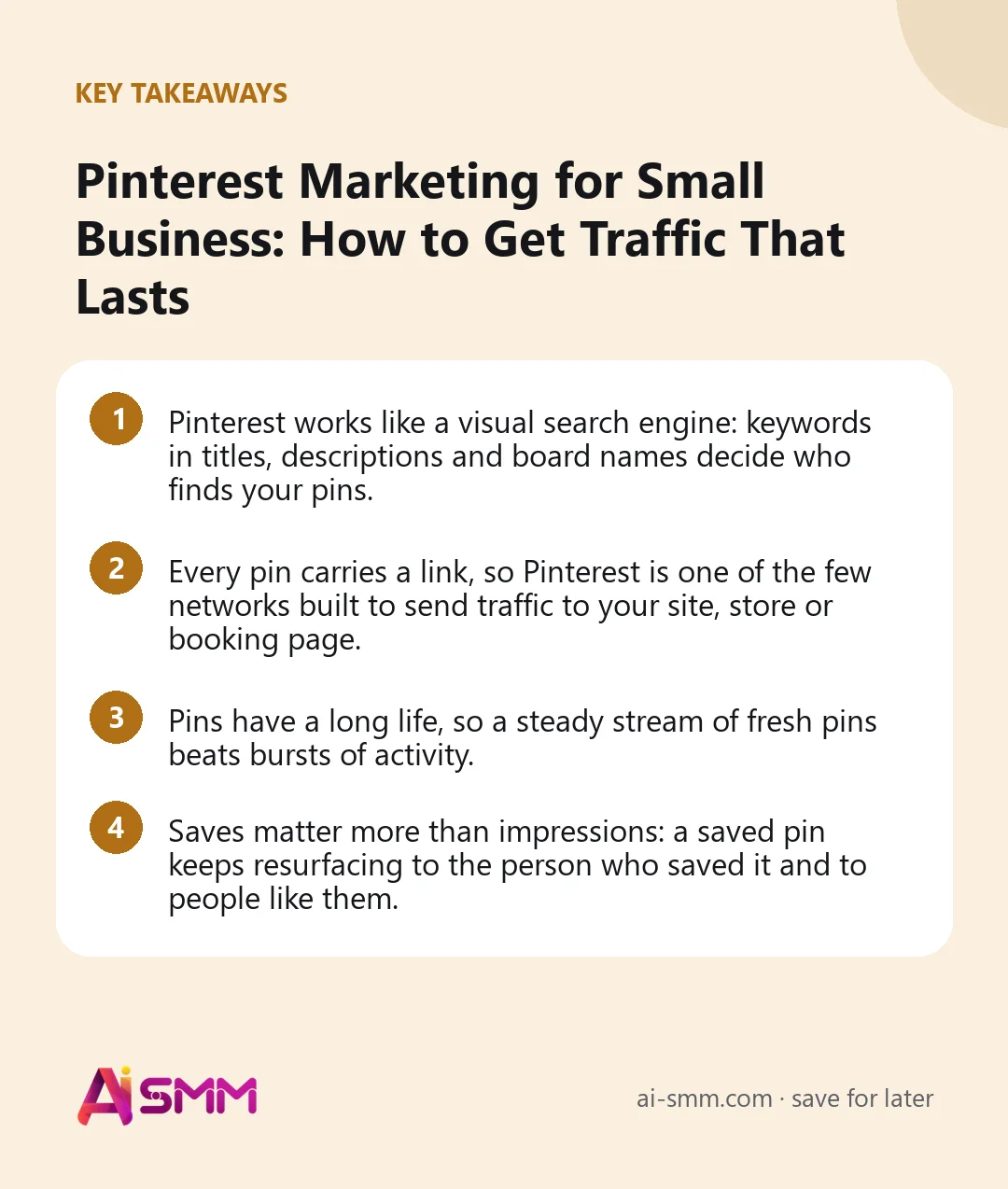
- Pinterest works like a visual search engine: keywords in titles, descriptions and board names decide who finds your pins.
- Every pin carries a link, so Pinterest is one of the few networks built to send traffic to your site, store or booking page.
- Pins have a long life, so a steady stream of fresh pins beats bursts of activity.
- Saves matter more than impressions: a saved pin keeps resurfacing to the person who saved it and to people like them.
Is Pinterest marketing worth it for a small business?
Pinterest reports hundreds of millions of monthly users, and many of them arrive with a plan: redecorating a room, planning a wedding, choosing an outfit, looking for a recipe or a gift. That intent is what makes it valuable. A person saving “small balcony garden ideas” is much closer to buying planters than someone watching a random video.
| Business type | Pinterest fit | What to pin |
|---|---|---|
| Home decor, furniture, DIY supplies | Excellent | Room ideas, styling tips, product in context |
| Fashion, jewelry, accessories | Excellent | Outfit ideas, gift guides, close-ups |
| Weddings and events | Excellent | Inspiration boards, checklists, real examples |
| Food, bakeries, catering | Strong | Recipes, seasonal menus, party platters |
| Beauty and hair salons | Strong | Hairstyle and nail ideas, before and after |
| Coaches, B2B services | Moderate | Infographics, checklists, guides linking to your blog |
If your customers make visual decisions or plan ahead, Pinterest deserves a place in your plan. If you sell something nobody searches for visually, your effort is better spent elsewhere.
1. Set up a Pinterest business account
- Create a business account or convert your personal one. It is free and unlocks analytics and ads.
- Claim your website so your pins show your profile and you can see activity from your site.
- Write a keyword-rich profile: business name plus what you do, for example “Nordic Nest | Scandinavian home decor”.
- Add a profile photo and cover that show your products or style, not only a logo.
- Consider Rich Pins if you run a store or blog; they pull extra details like price or title from your site.
2. Research keywords before designing anything
People type what they want into Pinterest search, and Pinterest suggests related terms as they type. Use that:
- Type your main topic into Pinterest search and note the suggested phrases.
- Look at the guided search bubbles under results for more specific terms.
- Check the Pinterest Trends tool to see when interest in your topic peaks during the year.
- Build a list of 20–40 phrases your customers use, in their words, not your internal product names.
A candle shop will find that people search “cozy bedroom ideas” and “autumn table decor” far more than “soy candle 200 ml”. Pins should meet people where their searches start.
3. Create boards that work as categories
Boards organize your pins and tell Pinterest what each pin is about. Treat them like shop categories named with keywords:
- Use clear, searchable board names: “Small kitchen storage ideas”, not “Our faves”.
- Write a one- or two-sentence board description with relevant keywords.
- Start with five to ten boards around your main product lines, use cases and seasons.
- Mix in helpful pins from others at the beginning so boards do not look empty, then fill them mainly with your own.
4. Design pins that get saved
Pinterest is visual-first. A plain product photo on a white background usually gets fewer saves than a pin styled for the platform.
| Element | What works |
|---|---|
| Format | Vertical, 2:3 ratio, for example 1000 × 1500 px |
| Image | Product in use or in a styled setting, bright and clear |
| Text overlay | Short and readable on a phone: “7 small balcony ideas” |
| Title | Keyword first, up to 100 characters |
| Description | Two or three natural sentences with keywords and a reason to click |
| Link | The exact page that continues the idea, not your homepage |
| Video pins | Short, vertical, understandable without sound |
Make several pins for the same product or article. Different images, headlines and angles reach different searches, and Pinterest favors fresh pins over re-pinning the same image again and again.
5. Link every pin to the right page
This is the part that turns saves into sales. A pin about “boho wedding table ideas” should lead to your page about wedding decor rentals, not your homepage. A pin showing a specific ring should open that ring’s product page. For services, link to the booking page for that service, so someone who saved a hairstyle idea can book it in two taps.
Check links regularly. A pin keeps working for months, which means a broken link or a sold-out product keeps wasting that traffic for months too.
6. Plan for seasons early
People start planning on Pinterest well before the event: holiday gifts, summer trips, back-to-school, weddings. Publish seasonal pins one to two months before the peak so they have time to be picked up and saved by the time searches rise. Use Pinterest Trends to see when your topics start climbing, and put those dates in your content calendar.
7. Post consistently and keep it sustainable
Pinterest rewards steady activity more than bursts. For a small business, a realistic rhythm is a few fresh pins several times a week, spread across relevant boards. Batch the work: design a month of pins in one session, then schedule them. In our experience, the first months on Pinterest are slow and traffic builds gradually as pins accumulate saves, so judge results over a quarter, not a week.
8. Measure what drives business
- Impressions show that pins appear in searches and feeds.
- Saves show that people found the pin worth keeping, the strongest signal of relevance.
- Outbound clicks show traffic to your site, visible in Pinterest’s own analytics and your website statistics.
- Followers matter less than on other networks, since most Pinterest reach comes from search.
Repeat what works: when a pin gets many saves, make new pins on the same topic with a different image and headline.
A simple monthly Pinterest plan
Here is a plan a small shop or studio can run in about two to three hours a month, most of it in one batch session:
| Week | What to publish | Where to link |
|---|---|---|
| Week 1 | 3–4 pins for your best-selling products, each with a new image or angle | Product pages |
| Week 2 | 3–4 idea pins: “how to style”, “5 ways to use”, a small checklist | Blog post, category page or guide |
| Week 3 | 3–4 seasonal pins for the season one to two months ahead | Seasonal collection or offer page |
| Week 4 | New versions of the pins that got the most saves this month | Same pages, new headline and image |
At the end of the month, spend fifteen minutes on analytics: which topics got saves, which got clicks, and which got neither. Next month, lean into the first two and drop the third. After three months you will have dozens of live pins, each still able to bring visitors, which is where Pinterest’s compounding effect starts to show.
What to pin if you have few product photos
You do not need a professional shoot for every pin. Useful alternatives: close-ups taken on a phone near a window, a flat lay of several products together, a simple text-based pin with a checklist or tips on a clean background, photos from happy customers (with permission), and short vertical videos of the product in use. Variety of images for the same product is a strength on Pinterest, not a weakness.
When to consider Pinterest ads
Pinterest ads promote existing pins to people searching or browsing related topics. They make sense once you know which pins already earn saves and clicks organically, the same principle as on any network: promote proven content, not guesses. For a small business, a modest test on one or two strong pins during your peak season is a sensible start. Judge the test by visits and sales on your site, not by impressions.
How to run Pinterest marketing in AI SMM
AI SMM handles the publishing and measurement side of Pinterest, so pins go out on schedule next to your other networks.
- Create pins. The AI content studio generates a pin image and a title from a product photo or a short brief, in your brand’s style.
- Schedule to the right board. Each pin gets a board, a title, a link and one image or one video, and publishes at the planned time from the same calendar as Instagram, Facebook and the rest.
- Link to where people can act. Point pins at product pages in your online store, a booking page for a specific service, or a link-in-bio page with several options.
- Track results. Analytics shows impressions, saves and followers for your pins, so you can see which designs and topics deserve more pins.
Worth knowing: Pinterest in AI SMM covers publishing and analytics only. There is no inbox for Pinterest, so comments on your pins are answered in Pinterest itself, and chat flows do not run there.
Pinterest marketing mistakes small businesses make
- Treating Pinterest like Instagram: square photos, hashtags and no keywords.
- Linking every pin to the homepage instead of the relevant page.
- Pinning in bursts, then going quiet for months.
- Board names that mean something to you but nothing to search, like “Stuff we love”.
- Publishing seasonal pins the week of the holiday, when planners already decided.
- Giving up after a month, before pins have had time to collect saves.
FAQ
How long does Pinterest marketing take to work?
Expect slow first months. Pins gain visibility as they collect saves, so traffic tends to build over several months rather than appearing in the first week.
How many pins should a small business post?
A few fresh pins several times a week is a sustainable pace. Consistency and quality matter more than hitting a specific daily number.
Do hashtags work on Pinterest?
Keywords matter much more than hashtags. Put searchable phrases in the pin title, description and board name, written the way customers search.
Can I reuse Instagram photos on Pinterest?
Yes, but adapt them: crop or redesign to a vertical 2:3 format, add a short text overlay, write a keyword-rich title and link the pin to a relevant page.
Want pins that go out on schedule and link straight to your products? Start with AI SMM and plan your first month of Pinterest pins in one sitting.
Posts, chats, video and sales in one workspace. 7 days free.
Start free