

 AI SMM team
A social media competitor analysis answers one practical question: what are similar businesses doing on social media that works, and where are they leaving customers unhappy that you could serve better? You do not need an agency report or a spreadsheet with fifty columns. For a small business, it comes down to picking three to five relevant rivals, comparing growth and posting pace over the same period, reading their content and comments carefully, and turning what you see into a short list of actions for next month.
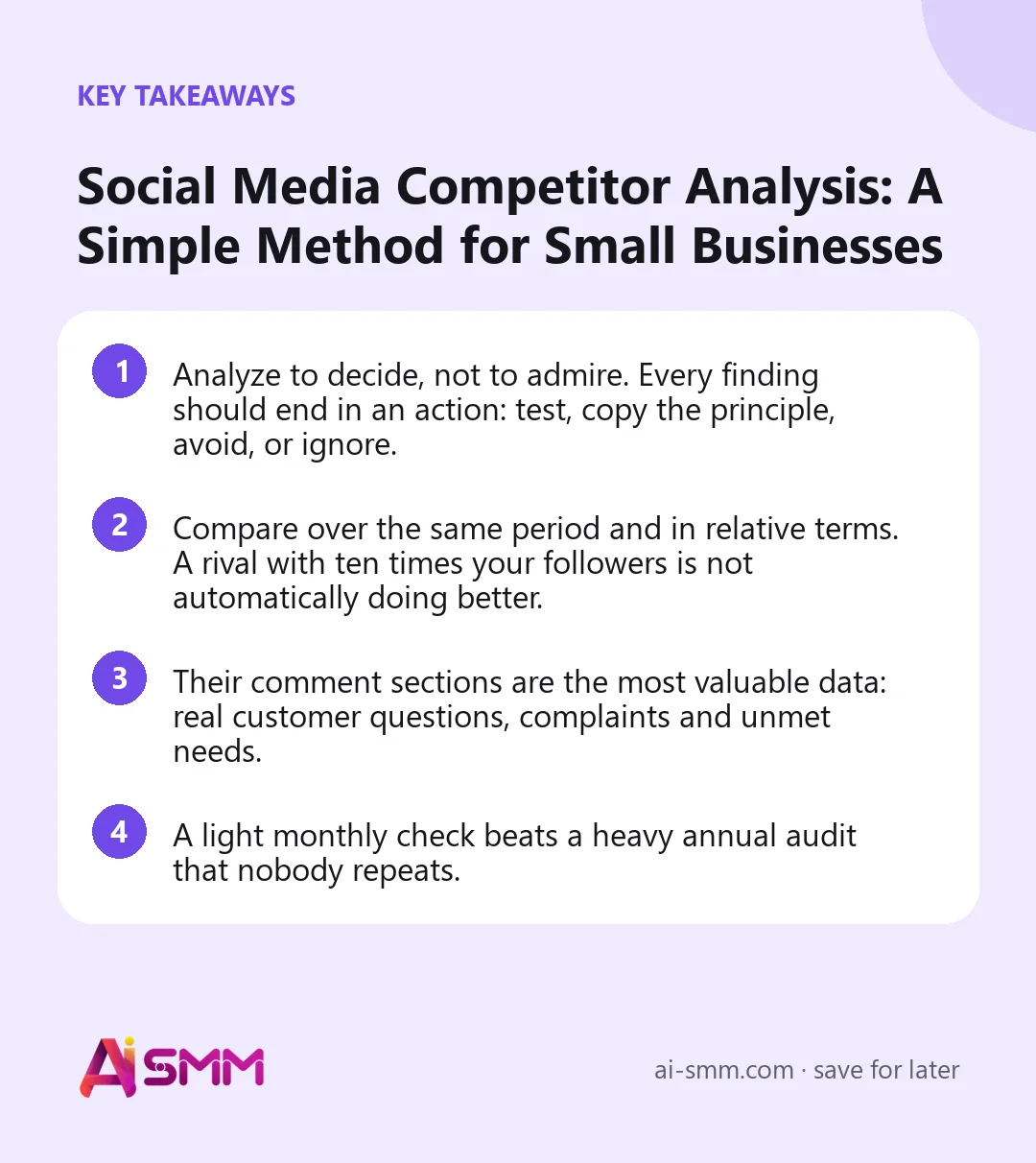
- Analyze to decide, not to admire. Every finding should end in an action: test, copy the principle, avoid, or ignore.
- Compare over the same period and in relative terms. A rival with ten times your followers is not automatically doing better.
- Their comment sections are the most valuable data: real customer questions, complaints and unmet needs.
- A light monthly check beats a heavy annual audit that nobody repeats.
1. What a social media competitor analysis is for
Most small business owners already look at competitors, usually late at night, scrolling a rival’s feed and feeling vaguely worse. That is not analysis. Analysis has a purpose and an output. Useful purposes include:
- Finding content formats and topics your audience clearly responds to.
- Spotting gaps: questions nobody answers well, services nobody shows, networks nobody uses in your niche.
- Setting realistic expectations for growth and engagement in your market.
- Noticing early when a competitor changes strategy, launches an offer or starts growing fast.
The output is short: three to five decisions about what you will do differently. If an analysis produces no decisions, it was entertainment.
2. Choose the right competitors
Pick three to five accounts across three groups:
- Direct competitors: same product, same area or same customer. For a dental clinic, the two clinics nearest to you.
- Indirect competitors: a different solution to the same need. For a home bakery, a local café selling cakes, or a supermarket bakery.
- One aspirational account: a business a few steps ahead of you, maybe in another city, whose approach you would like to learn from.
Avoid comparing yourself only to national brands with a marketing team and ad budget. Their numbers tell you little about what is realistic for a small team, and their tactics often depend on resources you do not have.
3. Decide what to collect
Keep the checklist short enough that you will actually repeat it. A practical set:
| What to look at | Question it answers |
|---|---|
| Networks they are active on | Where does our audience expect to find businesses like us? |
| Follower growth over the period | Who is gaining momentum, and since when? |
| Posting pace and formats | How often do they post, and which formats (Reels, carousels, Stories, videos)? |
| Top posts by engagement | Which topics and hooks get saves, shares and comments? |
| Offers and promotions | What discounts, bundles or lead magnets do they push? |
| Comment sections | What do customers ask, praise and complain about? |
| Response behavior | Do they answer comments, how fast, and in what tone? |
Look at the same period for everyone, for example the last 30 or 90 days. Comparing your last month with a competitor’s best year produces nothing useful.
4. Read their content, not just their numbers
Take the last 20–30 posts of each competitor and note three things for each: format, topic and the rough level of response compared with their other posts. Patterns appear quickly. Maybe a flower shop’s bouquet-assembly Reels get several times more saves than their photos of finished bouquets. Maybe a fitness studio’s posts about “first class nerves” get far more comments than schedule announcements.
What you are looking for is the principle, not the post. “Process videos outperform finished-product photos in our niche” is a principle you can apply with your own style. Copying a competitor’s post word for word is both unethical and usually ineffective, because your audience can tell.
Pay attention to what is missing
Gaps are often more valuable than hits. If no local salon explains how to care for hair after coloring, or no furniture maker shows how an order is delivered and assembled, that is an open topic you can own.
5. Mine the comment sections
Comments under competitor posts are free customer research. Read them looking for four things:
- Repeated questions: “Do you deliver to the suburbs?”, “Is there a version without nuts?” Each one is a content idea and possibly a product idea.
- Complaints: slow replies, long waits, unclear prices. These are your selling points if you do better.
- Praise: what exactly people love tells you what the market values.
- Unanswered comments: people asking and getting no reply are customers left on the table.
The people commenting are also a clearly interested audience. Engaging with them thoughtfully, with a genuinely useful comment on their own posts rather than a pitch under someone else’s, is a legitimate way to become visible to them.
6. Compare numbers fairly
Raw follower counts mislead. A few rules keep comparisons honest:
- Look at growth, not size. An account growing steadily from 2,000 followers may be doing more right than one stuck at 40,000.
- Relate engagement to audience size. Comments and saves per post matter more in relation to followers than as absolute numbers.
- Watch posting pace next to growth. If a competitor doubled their posting frequency two months ago and started growing, that is a signal worth testing.
- Be careful with sudden jumps. A spike may come from an ad campaign, a giveaway or a single viral post, not a repeatable strategy.
Put your own account in the same view. The point is not “who is winning” but “what is different between us, and which difference matters”.
7. Observe their customer experience from the outside
Social media is also customer service. Without pretending to be anyone, you can see a lot publicly: how fast they reply to comments, whether they answer complaints or delete them, how clear their bio and link are, how many taps it takes to book or buy from their profile. If you would genuinely buy from them anyway, notice the whole experience as a customer: which parts were smooth, which were annoying.
Small businesses often win exactly here. A competitor with a bigger audience may answer DMs in a day; answering in ten minutes is an advantage customers notice immediately.
8. Turn findings into actions
Close every analysis with a table like this:
| Finding | Action for next month |
|---|---|
| Process Reels get the most saves across two competitors | Test two process Reels per week for a month |
| Customers under a rival’s posts keep asking about delivery times | Pin a clear delivery post and add it to highlights |
| A competitor started posting daily and is growing faster | Increase from three to five posts a week, measure for six weeks |
| No one in the niche is active on Threads | Repurpose text tips there for a month and compare |
| Rival answers comments slowly | Set up instant first replies and mention fast service in the bio |
Keep the list to three to five actions. More than that and nothing gets done properly.
9. Make it a monthly routine
A competitor analysis done once goes stale within a season. A simple rhythm that fits a small business:
- Monthly (30 minutes): check growth and posting pace, skim top posts, read recent comments, update the action list.
- Quarterly (2 hours): revisit the list of competitors, review formats and offers in depth, check whether last quarter’s actions worked.
- When something changes: a new competitor opens nearby, a rival launches a big offer, or your own numbers move unexpectedly.
The monthly check is only realistic if the numbers are already collected for you rather than gathered by hand from each profile.
10. Doing this in AI SMM
In AI SMM, analytics has a Competitors tab in Pulse: add competitor accounts and their growth and posting pace appear next to your own for the period you choose, alongside the Posts, Best time and Benchmark tabs and an AI hint on every tab about what changed and what to try next. When a pattern is worth testing, the AI content studio helps you create your own version in your brand’s voice. The assistant in your browser can collect the people who comment on a competitor’s account on Instagram, LinkedIn, X or Threads, lets AI mark who fits your audience and saves them to Contacts with a tag, with every comment waiting for your approval. For agencies, the same view makes the monthly competitor check part of the client report.
11. A worked example: a neighborhood bakery
Say a small bakery with an Instagram account and a Telegram channel runs its first competitor analysis. It picks two bakeries in nearby districts, a café chain that sells pastries, and one well-known bakery in another city as the aspirational account.
Over the last 90 days, it notices a few things:
- One nearby rival started posting short morning Reels of bread coming out of the oven and has grown noticeably faster since then.
- Under the café chain’s posts, people keep asking whether anything is available without sugar, and rarely get a clear answer.
- The aspirational bakery posts a weekly “what’s baking this weekend” menu that collects many saves and comments.
- Both nearby rivals reply to comments slowly, often a day later.
The bakery turns this into four actions: two morning oven Reels a week, a clearly labeled low-sugar line with a post explaining it, a Friday menu post in both Instagram and the Telegram channel, and instant first replies to comments. Six weeks later, it checks its own growth and comments against the same competitors to see which actions paid off, keeps the two that clearly worked and replaces the others.
Nothing here required copying a single post. Each action came from a pattern or a gap, adapted to the bakery’s own products and voice.
FAQ
How many competitors should I analyze?
Three to five is enough for a small business: two or three direct competitors, one indirect and one account a few steps ahead of you. More than that turns the analysis into a chore you will not repeat.
How often should I do a social media competitor analysis?
A short monthly check of growth, posting pace, top posts and comments, plus a deeper review once a quarter. Also look again whenever a new competitor appears or your own results change sharply.
Is it okay to copy what works for competitors?
Copy principles, not content. If process videos work in your niche, make your own process videos. Reusing someone else’s text, photos or ideas one to one is unethical, can infringe their rights and rarely works because the audience notices.
What if my competitors are barely active on social media?
That is an opportunity. Look at indirect competitors and businesses in other cities, and move fast: in a quiet niche, a consistent account can become the obvious local choice within a few months.
Want to see how your accounts compare with competitors without screenshots and spreadsheets? Add competitor accounts to analytics in AI SMM and get your first AI hints on your own data.
Posts, chats, video and sales in one workspace. 7 days free.
Start free