
 AI SMM team
Most small business owners who open TikTok have the same two worries: “I’m not a dancer or a comedian” and “I don’t have time to film something every day”. Both are reasonable, and neither is a reason to skip the platform. TikTok shows videos to people based on what they watch, not only on whom they follow, so a small account with a useful 30-second clip can reach people who have never heard of the business. The challenge is not being entertaining, it is producing short videos steadily without it eating your week.
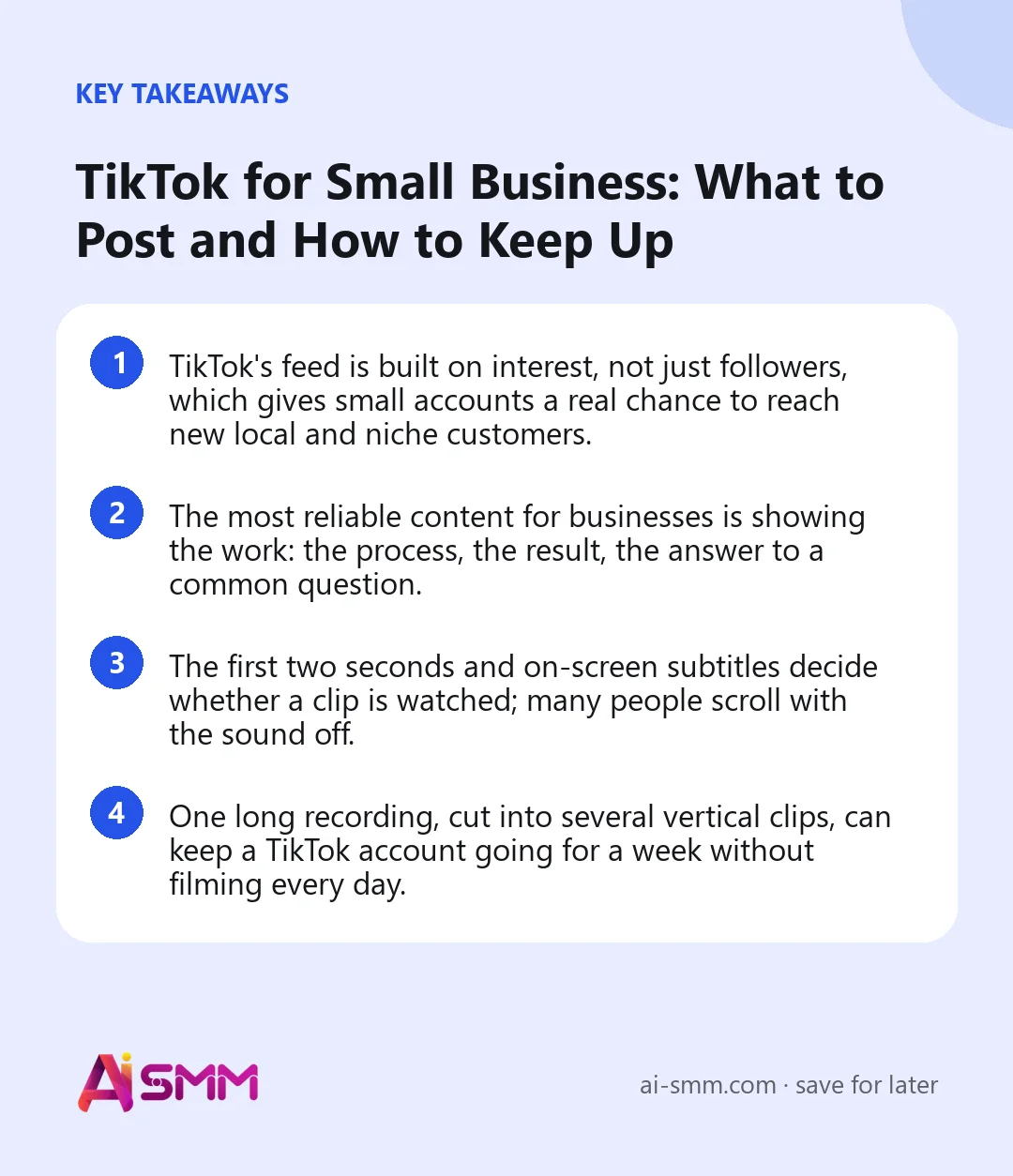
- TikTok’s feed is built on interest, not just followers, which gives small accounts a real chance to reach new local and niche customers.
- The most reliable content for businesses is showing the work: the process, the result, the answer to a common question.
- The first two seconds and on-screen subtitles decide whether a clip is watched; many people scroll with the sound off.
- One long recording, cut into several vertical clips, can keep a TikTok account going for a week without filming every day.
1. Why TikTok is worth it for a small business
On networks where reach depends mostly on followers, a new account starts from nothing. TikTok’s recommendation feed works differently: each video is tested on people likely to be interested, and if they watch it through, it is shown to more. That gives a bakery, a repair shop or a tutor the same starting line as a big brand, as long as the video is relevant to someone.
It also changes what “good content” means. Polished ads tend to underperform; honest, specific videos from real people tend to do well. A small business already has the most valuable material: a craft, a process and clients with questions.
Is TikTok right for you?
- Yes, if your work is visual or has a process (food, beauty, repairs, crafts, fitness, education), or your customers are under 40.
- Maybe, if you sell a service that is hard to show, like accounting; it can still work with explainer videos, but expect slower results.
- Probably not first, if your buyers are mostly older professionals reachable on LinkedIn or Facebook; start there and add TikTok later.
2. Set up the profile so viewers know what you do
When a clip performs well, curious viewers tap through to your profile. That visit should answer three questions in a few seconds: what you do, where, and how to get it.
- Use a business account so you have access to the insights TikTok provides.
- Write a one-line bio: “Phone repairs in 1 hour, city center” beats a slogan.
- Add one link to a page with your prices, address, booking or store, instead of a homepage where people get lost.
- Pin two or three videos that explain who you are: your best result, a “meet the team” clip, an answer to your most common question.
3. Content ideas that work for small businesses
You do not need trends or dances. Most successful small-business accounts rotate through a handful of formats built around their work.
| Format | What it shows | Example |
|---|---|---|
| Process | How something is made or done | A cake decorated from start to finish in 20 seconds |
| Before/after | The transformation you deliver | A cracked screen replaced, a haircut, a cleaned sofa |
| Answer a question | An expert reply to what customers ask | “Is it worth fixing a 5-year-old laptop?” |
| Myth vs fact | A common misconception corrected | A dentist on whether whitening damages enamel |
| Behind the scenes | The people and the place | Opening the shop at 7 a.m., packing orders |
| Product demo | How it works in real use | A backpack packed for a weekend, then worn |
| Customer story | A real result, with permission | A gym member’s first pull-up after two months |
If you do use a trending sound or format, adapt it to your business: the trend brings attention, but the clip should still show what you do.
4. Win the first two seconds
People decide whether to keep watching almost instantly. A slow intro (“Hi everyone, today I want to talk about…”) loses most of them. Start with the most interesting moment or a direct promise.
Hooks that work
- Show the result first, then how you got there.
- Ask the question your viewer has: “Why does your coffee taste bitter at home?”
- State a surprising fact from your work: “Most screen repairs take 20 minutes. Here’s why we charge for an hour.”
- Start mid-action: hands already working, the machine already running.
Make it watchable without sound
Add subtitles to every clip that has speech. Many people scroll in public places with the sound off, and subtitles also help viewers follow fast speech. Keep text on screen short and away from the edges where the interface covers it.
Length: for most business clips, 15–45 seconds is enough. Longer videos can work for tutorials, but only if every second earns its place.
5. Choose a posting rhythm you can keep
TikTok rewards consistency more than a perfect posting hour. An account that posts three times a week for three months usually learns more and grows more than one that posts daily for two weeks and then disappears. Pick a rhythm that survives a busy month.
- Minimum: 2–3 videos a week.
- Batch filming: one hour a week to film several clips at once, while the lighting and setup are ready.
- Schedule in advance: plan the week’s posts on Monday, so publishing does not depend on remembering.
- Use photo carousels too: on days without video, a carousel of product photos with a short caption keeps the account active with little effort.
Test a few posting times over two or three weeks and then look at your own numbers. There is no universal best hour; there is the hour your audience watches.
6. Turn one long video into a week of clips
The biggest shortcut for a small business is to stop thinking of TikTok as a separate production. You probably already record longer material: a webinar, a live stream, a tutorial for YouTube, a podcast episode, a walkthrough of your workshop. Each of these contains several short moments that work on their own.
- Record once, at length. Answer five customer questions in a row, or film a full process from start to finish.
- Cut it into vertical clips, each around one idea, with the speaker framed in the center and subtitles added.
- Give each clip its own hook and caption, written for someone who has not seen the rest.
- Schedule them across the week, and post the same clips to Instagram Reels and YouTube Shorts.
AI clipping tools speed this up by finding the strongest moments, reframing for vertical video and generating subtitles, leaving you to review and adjust rather than edit from scratch.
7. Handle comments where they happen
Comments are where TikTok turns attention into customers. Someone asks “how much?” or “do you ship to Canada?” and others read the answer. Reply quickly, especially in the first hours after posting, and consider replying to good questions with a new video: it answers the person and gives you your next piece of content.
TikTok comments are answered in the TikTok app itself. When a conversation needs more than a comment, like a quote, an order or a booking, point people to the link in your profile, where they can reach you in the channels you already manage: a booking page, a store, or a chat on Instagram, Telegram or WhatsApp.
8. Measure what to repeat
Look beyond view counts. For a small account, engagement rate, the share of viewers who liked, commented or shared, shows whether the clip resonated with the people who saw it. A clip with fewer views but high engagement is often a better guide to your next video than a viral one that got views from the wrong audience.
- Once a month, list your five best clips by engagement and look for what they share: format, topic, hook, length.
- Make two or three new clips in the same pattern.
- Watch whether profile visits and link clicks follow, not just views.
Worked example: a barbershop fills its TikTok from one session
Say a two-chair barbershop wants to reach younger clients nearby. Once a week, the owner sets up a phone on a tripod and records a full haircut with a quick commentary on what he is doing and why. That recording is cut into five vertical clips: the before/after, a fade technique close-up, “what to ask your barber for if you have thick hair”, a mistake people make with styling products, and a funny moment with the client (with permission).
Each clip gets subtitles and its own caption, and the five are scheduled across the week, with the same clips going to Instagram Reels. The bio link leads to a booking page. After a month, the owner sees that technique close-ups have the highest engagement rate and profile visits, so the next sessions focus on those, and he replies to the best comment questions with new short videos.
Common TikTok mistakes small businesses make
- Posting polished ads that look like commercials and get skipped.
- Slow intros that lose viewers before the interesting part.
- No subtitles, so people watching without sound scroll past.
- Posting in bursts and then disappearing for weeks.
- No link or unclear bio, so a viral clip brings views and no customers.
- Ignoring comments, which is where questions from future customers appear.
How this works in AI SMM
AI SMM publishes to TikTok videos and photo carousels on a schedule, from the same calendar as your other networks, so one clip can go to TikTok, Reels and Shorts. Video clipping takes a link to a long video from YouTube, Vimeo, Rutube, Twitch, Kick and other sources, finds the strongest moments and cuts vertical clips with subtitles, with templates including a viral TikTok style; an autopilot can clip every new video from channels you choose, and clips wait for your review by default. AI content studio writes captions and carousels, and analytics shows views, likes, followers and engagement rate. TikTok comments are not part of the inbox, so you answer them in the TikTok app; your link in bio page sends interested viewers to booking, a store or the chats you do manage.
FAQ
Can I answer TikTok comments in AI SMM?
No. TikTok is covered for publishing and analytics; comments are answered in the TikTok app itself.
How long does it take to cut clips from a long video?
Usually 10 to 30 minutes depending on the video’s length, and credits are charged only after a successful render.
Can the same clip go to TikTok and Instagram Reels?
Yes. A clip made once can be scheduled to both, as separate posts in the calendar.
Do I have to show my face?
No. Process videos, hands at work, product demos and before/after clips work well without a face on camera, though a recognizable person often builds trust faster.
If filming for TikTok every day sounds impossible, record once and let video clipping turn it into a week of short videos for TikTok, Reels and Shorts.
Posts, chats, video and sales in one workspace. 7 days free.
Start free