
 AI SMM team
How to make money on Instagram, honestly: most creators and small brands earn by selling something of their own (a service, a product, a digital download or paid access) and, once they have an engaged audience in a clear niche, by adding brand partnerships and affiliate links. Instagram’s built-in payouts exist but are uneven, depend on your country and eligibility, and rarely pay the bills for small accounts. This guide compares every realistic income stream, shows what you need before you start and gives a 90-day plan to the first sale, without promises of passive income.
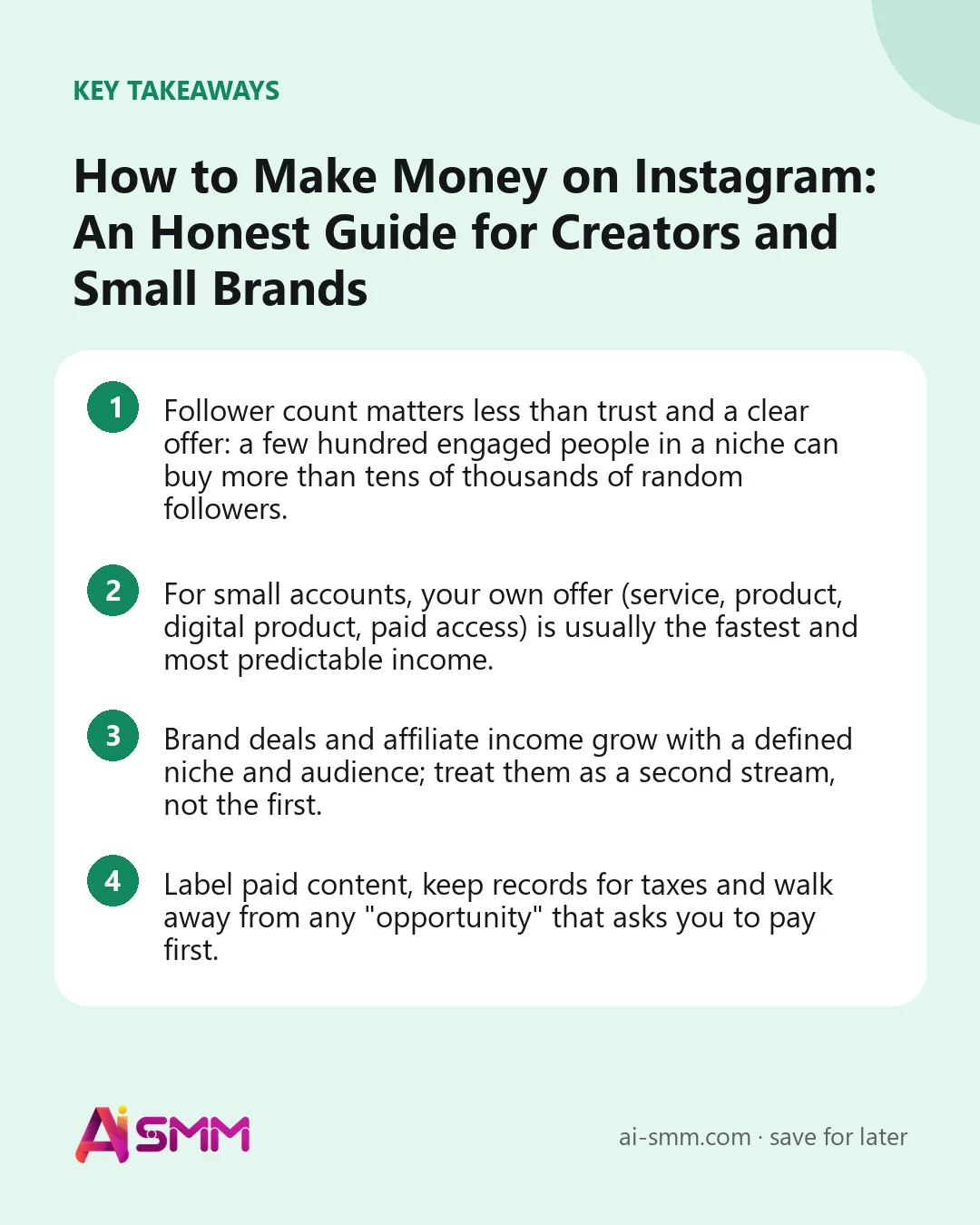
- Follower count matters less than trust and a clear offer: a few hundred engaged people in a niche can buy more than tens of thousands of random followers.
- For small accounts, your own offer (service, product, digital product, paid access) is usually the fastest and most predictable income.
- Brand deals and affiliate income grow with a defined niche and audience; treat them as a second stream, not the first.
- Label paid content, keep records for taxes and walk away from any “opportunity” that asks you to pay first.
Honest expectations before you start
Social media is full of screenshots of big earnings. They are real for a small minority and misleading for everyone else. What is typical instead:
- Income follows trust, and trust takes time. Expect months of consistent posting before people buy from an account they did not know before.
- The first money usually comes from people close to you: existing clients, friends of clients, a local community. That is normal and a good start.
- Platform payouts are the least predictable stream. Programs change, eligibility is limited and amounts vary widely.
- Monetizing takes work beyond posting: answering messages, packing orders, invoicing, negotiating, doing taxes.
None of this means it is not worth it. It means you should choose income streams that fit your situation and measure them like a business, not a lottery ticket.
Ways to make money on Instagram compared
| Income stream | Best for | Audience you need | Effort | Predictability |
|---|---|---|---|---|
| Your own services | Experts, freelancers, salons, coaches, photographers | Small but local or niche | Ongoing delivery of the service | High once clients return |
| Physical products | Makers, shops, bakeries, small brands | Small to medium | Stock, packing, delivery | Medium to high |
| Digital products | Experts and creators with know-how | Engaged niche audience | High upfront, lower later | Medium |
| Paid access and communities | Teachers, coaches, niche creators | Loyal core of followers | Regular content for members | Medium to high |
| Brand partnerships | Creators with a clear niche | Engaged audience that brands want | Pitching, producing, reporting | Low to medium |
| Affiliate links | Reviewers, educators, niche creators | Audience that trusts your recommendations | Low per post | Low to medium |
| Instagram’s creator tools | Eligible creators in supported countries | Depends on the tool and program | Low to medium | Low |
1. Sell your own services
If you already have a skill people pay for (hair, nails, photography, consulting, tutoring, design, repairs), Instagram is a shop window and a booking desk. It is the most reliable route for small accounts because each client can be worth a lot and you do not need a big audience.
- Show results: before/after, finished work, client feedback.
- Make prices or at least “from” prices visible in a Highlight or a carousel.
- Give one clear way to book: a link to a booking page, or “write BOOK in DMs”.
- Answer messages fast; speed often decides who gets the client.
2. Sell physical products
Handmade goods, clothing, cosmetics, food, prints: Instagram works well when the product looks good on a phone screen and can be shown in use. The key is a short path from post to payment: product in the post, price visible, a link to a mobile catalog or checkout, and quick answers in DMs about size, delivery and availability. For a full breakdown of selling, see how to sell on Instagram.
3. Create digital products
Digital products turn knowledge into something you make once and sell many times: guides, checklists, templates, presets, recipes, planners, recorded workshops or courses. They work when:
- Your content already answers a specific question people keep asking.
- Followers save your posts, which shows they value your know-how.
- The product solves one clear problem (“a meal plan for busy parents”, not “healthy living”).
Start small: a low-priced guide tests demand before you invest weeks in a course. A free lead magnet (a short checklist sent in DMs in exchange for a comment or email) helps you learn what people want and collect contacts for launches.
4. Offer paid access and communities
Some followers want more than free posts: a closed group, weekly live sessions, early access, personal feedback. Paid access can be a monthly membership, a paid chat, or access to a course for a fixed period. It works best for teachers, coaches and niche experts with a loyal core audience. Be clear about what members get each week and deliver it consistently; a membership that goes quiet loses subscribers quickly. Our guide to selling courses through chats shows how the payment and access part can run automatically.
5. Work with brands
Brand partnerships pay for your audience’s attention and trust. Brands care less about the raw follower count than about who your followers are and whether they act on your recommendations.
How to get your first brand deals
- Pick a niche brands can place you in: local food, parenting, home renovation, skincare for sensitive skin.
- Prepare a one-page media kit: who you are, who follows you (location, age, interests), typical reach and engagement, examples of past collaborations, what you offer.
- Pitch small and local brands first: cafes, shops and studios in your area often welcome creators and are easier to reach than big brands.
- Propose a specific idea, not just “let’s collaborate”: a Reel showing how you use their product, a Story series, a collab post.
How to price and protect yourself
There is no universal rate card; prices depend on niche, country, audience quality, the amount of work and usage rights. Calculate your time and costs, ask what the brand’s budget is, and agree in writing on deliverables, deadlines, payment terms, how long the brand can use the content and whether ads are allowed. Always use Instagram’s paid partnership label or a clear disclosure. Brands looking at this from the other side may find our guide to influencer marketing for small businesses useful.
6. Earn with affiliate links
Affiliate programs pay a commission when someone buys through your link or code. They suit creators who already recommend products or tools: equipment, books, software, beauty products. Recommend only what you actually use, explain why, disclose that the link is an affiliate link, and put links where people look for them (a link-in-bio page, Stories link stickers, a “my kit” Highlight). Affiliate income is usually small per sale; it adds up only when your audience trusts your picks.
7. Use Instagram’s built-in creator tools
Instagram has offered several monetization features to eligible professional accounts, such as subscriptions for exclusive content, gifts on Reels and badges during Live broadcasts, and from time to time bonus programs. Availability depends on your country, account type, age and compliance with Meta’s partner monetization policies, and specific programs are introduced, changed and ended over time. Check the monetization section of your professional dashboard to see what is available to you right now.
Treat these tools as a bonus. They can reward an existing engaged audience, but for most small accounts they are not a reliable main income.
What you need before you monetize
- A professional (creator or business) account, so you see statistics and can use business features.
- A clear niche and a bio that says who you help and how.
- A link page that works on a phone and shows your offers in order of importance.
- Proof: results, reviews, examples of your work or knowledge.
- A simple offer with a price, even if it is small.
- A routine for answering comments and DMs within hours, not days.
- Basic bookkeeping: a record of income, and advice on local tax rules for your situation.
A 90-day plan to your first Instagram income
An illustrative plan for a creator or small brand starting from a small account:
| Period | Focus | Actions |
|---|---|---|
| Weeks 1–2 | Foundation | Choose a niche, rewrite the bio, set up a link page, define one paid offer and one free lead magnet |
| Weeks 3–6 | Trust | Post 3 times a week (Reels for reach, carousels for depth), Stories most days, reply to every comment and DM |
| Weeks 5–8 | Conversations | Offer the lead magnet via a comment keyword, talk to people who take it, ask what they struggle with |
| Weeks 7–10 | First sales | Present the paid offer in a short series of posts and Stories; follow up personally with interested people |
| Weeks 10–13 | Review and second stream | Count sales and their sources, improve the offer, pitch two or three local brands or join one affiliate program |
Some people make the first sale in week three, others in month four. What matters is that the path from post to payment exists and that you learn from every conversation.
Scams and traps to avoid
- “Brand ambassador” offers where you pay: if a “brand” asks you to buy products at a discount to become an ambassador, you are the customer, not the partner.
- Fake collaboration requests: messages from accounts imitating well-known brands that ask for a fee, login details or a “verification” payment.
- Bought followers and engagement: brands check audience quality, and fake followers damage your reach.
- “Get rich on Instagram” courses: be wary of anyone whose main income is teaching others how to earn on Instagram with guaranteed results.
- Unclear contracts: agreeing to “unlimited usage” of your content for a small fee can cost you later.
How AI SMM helps creators and small brands earn
AI SMM puts the selling tools next to your content. A link in bio page collects your offers, forms and products on one mobile page. An online store handles products, orders, delivery and payments without a separate website, and a booking page lets clients choose a service and a time on their own.
Chat flows cover the conversation: a comment with a keyword under an Instagram post sends the free lead magnet in DMs, and a “sale with access” funnel issues an invoice, waits for payment and opens access to paid content for the paid number of days. Posts, Reels and Stories for the whole plan are scheduled in the content calendar.
FAQ
How many followers do you need to make money on Instagram?
There is no minimum for selling your own services or products; some businesses sell with a few hundred local followers. Brand deals and some of Instagram’s creator tools usually need a larger, engaged audience, and each program sets its own requirements.
How much can you earn on Instagram?
It ranges from nothing to a full income, and anyone promising a specific amount is guessing. Your earnings depend on your offer, niche, audience trust and how much work you put into selling. Track your own numbers and grow what works.
Does Instagram pay you for views?
Instagram has run bonus programs for eligible creators at times, but they are limited and change often. Most income on Instagram comes from selling your own offer, brand partnerships and affiliate commissions rather than from views.
Do I need to pay taxes on Instagram income?
In most countries, yes: income from sales, brand deals, affiliate programs and platform payouts is taxable. Rules differ by country and status, so keep records and ask a local accountant.
Pick one income stream from the table that fits you today, define a simple offer with a price and build the path from post to payment this week. When you want a link page, store and DM flows in one place with your Instagram content, try AI SMM.
Posts, chats, video and sales in one workspace. 7 days free.
Start free