
 AI SMM team
A good hashtag strategy in 2026 is short: use a few (usually 3–5) specific hashtags that describe exactly what the post is about, and put your real effort into the keywords in your caption and on-screen text. Hashtags no longer make a weak post go viral, but the right ones still help Instagram, TikTok and other networks understand who to show your content to and help people find it in search.
This guide explains how many hashtags to use on each network, how to find the right ones for a small business, a simple three-tier method for picking them, and the habits that quietly cut your reach.
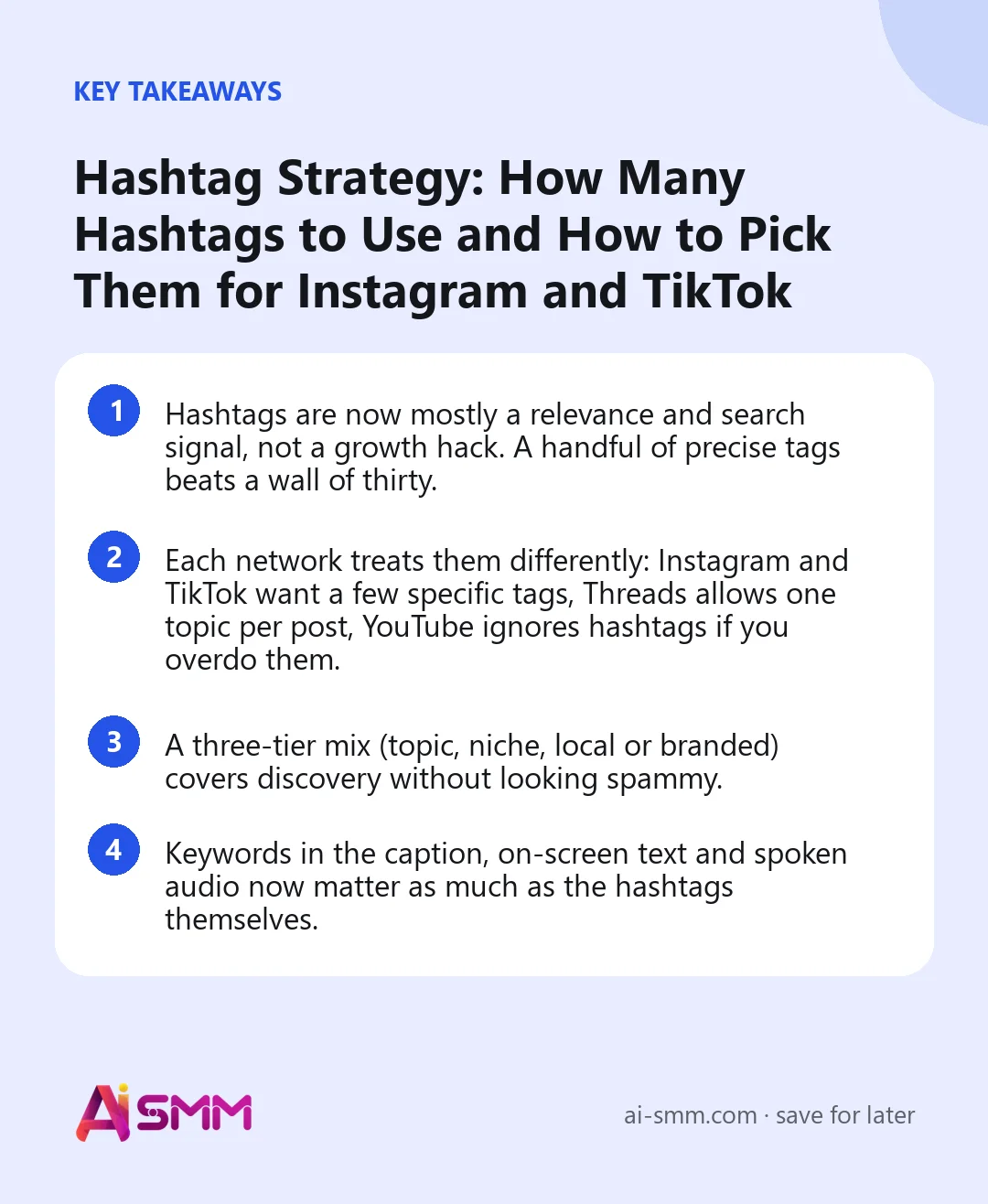
- Hashtags are now mostly a relevance and search signal, not a growth hack. A handful of precise tags beats a wall of thirty.
- Each network treats them differently: Instagram and TikTok want a few specific tags, Threads allows one topic per post, YouTube ignores hashtags if you overdo them.
- A three-tier mix (topic, niche, local or branded) covers discovery without looking spammy.
- Keywords in the caption, on-screen text and spoken audio now matter as much as the hashtags themselves.
Do hashtags still matter?
Yes, but for different reasons than a few years ago. Back then, adding thirty popular hashtags could put a post in front of thousands of strangers. Today, feeds are driven mainly by recommendation systems that look at how people react to a post and at everything the post contains: the caption, the image, the audio, the text on screen. Hashtags are one input among many.
What they still do well:
- Tell the network what the post is about. A precise tag like #weddingflorist helps classify content faster than a vague #love.
- Feed search. People search Instagram, TikTok and YouTube like search engines, and hashtags plus caption keywords are what those searches match.
- Organise your own content. A branded hashtag or a series tag lets followers see everything in one place, which is especially handy in a Telegram channel where hashtags work as clickable navigation.
- Join a conversation. Events, local communities and challenges often gather around one tag.
What they no longer do: rescue a post that nobody stops to watch. If the first second of a video or the first line of a caption does not hold attention, no hashtag will fix it.
How many hashtags to use on each network
The numbers below are practical ranges based on each network’s own guidance and on what works for small accounts in our experience. Platforms change their rules often, so treat this as a starting point and check the current in-app limits.
| Network | Recommended | Notes |
|---|---|---|
| 3–5 | Instagram itself recommends a few relevant tags and has been tightening how many a post can carry. Keywords in the caption matter just as much. | |
| TikTok | 3–5 | Mix one broad and a few specific tags; on-screen text and spoken words also feed TikTok search. |
| Threads | 1 | Threads lets you add a single topic tag per post, so pick the one that best describes it. |
| YouTube | 2–3 | The first few hashtags can appear above the title. Too many hashtags and YouTube may ignore them all. |
| 0–3 | Hashtags carry little weight now; clear topic words in the first lines do more. | |
| X (Twitter) | 0–2 | One relevant tag for an event or topic; more looks like spam in a short post. |
| 0–2 | Rarely a discovery tool for Pages; use only for events or campaigns. | |
| Telegram | 1–3 | Used as internal navigation: #tips, #prices, #reviews let readers filter your channel. |
The three-tier hashtag method
Instead of hunting for “the best hashtags”, build every set from three tiers. It keeps you relevant and specific at the same time.
Tier 1. Topic (1 tag)
One tag that names the broad subject: #nailart, #homebaking, #smallbusinesstips. These are large and competitive, so on their own they rarely bring views, but they anchor the post in the right category.
Tier 2. Niche (2–3 tags)
Tags that describe exactly this post and the people who care about it: #gelmanicureideas, #sourdoughforbeginners, #bookkeepingforfreelancers. This is where most of your discovery comes from, because the competition is smaller and the audience is more likely to be interested.
Tier 3. Local or branded (1 tag)
For a local business, one location tag (#lisbonnails, #brooklynbakery) often brings the most valuable viewers: people who can actually visit. Otherwise, use a branded or series tag (#AnnaBakesFridays) so followers can find all posts of that series in one place.
Five tags in total, all of them true to the post. That is the whole method.
How to find the right hashtags for your business
- Start from your customers’ words. How do clients describe what they want in DMs and reviews? “Natural-looking lashes”, “birthday cake without sugar”, “tax return help”. Those phrases are what they type into search.
- Use the search bar. Type a keyword into Instagram or TikTok search and look at the suggestions and related tags. They reflect what people actually search for.
- Look at posts that rank. Open the top results for a niche tag. If they are from accounts similar to yours and look like the content you make, the tag is a good fit. If they are unrelated or spammy, skip it.
- Check competitors and neighbours. Businesses near you or in your niche often use local tags you did not know existed.
- Keep a hashtag bank. Save sets by content pillar in a note or a document: one set for tips, one for before/after, one for offers. Rotate within each set rather than pasting the same five tags on every post.
Hashtags vs keywords: where discovery really happens now
On most networks, the caption is now indexed like a small web page. That changes how you write:
- Put the main keyword in the first line. “Gel manicure that lasts three weeks: 4 aftercare rules” works for both people and search.
- Use on-screen text in videos. TikTok and Reels read the words on screen. A title card with the keyword helps the video appear in search.
- Say it out loud. Auto-captions turn speech into text, so naming the topic in the first seconds adds another signal.
- Fill in alt text and file details where possible. Descriptive alt text on Instagram images helps accessibility and gives the network more context.
Think of it this way: keywords tell the network what the post is about, hashtags confirm it. When both point to the same topic, the post has the best chance of reaching the right people.
Hashtag mistakes that cut your reach
- Thirty generic tags on every post. It looks like spam to people and adds noise rather than relevance.
- Tags that do not match the content. Using a trending tag for an unrelated post confuses the classification and disappoints the viewers it brings.
- Banned or broken tags. Some tags get restricted because of abuse. If the tag page shows few or no recent posts, or a warning, drop it.
- Copy-pasting one identical block forever. Repeating exactly the same set on every post gives the network no extra information about each piece.
- Hiding the caption behind hashtags. On short-form networks, a caption that is half hashtags pushes the actual message out of view.
- Overthinking caption vs first comment. Whether tags go in the caption or in a first comment makes little difference to reach in our experience; clean captions simply read better.
How to tell if your hashtags are working
You cannot measure every tag separately on most networks, but you can see the pattern. On Instagram, the post insights show how many accounts reached were not following you; TikTok shows where views came from, including search. Compare posts with different hashtag sets over a few weeks:
- Does reach from non-followers grow with more niche tags?
- Do local tags bring more profile visits and messages from people nearby?
- Do posts with a clear keyword in the first line get more saves?
Change one thing at a time, keep what works, and review your hashtag bank once a quarter.
Example hashtag sets for small businesses
These illustrative sets follow the three-tier method. Swap in your own city and niche words, and check each tag’s recent posts before using it.
| Business and post | Topic | Niche | Local or branded |
|---|---|---|---|
| Nail studio, before/after | #nailart | #gelmanicure #shortnailsideas | #[city]nails |
| Bakery, new cake | #baking | #birthdaycakeideas #bentocake | #[city]bakery |
| Online clothing shop, styling tip | #fashion | #capsulewardrobe #officeoutfits | #[brand]style |
| Accountant, tax tip | #smallbusiness | #freelancertaxes #bookkeepingtips | #[brand]explains |
| Fitness coach, workout video | #fitness | #homeworkout #workoutforbeginners | #[city]fitness |
Notice that the niche tags carry the post. They are the ones a real person would type when looking for exactly this kind of content, which is why they bring viewers who stay, save and write.
Hashtags in AI SMM
In AI SMM, hashtags are part of the post, not a separate chore. The AI content studio generates captions and hashtags from a short brief, using your brand profile, so the suggestions match your niche instead of the most popular generic tags. You can edit the set, remove anything that does not fit, and mention your must-have branded or local tags in the brief so they are always included.
When one post goes out to several networks, the content calendar lets you adjust the text for each one: a few tags for Instagram, a single topic for Threads, a clean caption for LinkedIn. Text limits are checked for each network before publishing. The trend finder helps spot topics people are talking about right now, and analytics shows reach and engagement per post on the networks it covers, so you can compare how posts with different sets perform over time.
FAQ
How many hashtags should I use on Instagram in 2026?
Three to five relevant hashtags is a safe range. Instagram recommends a few specific tags and has been reducing how many a post can carry, so more tags will not help and may not even be allowed.
Should I put hashtags in the caption or the first comment?
In our experience the difference in reach is small. Putting them at the end of the caption keeps everything in one place and is easier to manage when scheduling.
Do hashtags work on TikTok?
Yes, as a relevance signal and for search. TikTok also reads your caption, on-screen text and speech, so combine a few specific tags with a clear keyword in the first line and on screen.
Should a small business create its own branded hashtag?
It helps if you run a recurring series, a challenge or collect customer photos. Ask customers to use it and it becomes a place to find posts about you. Without that, one local tag usually brings more value.
Stop guessing tags post by post: let the AI content studio draft captions with a focused hashtag set for each network, and spend the saved time on the first line of your caption.
Posts, chats, video and sales in one workspace. 7 days free.
Start free