
 AI SMM team
The Facebook algorithm decides which of the thousands of posts a person could see today actually appear in their Feed, and in what order. For a business Page that means the same post can reach 40 people or 4,000 depending on how well it matches what the system predicts each viewer will care about. If your Page reach has been sliding and you are not sure whether to post more, post differently or give up, this guide explains how the ranking works in plain terms, what Facebook quietly demotes and a practical routine that works with the system instead of against it.
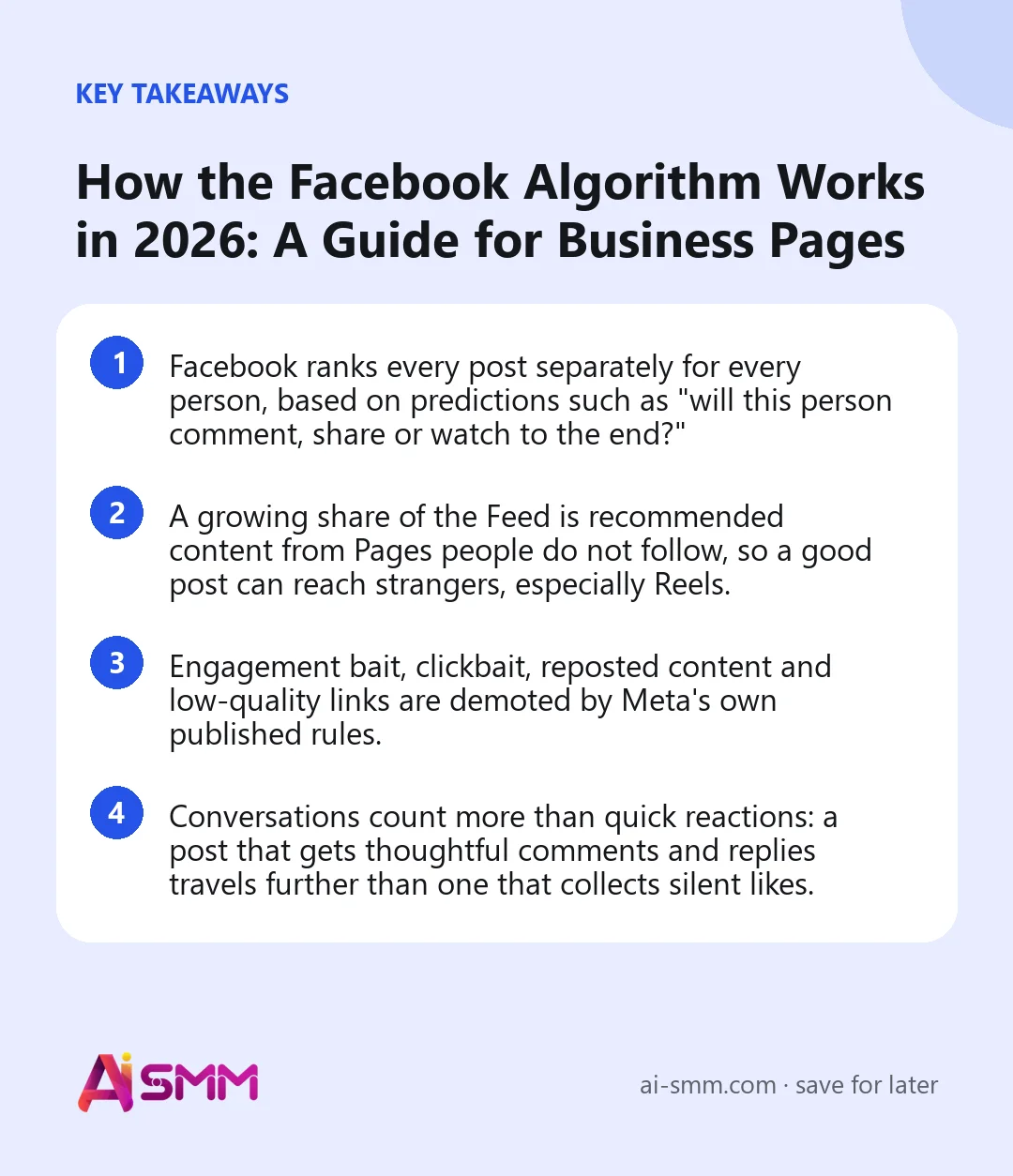
- Facebook ranks every post separately for every person, based on predictions such as “will this person comment, share or watch to the end?”
- A growing share of the Feed is recommended content from Pages people do not follow, so a good post can reach strangers, especially Reels.
- Engagement bait, clickbait, reposted content and low-quality links are demoted by Meta’s own published rules.
- Conversations count more than quick reactions: a post that gets thoughtful comments and replies travels further than one that collects silent likes.
How the Facebook algorithm ranks posts
Meta has described Feed ranking publicly in its Transparency Center, and the logic is simpler than the myths around it. Every time someone opens Facebook, the system goes through four steps:
- Inventory. It collects everything the person could see: posts from friends, Pages and groups they follow, plus recommended posts and Reels from accounts they do not follow.
- Signals. For each post it looks at thousands of signals: who posted it, how the viewer has interacted with that Page before, what type of content it is, how old it is, how other people are reacting to it, what device and connection the viewer has.
- Predictions. From those signals it predicts how likely this particular person is to react, comment, share, click, watch for a while, or hide the post and report it.
- Relevance score. The predictions are combined into a score, and the Feed is ordered by that score, with some variety mixed in so the person does not see five posts from the same source in a row.
The important part for a business: there is no single “Page reach” setting that Facebook turns up or down. Your post is scored again and again, separately for each person who might see it. A post that makes regular customers comment will be shown to more regular customers; a post that makes strangers stop and watch will be recommended to more strangers.
The signals that matter most for a business Page
| Signal | What it means in practice | What you can do |
|---|---|---|
| Relationship with the viewer | People who commented, messaged or clicked on your Page before see your new posts more often | Reply to every comment and message; each exchange strengthens the connection |
| Meaningful interactions | Comments, replies between people and shares to Messenger weigh more than a quick reaction | End posts with a real question people can answer from experience |
| Watch time on video and Reels | Whether people watch past the first seconds and to the end | Show the result in the first 2–3 seconds, keep Reels short and tight |
| Content type preference | Some people mostly watch video, others mostly read or look at photos | Mix photo posts, video and Reels instead of one format only |
| Recency | Fresh posts get their first test quickly; older posts fade unless they keep getting interaction | Post when your audience is online and stay around for the first hour |
| Negative feedback | “Hide post”, “Snooze” and reports push a Page down for that person and signal low quality overall | Avoid repetitive sales posts and anything that feels like a trick |
| Originality | Original photos and videos are preferred over reposted or watermarked material | Film and photograph your own work, even on a phone |
What the Facebook algorithm demotes
Meta publishes Content Distribution Guidelines that list what gets less distribution even when it does not break any rule. For a small business, the relevant items are:
- Engagement bait. “Comment YES if you agree”, “Tag three friends”, “Share if you want the discount”. Facebook detects these phrases and reduces reach for the post, and for Pages that use them repeatedly.
- Clickbait headlines. Link titles that hide what the article is about (“You won’t believe what happened next”) or exaggerate it.
- Links to low-quality pages. Sites stuffed with ads, slow pages or pages that do not match the post’s promise.
- Unoriginal content. Meta has said it reduces distribution for accounts that mostly repost other people’s videos and images without adding anything of their own.
- Sensational health or money claims. Miracle cures and “get rich” promises are limited even when they are not removed.
- Posts people hide. If a noticeable share of viewers hide a post, the system learns it is not wanted.
A useful test before posting: would you be comfortable if a customer read this post out loud to you? If it sounds like a trick, the algorithm probably reads it as one too.
Friends, followers and recommendations: where your reach comes from
Your posts can reach people in three ways, and each needs a slightly different approach:
- Followers of your Page. They see your posts in their Feed, but only some of them and not every time. Posts that start conversations reach a bigger share of them.
- Shares. When a customer shares your post to their profile, a group or a Messenger chat, you reach their friends with a personal recommendation attached, which is the strongest form of reach on Facebook.
- Recommendations. Facebook shows posts and especially Reels from Pages people do not follow if it predicts they will be interested. This is the main way new people discover a small Page today.
In our experience, most small Pages underuse the second and third routes. They write posts for existing followers only, while Reels and genuinely shareable posts (a useful checklist, a local tip, a before-and-after) are what bring in new people.
Which formats get the most reach on Facebook
| Format | Reach pattern | Best for |
|---|---|---|
| Reels | Most likely to be recommended to non-followers | Demonstrations, quick tips, transformations, behind the scenes |
| Photo post | Solid reach among followers, shareable when useful | New products, offers, results, team, events |
| Video post (longer) | Reaches people who prefer video; watch time matters | Tutorials, walkthroughs, interviews |
| Stories | Seen mostly by your most engaged followers | Daily updates, today’s slots, quick polls |
| Link post | In our experience often reaches fewer people than native media | Articles, booking pages, when the click is the goal |
| Text-only post | Can do well on personal profiles, weaker for most Pages | Short announcements, questions to the community |
A practical rule: if the goal is reach, lead with a Reel or a photo and put the key message in the post itself; if the goal is a click, accept a smaller audience and make the link worth it.
What does not matter as much as people think
- The “perfect” posting time. Timing helps the first test, but a strong post keeps spreading for a day or more. Post when your audience is usually online and do not obsess over the minute.
- Hashtags. On Facebook they play a small role. One or two relevant tags will not hurt; a block of twenty adds nothing.
- Posting every day no matter what. Frequency helps only when each post is worth seeing. Three good posts a week beat seven filler ones that people scroll past.
- Tricks with editing the post after publishing or deleting and reposting. There is no evidence this resets anything in your favour, and deleting loses the comments you already had.
How to work with the Facebook algorithm: 8 practical steps
- Know your audience in one sentence. “Parents within 10 km of our studio” is something you can write for; “everyone” is not.
- Make one Reel a week at minimum. It is your main way to reach non-followers. Film your work, a quick tip or a customer’s result.
- Write posts that invite real answers. “Which of these two colours would you pick for a kitchen?” gets comments without being bait.
- Reply to every comment within a few hours. Replies double the conversation on the post and strengthen your relationship with each commenter.
- Move detailed questions to Messenger. Answer publicly, then continue privately with the price or booking link. The public thread stays short, the lead does not get lost.
- Use original photos and video. Phone footage of your real shop beats polished stock images.
- Give people a reason to share. Checklists, local guides, seasonal reminders and genuinely funny moments from the workplace get shared; pure offers rarely do.
- Review the numbers monthly. Look at reach and interactions per format and topic, keep what works and drop what does not.
A weekly Facebook plan built around the algorithm
| Day | Format | Example for a local bakery |
|---|---|---|
| Monday | Photo post with a question | “Two new breads this week. Which one should stay permanently?” |
| Wednesday | Reel | 15 seconds of shaping croissants, finished tray in the last shot |
| Thursday | Stories | What is still available today, a quick poll on tomorrow’s special |
| Friday | Useful or shareable post | “How to keep sourdough fresh for five days”, as a photo with short steps |
| Every 2nd week | Offer or event | Weekend tasting, with a clear time and place |
Three to four posts a week plus Stories is enough for most small Pages. The time you save by not posting daily is better spent answering comments and messages.
How to tell if the algorithm is working for you
Do not judge by a single post. Look at four-week periods and compare:
- Reach per post by format. If Reels reach three times more people than photos, make more Reels.
- Share of reach from non-followers. A growing share means recommendations are working.
- Comments per post. A better signal of relevance than likes.
- Messages and enquiries. The business result. A post with modest reach that brings five Messenger enquiries beats a viral post that brings none.
- Geography of your audience. For a local business, reach outside your service area is not worth much.
For more on the whole Page strategy beyond ranking, see our guide to Facebook marketing for small business.
How to apply this in AI SMM
AI SMM connects your Facebook Page and puts it on one calendar with your other networks. AI Content Studio drafts captions in your brand’s tone from a short brief, including the question at the end, and can generate or adapt an image or a short video for the post. In the calendar you schedule photo posts, video posts, Reels and Stories for the week in one sitting; note that a Facebook Page post carries either photos or a video, not both mixed. Page comments and Messenger messages arrive in the shared inbox, so replying within a few hours becomes realistic, and a chat flow can answer a comment publicly and continue in Messenger with the details. Analytics shows followers, reach and the geography of your audience, so the monthly review above takes minutes rather than an afternoon.
FAQ
Why did my Facebook Page reach drop suddenly?
The most common reasons are a change in what you post (fewer Reels, more links or offers), a few posts that people hid, or a general shift in how much of the Feed goes to recommendations. Compare the last four weeks with the four before by format and topic before changing everything.
Does paying for ads improve organic reach?
No, Meta has consistently said ads and organic ranking are separate. Ads can bring new followers who then see your organic posts, but paying does not raise the score of your unpaid posts.
Is it better to post as a Page or from my personal profile?
Both have a role. The Page is where customers find you, message you and see reviews. Personal posts from the owner often get more interaction from friends, so sharing important Page posts to your profile with a personal comment is a good habit.
How many times a day should a business post on Facebook?
For most small businesses, once a day at most and three to four times a week is plenty. More posts only help if each one gets interaction; weak posts can lower how often your Page is shown.
Pick one idea from this guide for next week: one Reel, one post with a real question and a promise to yourself to answer every comment. Plan the week in AI SMM and see how the numbers change after a month.
Posts, chats, video and sales in one workspace. 7 days free.
Start free