
 AI SMM team
Someone comments “price?” under your Instagram post, and by the time you notice and reply hours later, they have already found another shop. A comment-to-DM funnel fixes that: it replies to the comment publicly with something short, then sends the person a private message with the details, right when their interest is highest.
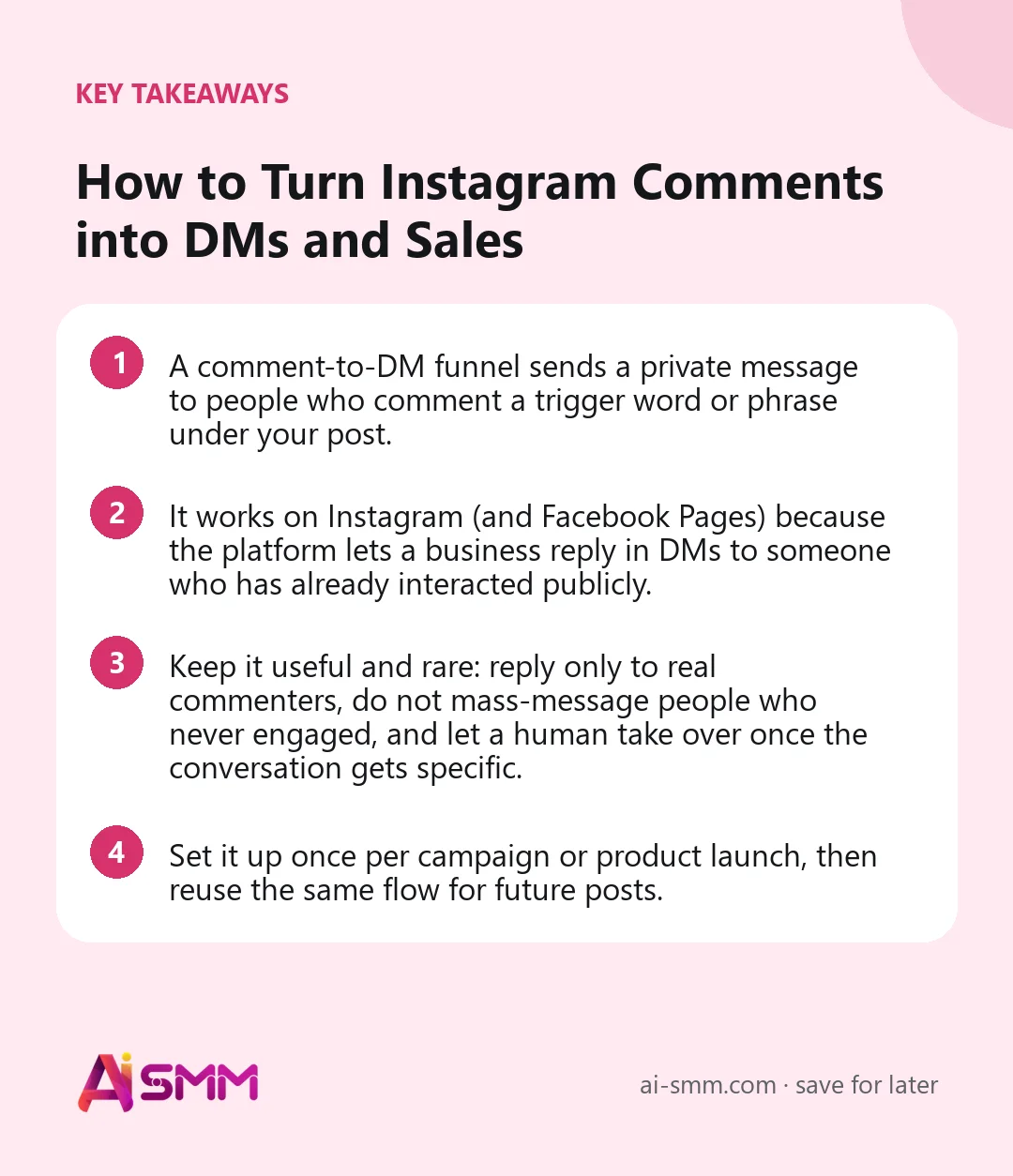
- A comment-to-DM funnel sends a private message to people who comment a trigger word or phrase under your post.
- It works on Instagram (and Facebook Pages) because the platform lets a business reply in DMs to someone who has already interacted publicly.
- Keep it useful and rare: reply only to real commenters, do not mass-message people who never engaged, and let a human take over once the conversation gets specific.
- Set it up once per campaign or product launch, then reuse the same flow for future posts.
1. What a comment-to-DM funnel actually is
You publish a post and ask people to comment a specific word, for example “GUIDE” or “SIZE”, to get something in return: a price list, a discount code, a booking link, a free guide. When someone leaves that comment, two things happen. First, a short public reply appears under the comment (often just a thank-you or an emoji, so the thread does not look automated). Second, the same person receives a direct message with the actual offer, link, or answer.
The public comment is the trigger. The private message is where the real conversation, and the sale, happens.
2. Why this converts better than a public reply alone
A public reply is easy to miss in a busy comment section, and it is not a private space to ask follow-up questions like “do you deliver to my area” or “what sizes do you have left”. A DM is personal, it lands in an inbox the person actually checks, and it gives you room to ask a qualifying question before sending a link to book or buy. It also keeps pricing and availability conversations out of the public comments, which matters for services where price depends on the client.
3. The Instagram rules you cannot break
This only works within Instagram’s own logic: a business can message someone in DMs after that person has interacted with the account, such as commenting on a post. That means the automation should only reply to people who actually left a matching comment, never to a list of followers who did not engage. Sending unsolicited DMs to people who never interacted with your content is against the platform’s spirit and gets accounts restricted. A comment-to-DM flow is safe specifically because the DM is a direct response to something the person did publicly, on that post, right now.
Two practical rules follow from this: reply promptly (within minutes, not days) so the DM still feels connected to the comment, and never repurpose the same automation to blast people who commented on an unrelated post from months ago.
4. Step 1: pick the right trigger comment
Choose a word that is easy to type and unlikely to appear by accident, like a product name, “PRICE”, or “INFO”. Ask for it clearly in the caption and, ideally, on the image or video itself, since many people do not read captions. A giveaway or a limited-time offer usually performs best as a trigger, because it gives people a reason to comment right away instead of scrolling past.
5. Step 2: write the DM sequence
The first message should deliver on the promise immediately: the price list, the link, the code. Do not make people ask twice for what the post promised. After that, one or two follow-up messages can ask a qualifying question (“Which service are you interested in?”, “What’s your size?”) to move the conversation toward a booking or a purchase. Keep the tone conversational, use the person’s name if you have it, and stop after two or three messages if there is no reply, so it does not read as pushy.
6. Step 3: qualify, then hand off to a human
Automation is great for the first reply and for answering common questions, but the moment someone asks something specific, like a custom order or a complaint, a real person should take over. A good setup flags these conversations in a shared inbox so your team sees them immediately instead of the person waiting for a bot loop that cannot help them.
7. Examples across different businesses
| Business | Trigger comment | What the DM delivers |
|---|---|---|
| Small coffee roastery | “BEANS” on a new blend post | Price list and a link to order, then a follow-up asking grind preference |
| Independent nail studio | “BOOK” on a new design post | Available time slots for the week and a booking link |
| Online clothing shop | “SIZE” on a product photo | Size chart, then a question about which size to reserve |
8. Common mistakes to avoid
The most common mistake is making the DM feel identical to a mass broadcast: no name, no reference to what the person commented on, just a generic sales pitch. Another is replying too slowly, which breaks the connection between the comment and the message. A third is never switching to a human, so people who need a real answer get stuck talking to a bot. Finally, using the same trigger word across unrelated posts confuses people and makes tracking what worked much harder.
9. How fast is fast enough
There is no hard rule from the platform about reply speed, but there is a practical one from human behavior: the longer the gap between a comment and the DM, the less the person remembers what they asked for. A reply within a few minutes still feels like a direct response. A reply the next morning feels like a cold message from a stranger, even though it technically answers the same comment. If you are running this manually, block a specific time twice a day to check and reply to trigger comments. If you are running it through automation, the delay is usually seconds, which is the main reason businesses set this up in the first place rather than relying on someone remembering to check comments.
10. Combining comment-to-DM with paid promotion
A boosted or paid post gets more comments in a shorter window, which makes a manual reply process fall apart quickly. If you plan to run ads or boost a post that asks for a trigger comment, set up the automation first and test it with a handful of comments before spending on reach. Nothing wastes ad budget faster than driving hundreds of comments to a post where the DM reply arrives a day late, after interest has cooled and the person has moved on to a competitor’s offer instead.
11. Deciding between a fully automatic flow and a semi-automatic one
Some businesses prefer to automate only the first message (the price list or the link) and have a person write every message after that. Others automate two or three exchanges, including a qualifying question, before handing off. Neither approach is wrong. A fully automatic flow suits high-volume, simple offers like a price list or a discount code. A semi-automatic flow suits higher-value services, like a custom quote or a consultation, where the second message benefits from a human reading the specific request. Start with more automation than feels comfortable, then dial it back if replies feel too generic for your audience, rather than starting fully manual and never getting around to automating it.
12. Tracking whether the funnel is actually working
Watch three numbers over the first few weeks: how many people leave the trigger comment, how many of those open the DM, and how many of those DMs turn into a booking or a sale. If comments are high but DM opens are low, the public reply or the delay is probably the issue. If DM opens are high but conversions are low, the message itself, the offer, or the price needs work. Reviewing this weekly, even informally, tells you far more than guessing at what to improve.
13. Setting up comment-to-DM funnels in AI SMM
In AI SMM, this is built as a chat automation flow tied to a specific post: you set the trigger comment, write the DM sequence with simple branches, and the flow sends the reply automatically once someone comments. Conversations land in the shared inbox together with regular comments and DMs, so your team can jump in the moment a question needs a human. Because the flow lives on your connected Instagram account, it also works the same way on Facebook Pages, so you can reuse the idea for a Facebook post without rebuilding it from scratch. If you want to go further, pair the flow with the AI knowledge base so follow-up questions get accurate answers instead of a generic script.
14. Writing a public reply that doesn’t look robotic
The public comment reply is small but it sets the tone for everything that follows. A reply that is exactly the same word for word under every single comment reads as obviously automated to anyone scrolling the thread, even if the private DM feels personal. Rotate a handful of short variations, an emoji, a “sending it your way”, a “check your DMs”, so the comment section still feels like a real business responding to real people, not a script running in the background.
15. What happens when someone comments the trigger word twice
People sometimes comment again if they don’t notice the first reply, or comment on a different post with the same word out of habit. Decide in advance whether a repeat trigger should resend the same message, skip silently, or trigger a lighter check-in like “did you get our last message?”. Leaving this undecided is how funnels end up sending the same price list five times to the same person, which looks careless rather than automated.
FAQ
Will Instagram restrict my account for using this?
Not if you only message people who actually commented the trigger word on that post. The risk comes from mass-messaging people who never engaged, not from replying to real commenters.
Can I run more than one comment-to-DM funnel at once?
Yes, as long as each one is tied to a specific post and trigger word. Running several at once on different posts is normal for a shop with multiple products or offers.
What if someone comments the trigger word but I don’t want to sell to them right now?
Send the DM anyway. Being present with useful information, even if they do not buy today, is what gets you remembered next time they need what you sell.
Does this replace my inbox team?
No. It handles the first, predictable step. Anything specific should still reach a person through the shared inbox.
If comments under your posts keep going unanswered, a comment-to-DM flow is one of the fastest fixes to set up. See how it fits your account in AI SMM’s chat automation.
Posts, chats, video and sales in one workspace. 7 days free.
Start free