
 AI SMM team
A chatbot for a small business is a set of automatic conversations in Instagram DMs, Telegram, WhatsApp or the chat on your website that answers routine questions, collects contact details, books appointments and takes simple orders, and hands anything unusual to a person. It does not replace you; it takes over the repetitive first five minutes of each conversation, including the ones that arrive at 11 p.m. This guide explains what a chat funnel actually does, how to tell whether you need one, which channel to start with, and how to launch your first flow in an afternoon.
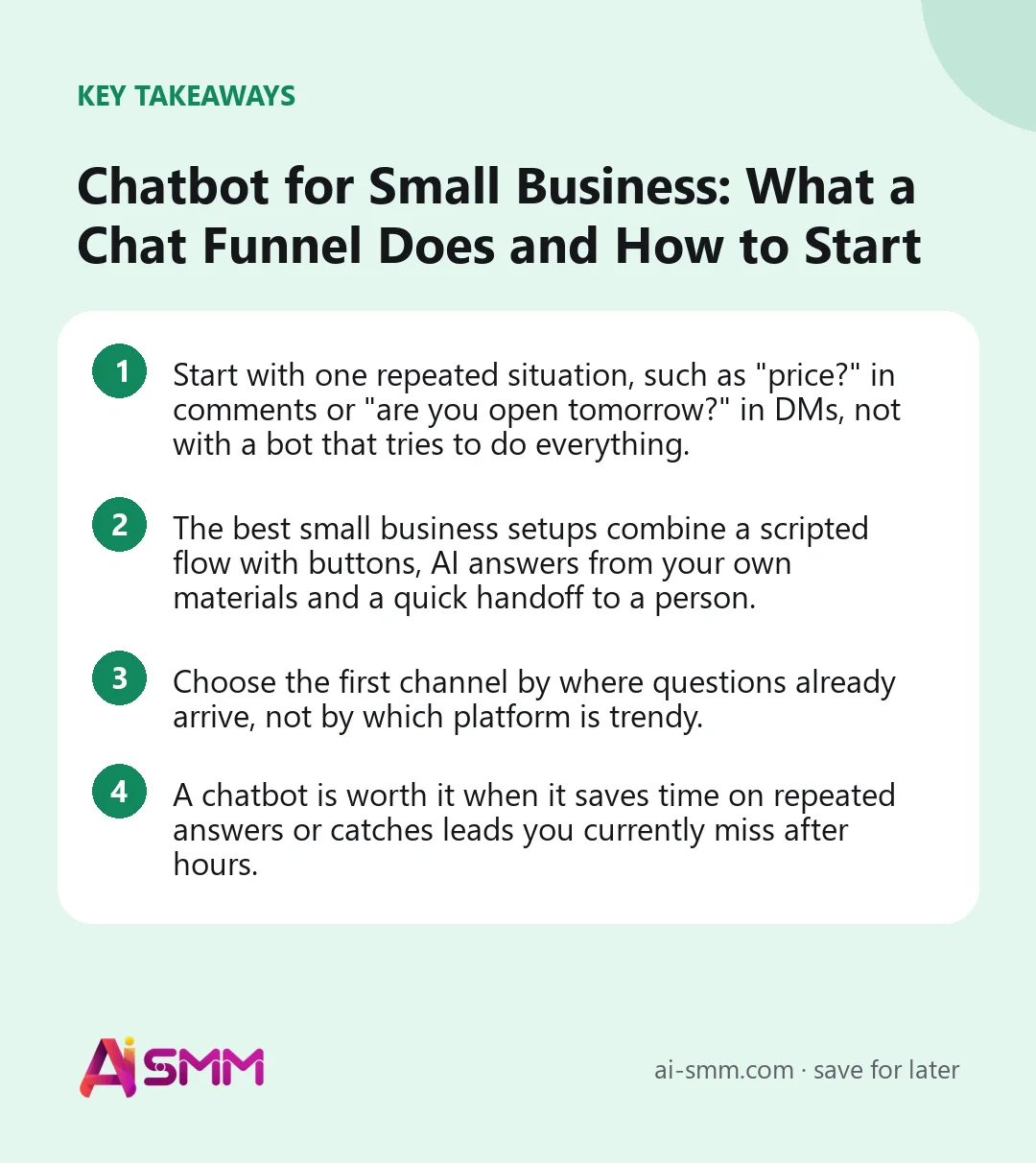
- Start with one repeated situation, such as “price?” in comments or “are you open tomorrow?” in DMs, not with a bot that tries to do everything.
- The best small business setups combine a scripted flow with buttons, AI answers from your own materials and a quick handoff to a person.
- Choose the first channel by where questions already arrive, not by which platform is trendy.
- A chatbot is worth it when it saves time on repeated answers or catches leads you currently miss after hours.
What a chatbot for small business actually does
“Chatbot” sounds like a robot that talks. In practice, for a small business it is closer to a well-organised receptionist following a script. The script is called a chat funnel or flow: a sequence of messages, buttons and conditions that moves a person from a first question to a useful result.
| Job | Example | What it saves |
|---|---|---|
| Answer frequent questions | Prices, hours, delivery, address | Typing the same answers every day |
| Deliver a promised item | A price list or guide after a comment | Manually sending files to each person |
| Qualify a lead | Two or three questions about budget and needs | Long back-and-forth before you know if it fits |
| Collect contacts | Phone or email in exchange for a discount | Leads lost after the chat closes |
| Book an appointment | Show free slots and confirm a time | Phone calls and schedule juggling |
| Sell and give access | Invoice, payment, access to a private channel | Manual invoices and checking payments |
| Follow up | A reminder when someone stopped replying | Leads forgotten in a busy week |
A funnel does not have to do all of this. Most small businesses get real value from one or two of these jobs done reliably.
Scripted flow, AI answers or a person: what is the difference?
There are three ways a chat conversation can be handled, and a good setup uses all three in the right places.
| Scripted flow | AI answers | A person | |
|---|---|---|---|
| How it works | Buttons, branches and fixed messages | Answers written by AI from your knowledge base | Someone on your team replies in the inbox |
| Best for | Predictable paths: booking, lead magnets, payments | Open questions about prices, terms, products | Complaints, complex requests, negotiations |
| Strength | Fully predictable | Handles varied wording | Judgement and empathy |
| Weakness | Rigid when people type something unexpected | Only as good as your materials | Limited hours, costs time |
A practical rule: script what must happen the same way every time, let AI answer from your prices and policies, and route anything sensitive to a person quickly.
Signs your business needs a chatbot
- You answer the same five questions many times a week.
- Messages arrive in the evening or on weekends and wait until morning.
- Comments like “price?” or “how to order?” under posts go unanswered for hours.
- You promise a guide or discount in a post and then send it by hand to each person.
- Leads go quiet mid-conversation and nobody follows up.
- Booking takes three or four messages back and forth.
If two or more of these are true, a simple funnel will likely pay for itself in saved time within weeks. If none are true and you get a few messages a week, a chatbot is not your priority yet.
Which channel to start with
Start where your clients already write to you. Here is a starting point by type of business:
| Business | Start with | First flow |
|---|---|---|
| Beauty salon, studio | Instagram comments and DMs | Comment “price” → price list in DMs → booking |
| Expert, coach, course creator | Telegram | Subscribe to the channel → get a free guide |
| Cafe, delivery | WhatsApp or Telegram | Menu, delivery zones, order status questions |
| Online store | Website chat and Instagram DMs | Delivery and returns answers, discount for a contact |
| Local services | WhatsApp and website chat | Two qualifying questions → request with a phone number |
Different networks allow different things. On Instagram and Facebook, a comment can trigger a private message. In Telegram, a bot can check whether someone subscribed to your channel and accept payments in Telegram Stars. One well-built flow can often be connected to several channels later.
Five starter chat funnels for a small business
1. Comment to DM
Trigger: someone comments a keyword under a post. The flow replies publicly (“sent you the details”) and sends the promised item in DMs, then offers a next step such as booking. Great for posts that promise a price list, a checklist or a discount.
2. Subscribe and get a gift
Trigger: someone starts the bot. The flow asks them to subscribe to your Telegram channel, checks the subscription and then gives the gift. It grows the channel and hands over value in one move.
3. Lead magnet with a contact
Trigger: a message or a button. The flow asks one or two questions, then offers a discount or guide in exchange for a phone number or email. The contact is saved with a tag so you can follow up.
4. Booking in the chat
Trigger: the word “book” or a button. The flow shows services and free times, books the slot and reminds the client before the visit. Fewer calls, fewer no-shows.
5. Catch the silent one
Trigger: inactivity. If someone asked about a price and stopped replying, the flow sends a gentle follow-up after a set time, or reaches them in another messenger. Many “lost” leads were simply busy.
How to launch your first flow in an afternoon
- Pick one situation. Choose the question or comment you see most often.
- Write the ideal conversation. On paper, write what a great employee would say, in three to five messages.
- Add buttons for the common answers. Buttons are faster than typing and keep people on the path.
- Add an exit to a person. A “talk to a human” button or an automatic handoff when the bot is unsure.
- Test it as a draft. Go through it yourself from a second account, including wrong answers.
- Publish and mention it. Tell people in a post or story what to comment or which word to send.
- Review it weekly. Read a few real conversations and fix where people drop off.
What to measure
- How many conversations the flow started per week.
- How many people reached the end: got the item, left a contact, booked.
- How many conversations were handed to a person, and why.
- Time to first response before and after the bot.
- Bookings or orders that started in a chat.
If many people stop at the same step, that step is the problem: too many questions, an unclear button or an unexpected request for a phone number too early.
What to prepare before you build
The build itself is the quick part. What slows most businesses down is missing material. Gather this first and the flow almost writes itself:
- The 10 questions clients ask most often, with the answers you actually give.
- Current prices, or price ranges, for your main services or products.
- Working hours, address, delivery zones and payment options.
- The one thing you want a new contact to do: book, order, leave a phone number or subscribe.
- The item you promise in exchange: a discount code, a price list, a short guide.
- A name and tone for the bot that match your posts, formal or friendly.
An example: a nail studio’s first month with a chat funnel
Here is an illustrative scenario. A two-person nail studio gets most of its questions under Instagram posts: “price?”, “any slots on Saturday?”. The owner answers in the evenings, and by then some people have already booked elsewhere.
In week one, she launches a single comment-to-DM flow: anyone who comments “price” under a post gets a public reply and a DM with the price list and a “Book a slot” button. In week two, she adds AI answers for open questions, based on a short knowledge base with prices, aftercare rules and the address. In week three, she notices that many people open the price list but do not book, so she adds a follow-up the next day: “Still thinking? Here are this week’s free slots.” In week four, she reads twenty real conversations and rewrites two answers that confused people.
The result she cares about is not the bot itself but fewer evenings spent typing and fewer lost bookings. The same step-by-step approach works for a cafe, a repair service or an online shop: one flow, one improvement per week.
How to do it in AI SMM
In AI SMM, chat automation offers ready funnels that open as drafts with the blocks already wired: comment to DM, subscribe and get a gift with a Telegram subscription check, a lead magnet that collects a phone number, a sale with paid access for a set number of days, and a follow-up for leads who went quiet. If you prefer, describe the flow in plain words and the agent assembles a draft for you. Every run is logged step by step, so you can see why the bot answered the way it did.
For open questions, connect an AI knowledge base with your prices, services and policies; AI answers from it and hands the conversation to a person in the shared inbox when it is not sure. Salons and studios can link flows to online booking so a comment ends with a confirmed appointment. The same flow can work in Telegram, WhatsApp, the website chat and under Instagram posts.
Common mistakes
- Building a giant bot with twenty branches before testing one simple flow.
- Hiding the way to reach a person. Frustrated clients leave.
- Asking for a phone number in the first message, before giving any value.
- Writing like a robot. Use the same tone as your posts.
- Setting it up once and never reading the real conversations.
FAQ
Do I need to know how to code to build a chatbot?
No. Modern flow builders use blocks, buttons and conditions on a visual canvas, and some can assemble a draft from a plain description.
Will a chatbot annoy my clients?
Only if it blocks them. A bot that answers quickly, offers buttons and hands over to a person when needed usually feels like good service, especially outside working hours.
Can a chatbot take payments?
Yes, a flow can issue an invoice, wait for payment confirmation and then give access, for example to a private channel for a set number of days. In Telegram, payments in Stars are also possible.
How much time does a chatbot need each week?
After launch, 15–30 minutes a week to read a sample of conversations and update answers is usually enough for a small business.
Choose the one question you answer most often and turn it into your first flow with a ready template in chat automation on AI SMM.
Posts, chats, video and sales in one workspace. 7 days free.
Start free