
 AI SMM team
Most small businesses have the same quiet problem on social media: people follow, maybe like a post or two, and then drift away until a competitor catches their attention. Discounts bring them back once, but a discount alone trains customers to wait for the next sale. Gamification offers a different lever. Points, small tasks, a leaderboard and rewards for bringing a friend give people a reason to come back to your chat on their own, and every visit is a chance to sell again.
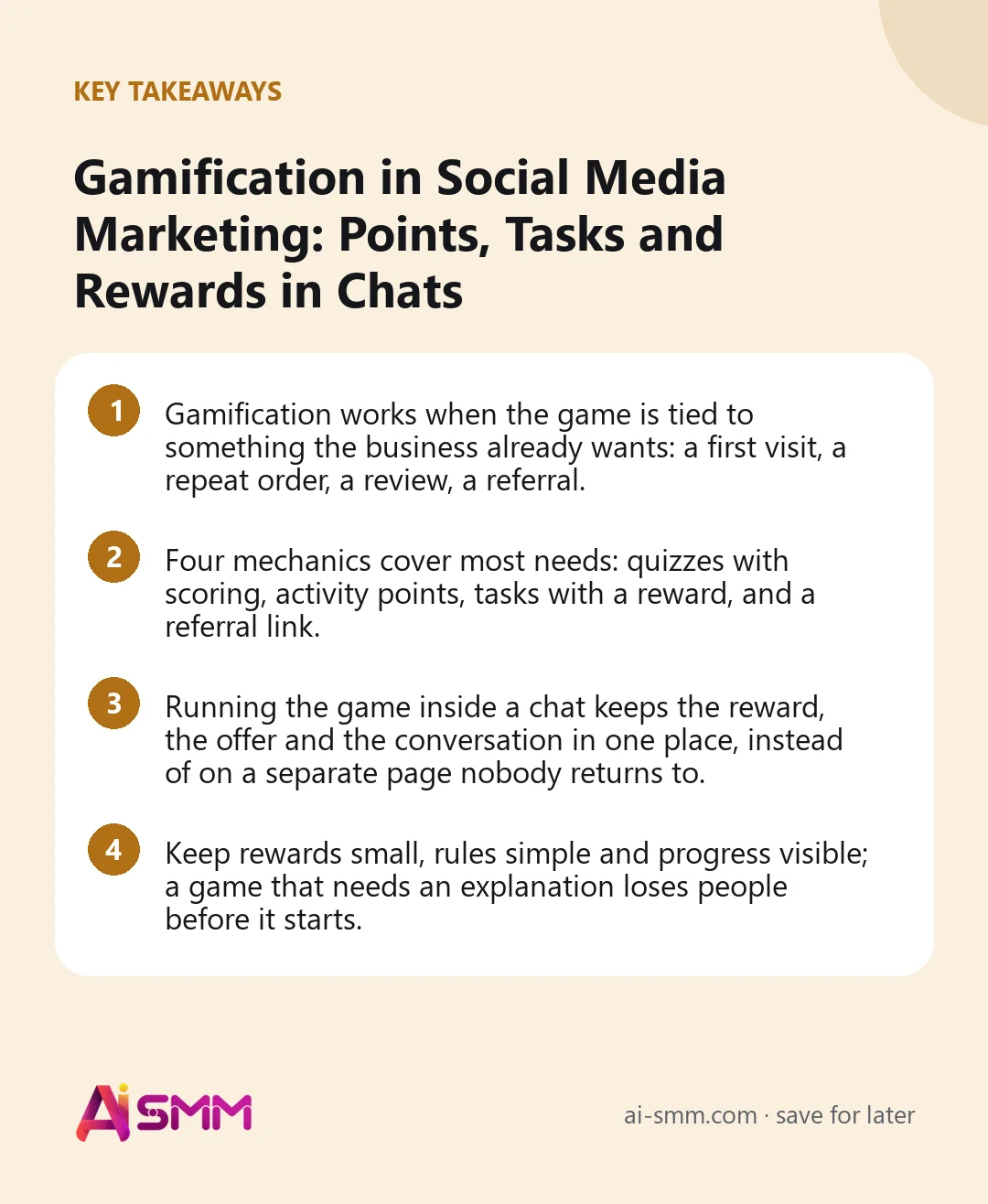
- Gamification works when the game is tied to something the business already wants: a first visit, a repeat order, a review, a referral.
- Four mechanics cover most needs: quizzes with scoring, activity points, tasks with a reward, and a referral link.
- Running the game inside a chat keeps the reward, the offer and the conversation in one place, instead of on a separate page nobody returns to.
- Keep rewards small, rules simple and progress visible; a game that needs an explanation loses people before it starts.
What gamification means for a small business
In marketing, gamification simply means borrowing a few mechanics from games, such as scores, levels, challenges and prizes, and using them to shape customer behaviour. It does not require building an app or hiring a game designer. For a salon, a coffee shop, an online store or an expert with a course, it usually comes down to three questions: what do you want people to do more often, how will you count it, and what do they get when they reach a goal.
The reason it works is not complicated. People like to see progress, they like finishing things they started, and they respond to a small reward more reliably than to an abstract promise of value. A card with seven stamps out of ten at a coffee shop is gamification. So is a quiz that tells someone which skincare routine suits them. Moving these mechanics into social media chats simply puts them where your customers already spend their time.
What gamification is not: a replacement for a good product or honest service. If the core experience disappoints, points will not save it. Treat game mechanics as an amplifier for relationships that already have some goodwill, not as a way to manufacture it from nothing.
Why chats are the right place for game mechanics
A game on a separate landing page asks someone to leave the conversation they were already having with you, open a new tab, and remember to come back. Most people do not. A game inside a chat in Telegram, Instagram DMs or WhatsApp keeps everything in the same window: the question, the score, the reward and the next offer arrive as messages in a thread the person already has open.
There is a practical advantage too. When the game runs inside a chat flow, every answer and every point is attached to a real contact. You know who played, how far they got and what they chose, which means the follow-up can be personal. A landing page quiz often ends with an anonymous result; a chat quiz ends with a conversation you can continue.
Finally, chats have a natural rhythm for returning. A message saying “you are 20 points away from a free dessert” lands in the same place as the last order confirmation, so the reminder feels like part of an ongoing relationship rather than an ad.
1. Quizzes with scoring that lead to an offer
A quiz is usually the easiest place to start. Ask three to five questions, give each answer a score, and send people down different branches depending on the total. Someone who scores high on “ready to book” gets a first-visit discount; someone who scores low gets a helpful tip and a softer invitation.
Examples that work
- Beauty salon: “Find your treatment” quiz about skin type and goals, ending with a matching procedure and a booking link.
- Online store: a product finder that asks about budget and use, then recommends two or three items.
- Expert or coach: a short knowledge test; high scorers are invited to the advanced paid course, others to a free starter guide.
The key is that the quiz ends with something specific. “Thanks for playing” wastes the attention you just earned. A result plus one clear next step, one tap away, turns the game into a sales conversation without it feeling like one.
2. Activity points that build loyalty over time
Quiz points live inside one game. Activity points are different: they accumulate on the customer’s profile across every interaction. An order, a booking, a review, a reply to a survey, joining your Telegram channel, each can earn a few points. Over weeks and months those points turn into a loyalty level.
Set a small number of thresholds, not a complicated ladder. For example, a café might use three levels: after 100 points a free drink, after 300 a dessert, after 600 a table reservation priority on busy evenings. The exact numbers matter less than two rules: the first reward should be reachable within two or three visits, and the customer should always be able to see how far they are from the next one.
Points also give you a reason to message people that is not a sales pitch. “You have 80 points, one more order gets you a free drink” is useful information, and it tends to be welcomed rather than ignored.
3. Tasks and challenges with a clear reward
A task is a small, concrete action with a reward attached: leave a review after your visit, share your order in Stories and tag us, invite one friend, complete your profile, try a new menu item this week. Tasks are powerful because they point customer energy at something that helps the business, while the customer feels they are simply playing along.
Good tasks share a few traits:
- They are easy to check. “Subscribe to our Telegram channel” can be verified automatically; “tell everyone about us” cannot.
- They take minutes, not hours. A challenge that needs a weekend of effort attracts only your most loyal fans.
- They have a deadline or a season. A “summer challenge” with five tasks creates more urgency than an open-ended list.
- The reward matches the effort. A review or a referral deserves more points than opening a message.
A subscription task deserves a special mention. In Telegram, a chat flow can check whether someone actually joined your channel before giving the gift, which removes the usual problem of people subscribing, grabbing the reward and leaving a minute later.
4. Leaderboards that create friendly competition
A leaderboard shows who has earned the most points in a period. It works best for communities where people already know each other a little: a fitness studio, a book club, a course cohort, a local shop with regulars. Seeing your name near the top is a motivation of its own, often stronger than the prize.
A few rules keep leaderboards healthy. Reset them regularly, monthly or per season, so newcomers have a real chance and the same three people do not win forever. Reward more than the first place; a prize for the top ten keeps the middle of the table engaged. And respect privacy: show shortened names rather than full names, and never publish anything about purchases or amounts spent.
For businesses where customers do not know each other, such as a dentist or an accounting firm, skip the public leaderboard and use personal progress instead. Competition only motivates when there is someone to compete with.
5. Referral rewards that turn customers into a channel
Referral programs are the most direct way gamification turns into revenue. Every contact gets a personal link to share. When a friend comes through that link and completes an order or a booking, both sides get something: a discount for the newcomer, points or a gift for the person who invited them.
Tie the reward to a real action, not a click. If people get rewarded just for a friend opening a link, you pay for curiosity rather than customers. When the reward triggers only after a first order or a confirmed visit, the incentive stays honest and the cost of acquiring a new client stays predictable.
Make the link easy to share from the chat itself. A message like “Here is your link, send it to a friend who would like our lavender latte” with a ready-to-forward text does more than a buried referral page on a website.
How to design a game that does not backfire
Gamification can annoy people as easily as it delights them. The most common mistakes are predictable, so they are easy to avoid.
| Mistake | What happens | Better approach |
|---|---|---|
| Rewards that are too far away | People never reach the first prize and stop playing | Make the first reward reachable in 2–3 interactions |
| Complicated rules | Nobody reads them, nobody plays | Explain the game in one sentence |
| Points for everything | Points lose meaning and the budget leaks | Reward only actions that help the business |
| A game with no end | Engagement fades after a couple of weeks | Run seasons, reset leaderboards, add new tasks |
| Rewards only in discounts | Customers learn to buy only with a discount | Mix in experiences: early access, a gift, a small privilege |
One more principle: never let the game block the purchase. If someone just wants to order, they should be able to do it in one step. The game is an invitation, not a toll gate.
Measuring whether gamification pays off
A game is a marketing tool, so judge it like one. Before you launch, write down the one behaviour you want to change: more repeat orders, more reviews, more referrals, more people finishing a quiz and booking. Then watch that number, not the number of points issued.
Useful questions to check after a month:
- How many people started the quiz or the challenge, and where did they drop off?
- Did players come back more often than non-players over the same period?
- How many new customers arrived through referral links, and what did each reward cost?
- Which rewards were actually claimed? An unclaimed reward is a sign the threshold is too high or the prize is not attractive.
In our experience, the first version of any game needs adjusting. Treat the first month as a test, change one thing at a time, and keep what moves the target number.
Running gamification in AI SMM
In AI SMM, gamification is not a separate app; it is a set of blocks inside the chat flow builder, so the same game works in any connected messenger. A quiz is built from question blocks with scoring, and a “check score” block splits the flow by the total: enough points lead to a discount, fewer points lead to a tip or a softer offer. Quiz points stay within one run, while activity points are saved on the contact card, so loyalty builds up across orders, bookings and conversations.
You can set loyalty thresholds, give every contact a personal referral link right in the chat, and have a reward step fire automatically once the condition is met, for example after a friend completes an order. Tasks and a leaderboard use the same points from the contact card, so there is one place where a customer’s progress lives. In Telegram, a flow can also check that someone really subscribed to your channel before handing out a gift.
Every player lands as a contact in the shared inbox with their answers and points attached, so the team can see who is close to a reward and follow up with context. The flow run history shows where each conversation stopped, which makes it easy to spot the question where people drop out of a quiz.
FAQ
Does gamification work for B2B or only for consumer brands?
It works for both, but the mechanics differ. B2B audiences respond better to quizzes that diagnose a problem, knowledge tests and early-access rewards than to public leaderboards or discount points. The principle is the same: give value first, reward the actions that move the relationship forward.
How big should the rewards be?
Smaller than most people expect. A free drink, a sample, early access to a new collection or a small gift usually motivates as well as a large discount, and it protects your margin. What matters most is that the first reward is close enough to feel achievable.
Will a game in chats annoy my followers?
Only if you push it on everyone. Invite people to play through a post, a Stories mention or a comment trigger, and let them opt in. Progress messages should be occasional and useful, such as reminding someone they are one step from a reward, not a daily nudge.
Which networks can run a chat game?
Any channel where your chat flows run. Telegram bots, Instagram DMs and WhatsApp are the most common for small businesses, and one flow can be connected to several channels at once.
A good game gives customers a reason to come back before they need to buy, and that is exactly when repeat sales start. Build your first quiz or loyalty flow with AI SMM gamification.
Posts, chats, video and sales in one workspace. 7 days free.
Start free