
 AI SMM team
Social media for online schools is where most students first meet you, long before they see a sales page. Someone watches a short explanation, saves a carousel, joins a free lesson, and only weeks later decides whether your course is worth their money and evenings. Many schools skip the middle of that path: they post launch announcements, run a webinar, and then go quiet until the next intake. This guide covers what to post between launches, how to move people from a free lesson to enrollment through chats and booked calls, a weekly plan for a small team, and how to keep students engaged once they have paid.
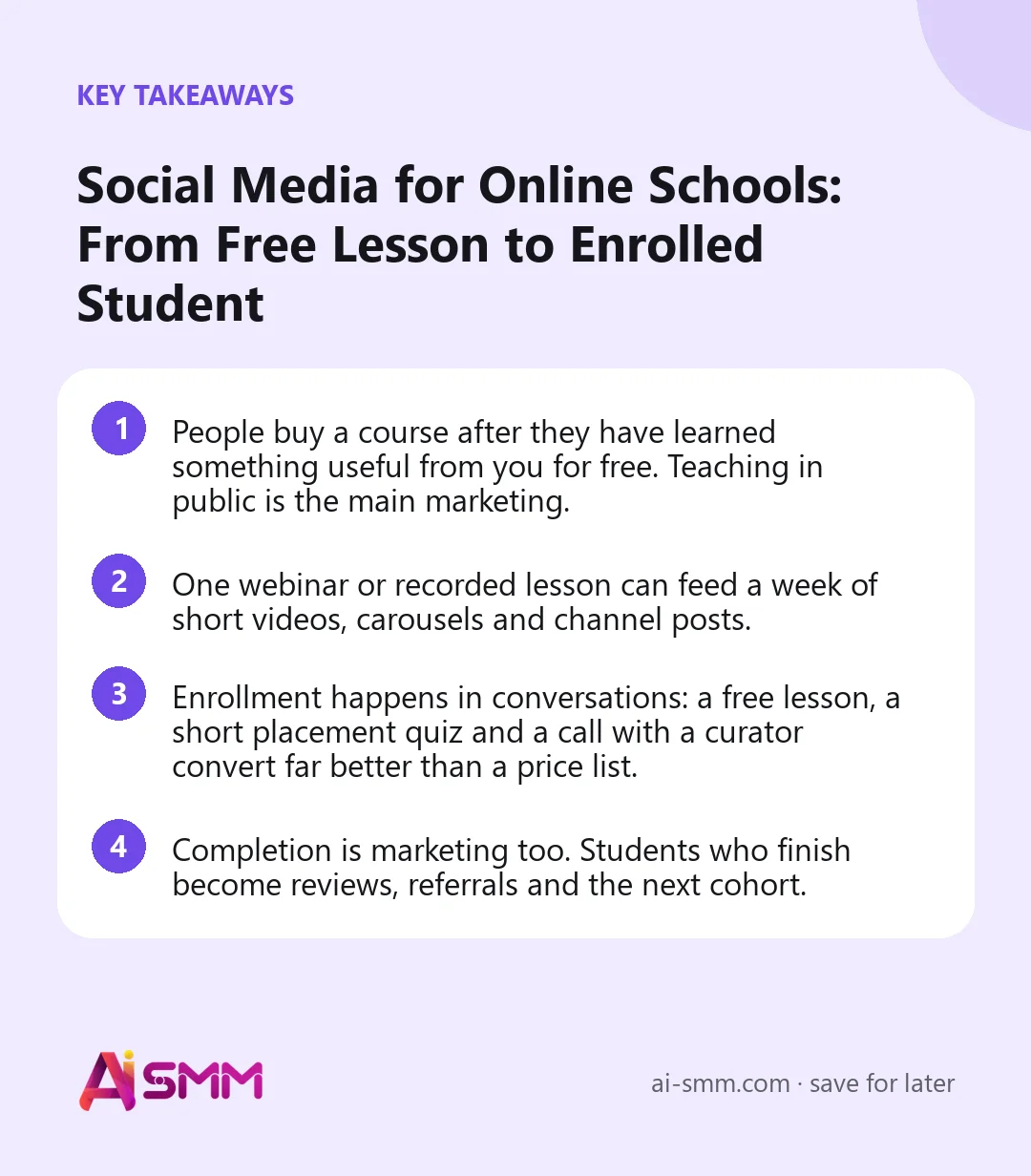
- People buy a course after they have learned something useful from you for free. Teaching in public is the main marketing.
- One webinar or recorded lesson can feed a week of short videos, carousels and channel posts.
- Enrollment happens in conversations: a free lesson, a short placement quiz and a call with a curator convert far better than a price list.
- Completion is marketing too. Students who finish become reviews, referrals and the next cohort.
1. Why social media for online schools works like a free trial
An online course is a promise of change: a new language, a new profession, a skill for work. The buyer cannot touch it before paying, so they look for proof in what you publish:
- Can these teachers explain clearly? A two-minute lesson on social media answers that better than any description.
- Is this for someone like me? Content for beginners, people switching careers, parents, busy professionals.
- Do students actually finish and get results? Stories from graduates, shown honestly.
That is why the most effective school accounts look like a free mini-course spread across the feed, with clear invitations to go deeper.
2. Choose networks by the format you teach in
| Network | Role for an online school |
|---|---|
| YouTube | Full lessons and webinar recordings that people find through search months later |
| Short lessons in Reels, carousels with cheat sheets, Stories with polls and quizzes | |
| TikTok | Quick tips that reach people who have never heard of you |
| Telegram | A school channel with daily practice, announcements, and private channels for paid students |
| Professional courses: career stories, skills employers ask for, corporate training | |
| Threads | Short questions and discussions, useful for testing topics before you film them |
A small school can run YouTube for long lessons, one short-video network for reach and a Telegram channel as the place where interested people wait for the next intake.
3. Content pillars with examples
Mini-lessons
- “Three phrases that make your English emails sound less formal”, 45 seconds.
- A carousel cheat sheet: “Excel shortcuts that save 20 minutes a day”, worth saving.
- A common mistake and how to fix it, shown on screen.
Teachers and method
- A teacher’s story: how they learned the skill themselves and what they got wrong.
- “How a week in our course looks”: lessons, homework, feedback, live sessions.
- Why you teach in a certain order, explained in one simple diagram.
Student stories
- A graduate’s first project or first job in the new field, shared with permission.
- Before and after homework: the same task on day 1 and day 30.
- Honest stories about difficulties: “I nearly quit in week three, here is what helped.”
Community and practice
- A daily or weekly challenge in the channel: one exercise, answers the next day.
- Live Q&A sessions announced in advance.
- Polls: “What should our next free lesson be about?”
Be careful with income or career promises. “Graduates earn X” invites doubt and, in many countries, advertising complaints. Show real examples and say clearly that results depend on the student’s effort.
4. Turn one webinar into a week of content
Recording a lesson or webinar is the most expensive part. Reuse it fully:
- The full recording goes to YouTube with a searchable title: the skill, the level, the result.
- Five to ten short clips for Reels, TikTok and Shorts: one idea per clip, subtitled.
- A carousel with the main steps or a cheat sheet from the lesson.
- A Telegram post with a short summary and one exercise for subscribers.
- A Stories quiz based on the lesson, with the answer the next day.
Pick clips where the teacher explains one thing clearly from start to finish. Those do better than jokes or introductions, because people save them.
5. Get leads from chats and booking
Most people who like your content will not buy from a sales page. They have questions: “I’m a total beginner, will I keep up?”, “How many hours a week?”, “What if I miss a live session?”. The school that answers these personally and quickly enrolls more students.
A free lesson funnel in chats
- A post or Reel ends with: “Comment LESSON and we will send you the free first lesson.”
- The person gets a direct message with the lesson and a question: “What is your level right now?”
- Two or three quiz questions place them into a level and suggest the right course.
- They are invited to the school’s Telegram channel or a short series of follow-up messages with useful material.
- Near the start of the intake, they get a personal invitation and a link to book a call.
Book a call with a curator or teacher
For more expensive programs, a 15–20 minute call removes most doubts. Let people pick a time themselves on a booking page with the schedules of your curators, and send a reminder the day before. A call that starts with the person’s quiz answers already on screen is shorter and more useful for both sides.
Payment and access without manual work
For smaller products, such as a mini-course or a paid practice channel, the whole sale can happen in the chat: an invoice, payment and access to a private Telegram channel for the paid period, without a manager sending links by hand.
Answer “it’s too expensive” and “I don’t have time”
These two objections come up in almost every enrollment conversation. Prepare honest answers in advance rather than improvising. For price: explain what is included (feedback on homework, live sessions, a curator), offer a smaller entry product or payment in parts if you have them, and never invent a fake deadline. For time: show the real weekly load, for example “three 20-minute lessons and one homework task”, and share a story of a student with a full-time job who finished the course. Turn the best answers into posts too, because the people who do not ask have the same doubts.
6. Keep students engaged until the end
Low completion rates are the hidden problem of online education. Students who drop out do not leave reviews or buy the next course. Social media and chats can help:
- Tasks and points: a point for each homework submitted, a leaderboard for the cohort, a small reward for everyone who finishes.
- Reminders: a friendly message before a live session and a nudge to someone who has not opened a lesson for a week.
- A student-only channel with extra material, answers to common questions and graduate stories.
- Referral links: a discount for both the student and a friend who enrolls.
7. A weekly plan for a small school
| Day | Post | Goal |
|---|---|---|
| Monday | Short clip from last week’s lesson on Reels, TikTok and Shorts | Reach |
| Tuesday | Carousel cheat sheet on one topic | Saves, trust |
| Wednesday | Telegram practice post with an exercise | Keep subscribers warm |
| Thursday | Student story or homework “day 1 vs day 30” | Proof |
| Friday | Teacher introduction or “a week in the course” | Explain the product |
| Saturday | Stories quiz, answer on Sunday | Engagement |
| Sunday | Full lesson or webinar recording on YouTube (every two weeks) | Search traffic |
In the weeks before an intake, replace one or two posts with invitations to the free lesson and reminders about the start date. Do not switch the whole feed to selling; the audience came for learning.
8. Common mistakes
- Only posting during launches. Silence between intakes means starting from zero every time.
- Talking about the course instead of teaching. Proof of teaching quality sells better than a list of modules.
- Promising incomes or jobs. It creates distrust and may break advertising rules.
- One funnel for everyone. A beginner and a professional need different first steps.
- Slow answers to “Is this for me?”. That question is the last step before buying.
- Forgetting current students. A cohort that feels abandoned will not recommend you.
9. How AI SMM helps an online school
AI SMM covers both content and enrollment. Video clipping turns a YouTube lesson or webinar into subtitled vertical clips, the AI content studio drafts carousels and Telegram posts from the same topic, and everything goes into one calendar across YouTube, Instagram, TikTok, LinkedIn, Threads and your Telegram channel. Analytics shows which topics gathered the most saves and replies (Telegram itself has no analytics in AI SMM, so judge your channel by replies and enrollments).
Chat flows run the “comment LESSON” funnel, the placement quiz, follow-up messages before an intake and paid access to a private Telegram channel after payment. Tasks, points and leaderboards for a cohort work inside the same chats. The booking page lets people choose a call with a curator or a trial lesson with a teacher, with reminders sent automatically, and the unified inbox keeps questions from Instagram, Telegram, WhatsApp and the website chat in one list. Put the free lesson, the booking link and the channel on one link in bio page. Schools built around one teacher’s name will find more ideas in the experts and creators solutions.
10. What to measure
- Free lesson requests per week and where they came from.
- Share of free-lesson students who booked a call or bought a course.
- Completion rate per cohort, with and without reminders and challenges.
- Enrollments from referral links and returning students.
FAQ
What is the best social network for an online school?
YouTube for long lessons that bring search traffic, plus one short-video network for reach. In Russian-speaking markets, a Telegram channel is often the main place where interested people wait for the next intake.
How much free content should we give away?
More than feels comfortable. Free lessons show the quality of teaching; the course sells structure, feedback, practice and a result. People rarely buy less because they learned something for free.
Should we run webinars or record short lessons?
Both work together. A live webinar gathers people at one moment and lets them ask questions; its recording becomes a week of short content. Short lessons keep the feed alive between webinars.
How do we collect honest student reviews?
Ask at a moment of success, for example after the final project, with two or three specific questions. Publish only with permission and do not edit away the difficulties students mention.
Want every free lesson request to turn into a conversation that ends with enrollment? Build the funnel in chat automation in AI SMM.
Posts, chats, video and sales in one workspace. 7 days free.
Start free