
 AI SMM team
The Threads algorithm decides which posts appear in the For You feed, and for most brands that feed is where almost all of the reach comes from. Unlike Instagram, Threads rewards words and conversation more than polished visuals, which is good news for small businesses and experts who can write but do not have a production budget. The catch is that the rules are different: a post that would do well on Instagram can disappear on Threads, and a two-line opinion with a lively reply thread can reach thousands of people who have never heard of you. This guide explains what the ranking looks at, why replies matter so much and a routine that helps a business account get seen.
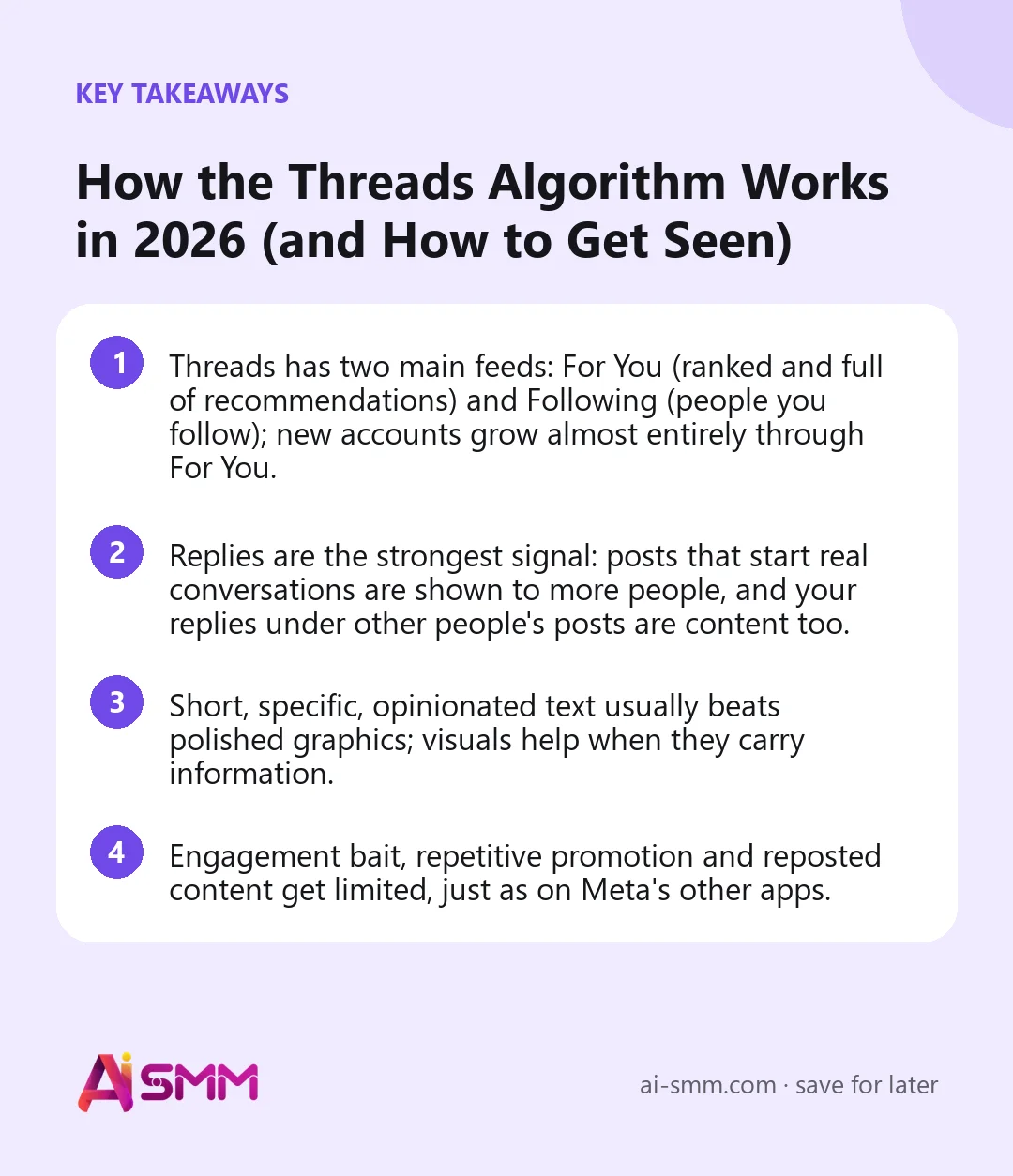
- Threads has two main feeds: For You (ranked and full of recommendations) and Following (people you follow); new accounts grow almost entirely through For You.
- Replies are the strongest signal: posts that start real conversations are shown to more people, and your replies under other people’s posts are content too.
- Short, specific, opinionated text usually beats polished graphics; visuals help when they carry information.
- Engagement bait, repetitive promotion and reposted content get limited, just as on Meta’s other apps.
The two feeds: For You and Following
When someone opens Threads, they land on For You, a ranked feed that mixes posts from accounts they follow with recommended posts from accounts they do not. They can switch to Following, which shows only accounts they follow. Most people stay on For You, which means that for a business account, especially a new one with few followers, the recommendation system is the main door to an audience.
This is also why follower counts on Threads say less than on Instagram. A small account can have a post seen by many times its follower count if the post starts a conversation, and a large account can post into silence if its posts do not.
How the Threads algorithm ranks posts
Threads is built by Meta and uses the same general approach as Facebook and Instagram: for each person, the system gathers candidate posts, looks at signals about each one, predicts how that person is likely to respond and orders the feed by those predictions. Meta and the head of Instagram and Threads have talked publicly about the main factors. In plain terms, the algorithm is asking:
- Is this person likely to reply, like, repost or quote this? Replies carry the most weight because Threads is built around conversation.
- How have they interacted with this account before? People who replied to you or liked your posts see you more often.
- Is the topic something they engage with? Signals include what they read, reply to and follow on Threads, and Meta has said activity on Instagram can inform recommendations too.
- How fresh is it? Threads favours recent posts, but an older post can come back into feeds when a new wave of replies arrives.
- Is there any negative feedback? Muted, hidden or reported posts and accounts are shown less.
The ranking signals that matter for a brand
| Signal | Why it matters | What to do |
|---|---|---|
| Replies and reply chains | The clearest sign that a post is worth attention | Ask questions you would genuinely like answered and reply back to people |
| Reposts and quotes | Carry your post to new audiences with someone’s endorsement | Write lines people want to add their own view to |
| Likes | A light, quick signal of interest | Useful, but do not optimise for likes alone |
| Time spent on the post | Longer reading or viewing suggests value | Make every line count; use a carousel when you have steps or examples |
| Relationship | People who interacted with you before get your posts more often | Stay in conversation with your regulars |
| Topic relevance | Posts reach people interested in the topic | Stick to a few clear subjects; add a relevant topic tag |
| Negative feedback | Mutes, hides and reports reduce distribution | Avoid repetitive selling and provocation for its own sake |
Why replies are half of the Threads algorithm
On Threads, a reply is not just a reaction to content; it is content. Replies you write under other people’s posts can appear in feeds, bring people to your profile and start the relationship signals that make your own posts show up for them later. For a small business this changes the daily routine:
- Answer every reply on your own posts, ideally within the first hour or two. A post with a back-and-forth looks alive to the algorithm and to readers.
- Reply thoughtfully under posts in your niche. A useful two-sentence answer under a popular post from an industry voice can bring more profile visits than your own post that day.
- Ask real questions. “What is the one tool you would never give up in your kitchen?” invites answers from experience. “Thoughts?” invites nothing.
- Keep the conversation going. Replying with a follow-up question turns one comment into a thread, and threads are what the ranking loves.
If replying is a chore, treat it as the main task and posting as the secondary one. Many accounts grow on Threads mostly through replies.
Topic tags, search and discovery
Threads lets you add a topic tag to a post, which places it into a topic that people can browse and search. It is not a hashtag wall: one relevant topic is the norm. Choose the topic your ideal reader would actually look for (“small business”, “interior design”, “coffee”), not a generic one. Keywords in the text itself also help people find your posts through search, so name the subject plainly instead of hinting at it.
What the Threads algorithm limits
- Engagement bait. “Like if you agree”, “Reply with an emoji to get the guide” and similar prompts are treated as low quality across Meta’s apps.
- Repetitive promotion. An account that posts mostly offers and links teaches the system that people do not engage with it.
- Reposted or unoriginal content. Screenshots of other people’s posts and recycled memes without your own view add little and are not what recommendations favour.
- Content that breaks recommendation rules. Meta applies its recommendation guidelines on Threads too, so borderline or sensational content may be seen by followers but not recommended further.
- Posts people mute or hide. If readers keep hiding your posts, fewer will be shown.
Links are allowed and useful, but in our experience a post whose whole value is “click here” rarely travels far. Say the useful thing in the post and add the link as a bonus.
What kind of posts do well on Threads
| Post type | Example for a small business | Why it works |
|---|---|---|
| A clear opinion | “Most cafés price their filter coffee too low. Here is why we changed ours.” | Invites agreement and disagreement in replies |
| A short lesson | “Three things I check before accepting a renovation job.” | Easy to read, easy to save and repost |
| A question to the community | “Designers: what is the client request you hear most often?” | Collects replies from the right people |
| A behind-the-scenes moment | A photo of today’s workshop mess with one honest line | Makes the account human |
| A carousel with steps | Five photos showing how an order is packed | Keeps people on the post longer |
| A small win or mistake | “We lost a big order because of one missing email. New rule:” | Stories get replies and quotes |
Keep text short (Threads posts are limited to 500 characters), put the most interesting line first and cut anything that sounds like a press release.
A daily Threads routine for a small business
- Morning, 10 minutes: reply to everything from yesterday and leave two or three useful replies under posts in your niche.
- One post a day: rotate opinion, lesson, question and behind the scenes. Short text is enough; add a photo or carousel when it carries information.
- First hour after posting: be around to answer replies quickly.
- Evening, 5 minutes: a final round of replies and a note of any question worth turning into tomorrow’s post.
- Once a week: look at which posts got replies and reposts, not just views, and write more like them.
Daily posting is realistic on Threads because posts are short. If your time is tighter, three posts a week plus daily replies still works better than daily posts with no replies. For the wider plan of what Threads should do for your business, see our Threads marketing strategy guide.
How to read your Threads numbers
- Views tell you whether the post was shown. High views with no replies means the hook worked but the content did not start a conversation.
- Replies are the best signal of what to repeat.
- Reposts and quotes show what people want to be associated with, often your most shareable ideas.
- Follower growth after a post shows which topics bring the right people, not just attention.
A post with modest views and many replies is usually a better model for the next one than a post with big views and silence.
How to apply this in AI SMM
AI SMM connects your Threads account and places it on the same calendar as Instagram and your other networks. AI Content Studio drafts short text posts, captions for photos or video and the slides of a carousel from a brief, in your brand’s tone; for a text-first network it is worth reading and editing the drafts so they sound like you. Scheduling lets you prepare a week of posts in one sitting so your daily time goes into replies. Replies and mentions arrive in the shared inbox, so a question under yesterday’s post does not go unanswered. Analytics shows views, likes, replies, reposts, quotes and followers per post, which is exactly what you need for the weekly review. For replies under other people’s posts, the Chrome extension is an assistant in your browser: it can like posts and follow accounts in your niche within Threads’ limits and drafts comments that are posted only after you approve them.
FAQ
Does posting on Threads at a specific time matter?
It matters less than on some networks. Recent posts get a boost, so posting when your audience is awake and being around to reply for the first hour helps, but a post with a good conversation keeps travelling well beyond the first hours.
Should I cross-post my Instagram captions to Threads?
Reuse the idea, not the text. Threads favours shorter, conversational posts, so rewrite the caption into one clear statement or question and drop the hashtag block.
Do links hurt reach on Threads?
Links are allowed, but a post that exists only to send people elsewhere usually gets fewer replies, and replies drive reach. Give the value in the post and add the link as a next step.
How long does it take to grow on Threads?
With daily replies and three to seven posts a week, most accounts see which topics work within four to six weeks. Growth is uneven: one conversation can bring more followers than a month of quiet posts.
Start with the replies: ten useful answers this week under posts in your niche, plus three posts of your own that ask a real question. Schedule your Threads posts in AI SMM so your time goes into the conversations that the algorithm rewards.
Posts, chats, video and sales in one workspace. 7 days free.
Start free