
 AI SMM team
Social proof marketing means showing potential customers that other people like them already chose you and were happy: reviews, ratings, client results, numbers, recognisable partners and real conversations. When people are unsure, they look at what others did, and a small business rarely has a famous brand to lean on, so proof does the persuading that advertising cannot. Below are nine types of social proof, how to collect them honestly, where to place each one on social media and your site, and the mistakes that turn proof into a red flag.
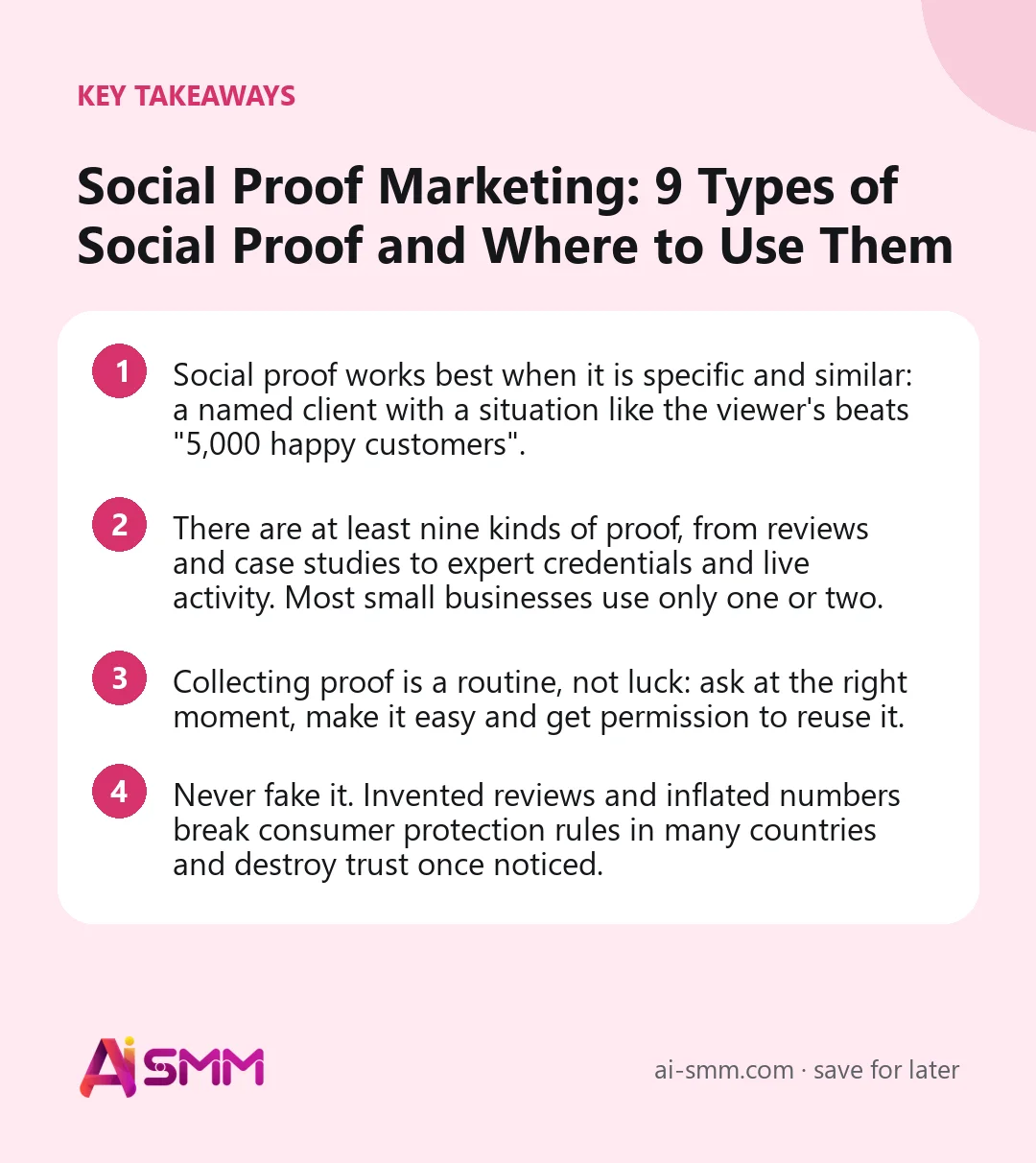
- Social proof works best when it is specific and similar: a named client with a situation like the viewer’s beats “5,000 happy customers”.
- There are at least nine kinds of proof, from reviews and case studies to expert credentials and live activity. Most small businesses use only one or two.
- Collecting proof is a routine, not luck: ask at the right moment, make it easy and get permission to reuse it.
- Never fake it. Invented reviews and inflated numbers break consumer protection rules in many countries and destroy trust once noticed.
What social proof marketing is and why it works
Social proof is the tendency to treat other people’s choices as evidence of what is right, especially when we are uncertain. Choosing a new dentist, a wedding photographer or an accountant is exactly that kind of uncertain decision: the customer cannot test the service before buying, so they look for signs that it worked for others.
Social proof marketing is the deliberate practice of collecting those signs and putting them where decisions happen: in your posts, in your profile, next to the booking button, in a chat reply to “is it worth it?”. It is not a campaign; it is a layer that runs through all your content.
Three things make proof persuasive:
- Similarity: the viewer recognises themselves in the person giving the proof (same city, same problem, same budget).
- Specificity: details, numbers and names make it believable. “Fixed my leaking roof the same day, fair price, cleaned up after” beats “Great service!”.
- Recency: a review from last week says more than a dozen from three years ago.
9 types of social proof for small businesses
| Type | What it looks like | Best for |
|---|---|---|
| 1. Customer reviews and ratings | Star ratings and written reviews on maps, marketplaces, your site or social pages | Every business; the baseline |
| 2. Testimonials | A short quote from a named client, ideally with a photo or video | Services, experts, B2B |
| 3. Case studies and results | Before/after, problem → solution → result with numbers | Services with visible outcomes: renovation, beauty, fitness, marketing, consulting |
| 4. User-generated content | Customers’ own posts, photos and videos featuring your product | Products, cafés, events, travel |
| 5. Numbers (“wisdom of the crowd”) | “1,200 cakes baked this year”, “300 students”, “12 years in the district” | Established businesses with real volume |
| 6. Expert and credential proof | Certificates, licences, training, professional memberships, awards | Health, legal, finance, education |
| 7. Partner and client logos, press mentions | “As featured in…”, brands you supply or work with | B2B, suppliers, agencies |
| 8. Influencer and creator endorsements | A local creator or niche expert using and recommending you | Consumer products, beauty, food, lifestyle |
| 9. Live activity and community | Comments, busy Stories from your venue, a lively chat or channel, “3 slots left this week” | Venues, events, limited offers |
You do not need all nine. Choose the three or four that suit your business and make them consistently visible.
How to collect social proof (without awkward begging)
Ask at the moment of highest satisfaction
The best time to ask is when the client has just felt the result: right after the haircut in the mirror, when the parcel arrives, when the renovation is finished, when a student passes the exam. A week later, the emotion has faded and the request feels like admin.
Make it effortless
- Send one direct link to the review page, not “find us on the map”.
- Ask one or two specific questions instead of “leave a review”: “What was your situation before? What changed?” This also produces more useful, specific reviews.
- Offer a quick option: a voice message or a two-line reply in chat that you can turn into a testimonial with their permission.
Build asking into your process
| Business | When to ask | How |
|---|---|---|
| Salon or studio | At the end of the visit | A short message with a review link and a request to tag you in Stories |
| Online shop | A few days after delivery | Message or email with a direct link to the product review |
| Consultant or agency | After a milestone with a measurable result | A short call or three written questions for a case study |
| Course or school | After the final lesson or first success | A form with “before / after / what helped” and consent to publish |
| Café or restaurant | While the guest is still at the table | A small card or table sign with a link or code; staff mention it, never pressure |
Get permission, then keep it
Before you publish a client’s name, photo, message screenshot or post, ask. A simple “Can we share your words on our page with your first name?” is enough, and keep the reply. For health, legal and financial services, be extra careful: clients may not want anyone to know they used you, even if they were delighted.
The guide to user-generated content covers in detail how to get customers to post about you and how to reuse their content with permission.
Where to place social proof
Proof works hardest where people hesitate. Map the moments of doubt in your customer’s path and put the right proof next to each.
| Where | What proof to show |
|---|---|
| Profile bio and highlights | A short credential or number in the bio; highlights named “Reviews”, “Results”, “Before/after” |
| Feed posts | A regular “client story” or “review of the week” series; before/after carousels; case studies |
| Stories | Reshared customer mentions (with the network’s own share), screenshots of kind messages with names hidden unless permitted |
| Pinned posts | Your strongest case study or a roundup of reviews |
| Link in bio page | A reviews section or link near the booking and catalogue buttons |
| DMs and chat replies | A link to results or reviews when someone asks “does it really work?” or “is it worth the price?” |
| Website and store | Reviews on product and service pages, testimonials near the price, logos near the contact form |
| Website popups and widgets | Recent activity (“12 people booked this week”), real numbers, a short quote, shown at the right moment |
| Email and Telegram channel | A monthly “what clients said” digest; one case study per issue |
Turning proof into content
A single good review can feed several posts. Examples of formats that turn proof into content people actually read:
- Review of the week: the quote in large type, the client’s first name and service, and one sentence from you on what you did.
- Before/after with the story: what the client came with, what you did, how long it took, what it cost if you show prices.
- Case study carousel: slide 1 the result, slides 2–5 the problem, the approach and the numbers, the last slide an invitation.
- Question from a review: a client mentions a worry they had (“I was scared it would hurt”); make a video answering that worry.
- Client interview Reel: 30 seconds of a happy client explaining why they came back, filmed with permission.
- Milestone post: a real number reached (“our 500th wedding cake”) with thanks to clients.
Keep proof posts to a steady share of your content, for example one or two a week, rather than a flood right after you collect a batch.
Honesty rules: what not to do
Social proof works because people believe it. Faking it is dishonest and, in many places, illegal: consumer protection authorities in the US, the EU, the UK and elsewhere treat fake reviews and misleading endorsements as unfair practices. The rules below are general guidance, not legal advice.
- No invented reviews, no reviews written by staff or friends pretending to be customers, and no buying reviews.
- No selective hiding that misleads. Filtering spam is fine; deleting every critical review is not.
- Disclose paid or gifted endorsements. Creators who got paid or received free products must say so, and you should make sure they do.
- No inflated numbers. “Thousands of clients” when you had 200 will be noticed. Use the real figure; a modest honest number is more persuasive than a vague big one.
- No incentives for positive reviews only. If you thank people for reviews, thank them for any honest review, not only five-star ones.
Handling negative reviews as social proof
A profile with only perfect ratings can look suspicious. A few critical reviews with calm, helpful replies often build more trust than none, because readers see how you behave when something goes wrong.
- Reply publicly and quickly, ideally within a day.
- Thank, acknowledge and do not argue. “Thank you for telling us. You’re right that we were late, and that’s not the standard we want.”
- Offer a fix and move details to private messages.
- Follow up. If the client is satisfied after the fix, they sometimes update the review.
How you answer comments and DMs is itself social proof; the guide to social media customer service has scripts for common situations.
Using social proof with AI SMM
Comments and DMs from Instagram, Facebook, Threads, YouTube and other connected channels arrive in one inbox, so kind words are easy to spot and critical ones get a quick reply before they grow. When you get a good review, the AI content studio helps turn it into a “review of the week” post or a case study caption in your brand voice, which you then schedule in the calendar alongside your other content.
On your website, popups include social proof widgets that show recent activity, and A/B tests show whether a proof message actually leads to more leads than a plain form. If you sell through the online store, product reviews sit on the store itself, next to the buy button, which is where hesitation is highest. A link in bio page can collect your review, results and booking links in one place for visitors coming from social media.
FAQ
What is the most effective type of social proof?
For most small businesses, specific reviews and case studies from clients similar to the viewer. A detailed story from someone in the same situation persuades more than large numbers or logos.
How many reviews do I need before they start working?
There is no magic number, but even a handful of recent, detailed reviews makes a difference compared with none. Focus on a steady flow of fresh reviews rather than a one-off campaign.
Can I use screenshots of client messages?
Only with permission, and hide names, photos and contact details unless the client explicitly agreed to show them.
Is it okay to offer a discount for a review?
Thanking people for any honest review is generally fine where the network’s and review platform’s rules allow it; rewarding only positive reviews is not. Check the rules of the specific review site, since many forbid incentives completely.
Your happiest clients are your best marketing, as long as their words reach the people still deciding. Collect replies in one inbox and turn the best into proof this week.
Posts, chats, video and sales in one workspace. 7 days free.
Start free