
 AI SMM team
Social media ROI (return on investment) is the profit your social media activity brings compared with what it costs: ROI = (return − cost) ÷ cost × 100%. If you spend €500 a month in total and social media brings €1,500 in gross profit, your ROI is 200%. The formula is simple; the hard part is filling it in honestly, because most small businesses forget to count their own time and do not know which sales actually came from social. This guide explains what to count as return and cost, how to trace sales back to social media, walks through a full example and shows the levers that raise ROI.
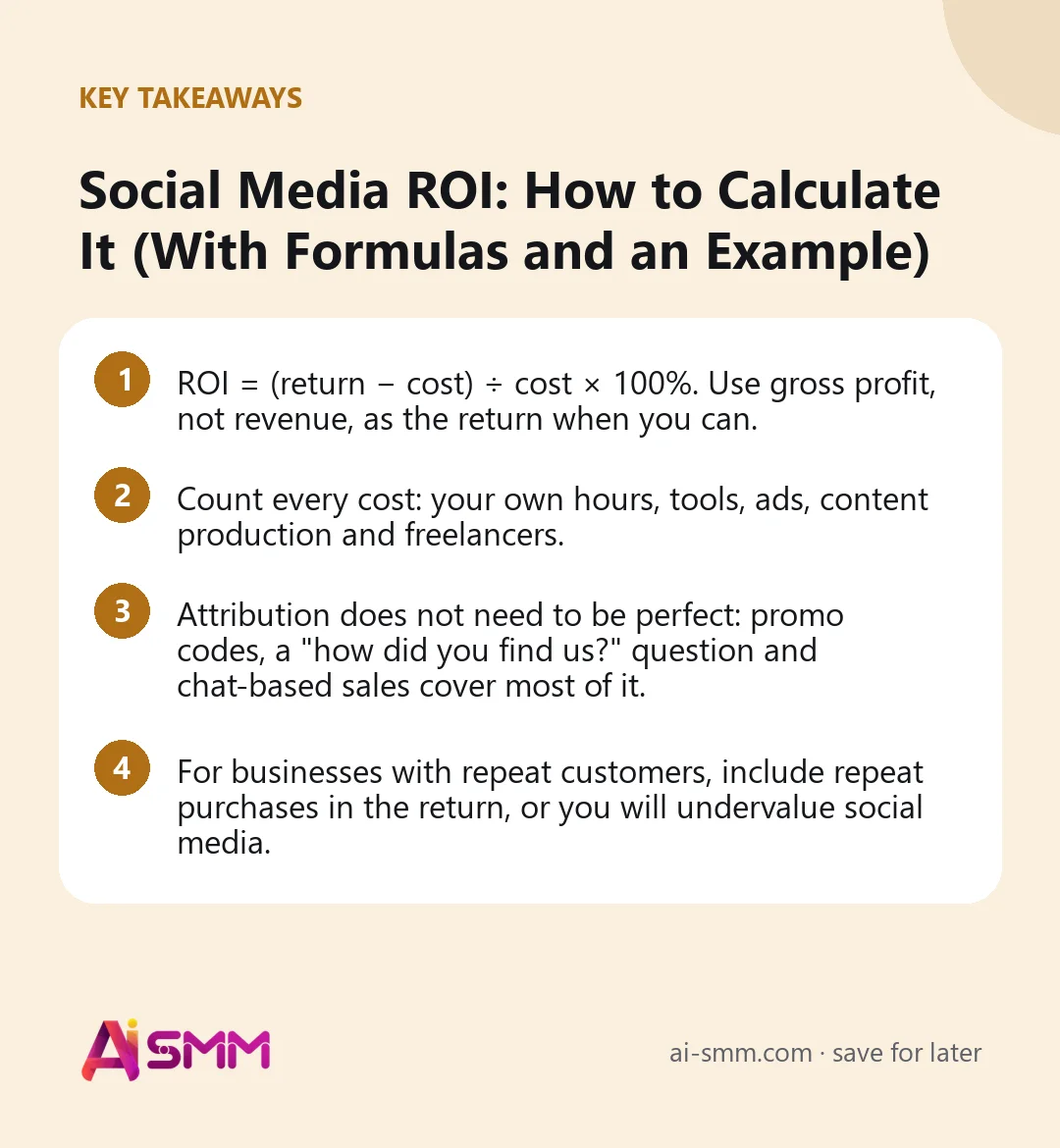
- ROI = (return − cost) ÷ cost × 100%. Use gross profit, not revenue, as the return when you can.
- Count every cost: your own hours, tools, ads, content production and freelancers.
- Attribution does not need to be perfect: promo codes, a “how did you find us?” question and chat-based sales cover most of it.
- For businesses with repeat customers, include repeat purchases in the return, or you will undervalue social media.
The social media ROI formula
Social media ROI = (return from social − cost of social) ÷ cost of social × 100%
- ROI above 0%: social media pays for itself and makes a profit.
- ROI of 0%: you break even.
- ROI below 0%: it costs more than it brings, at least in the period you measured.
Two decisions shape the result more than any other: what you count as return, and over what period. Make both explicit and keep them the same from month to month, otherwise ROI numbers cannot be compared.
Revenue or profit?
If you put revenue into the formula, a cafe selling a €5 coffee with €1.50 of ingredients looks far more profitable than it is. Use gross profit where you can: revenue minus the direct cost of the product or service. If you only know revenue, say so in your report and interpret the result with care.
What counts as return from social media
| Type of return | How to value it | Example |
|---|---|---|
| Direct sales | Gross profit of orders attributed to social | Orders placed after a DM conversation or via a link from a post |
| Bookings for services | Gross profit per visit × bookings from social | Appointments booked from Instagram or a Telegram bot |
| Leads | Lead value = average deal profit × lead-to-client rate | B2B inquiries from LinkedIn posts |
| Repeat purchases | Profit from repeat orders by customers who came from social | A client from Instagram who returns every month |
| Saved costs | Hours or fees you no longer spend | Fewer phone calls because common questions are answered in chats |
How to value a lead
If you sell through leads rather than direct orders, value each lead with a simple formula: lead value = average profit per deal × share of leads that become clients. If an average project brings €800 profit and one in five leads becomes a client, each lead is worth about €160. Multiply by the number of leads from social to get the return.
Customer lifetime value
For businesses with regular customers, the first purchase is only part of the story. A hairdresser’s client might come back eight to ten times a year. If you count only the first visit, social media will look unprofitable when it is actually the main source of long-term clients. A practical compromise: count first purchases plus repeat purchases within a fixed window, for example three or six months.
What counts as cost
| Cost | How to calculate | Often forgotten? |
|---|---|---|
| Your own time | Hours per month × the value of an hour of your time | Almost always |
| Staff time | Hours per month × hourly cost of the employee | Often |
| Tools and subscriptions | Monthly fees for planner, design, AI, editing apps | Sometimes |
| Ads | Ad spend for the period | Rarely |
| Content production | Photographers, props, samples, video editing | Often |
| Freelancers or agency | Their fees for the period | Rarely |
| Giveaways and discounts | Cost of prizes and promo discounts given via social | Often |
How to value your own hour: use what you would pay someone to do the same work, or what you could earn doing billable work in that hour. Either is fine; just be consistent.
How to attribute sales to social media
You do not need enterprise software to know which sales came from social. Combine two or three of these simple methods and you will cover most of it.
- Ask “How did you find us?” in the booking form, at checkout or at the first visit. The simplest and often the most accurate method for local businesses.
- Track sales that happen in chats. If an order or booking is agreed in an Instagram DM, a Facebook message, WhatsApp or a Telegram bot, the source is obvious. Tag those contacts with the channel they came from.
- Use unique promo codes per network or campaign: “INSTA10”, “TG10”. Redemptions show the source.
- Add UTM parameters to links in posts and bios, so web analytics shows visits and orders from each network.
- Use dedicated landing pages or a link-in-bio page for social traffic, so everything that happens there can be counted separately.
- Keyword comments. When someone comments a keyword and receives an automatic DM with an offer, both the conversation and the resulting order have a clear source.
Attribution will never be perfect. Someone might see your Reel, forget you, then Google you a week later. Accept that social media often gets less credit than it deserves and note that in your report rather than inflating numbers.
How to calculate social media ROI: a worked example
Say a small nail studio wants to know whether social media pays off. It uses Instagram and a Telegram channel, and books clients through DMs and an online booking page. Numbers for one month (illustrative):
Step 1. Add up the costs
| Cost | Amount |
|---|---|
| Owner’s time: 6 hours a week, about 26 hours × €20 | €520 |
| Social media tool (a paid plan) | €50 |
| Boosted posts | €150 |
| Props and small production costs | €30 |
| Total cost | €750 |
Step 2. Count attributed sales
32 new clients said they found the studio on Instagram or Telegram, or booked directly from a DM. The average first visit costs €45, with a gross margin of about 60% after materials, so gross profit per first visit is €27.
First-visit return = 32 × €27 = €864.
Step 3. Add repeat purchases within the window
From past experience, about half of new clients come back at least once within three months. That is 16 repeat visits × €27 = €432.
Total return over the three-month window = €864 + €432 = €1,296.
Step 4. Apply the formula
- ROI with first visits only = (€864 − €750) ÷ €750 × 100% ≈ 15%.
- ROI including repeat visits = (€1,296 − €750) ÷ €750 × 100% ≈ 73%.
The difference is the whole point: judged only by first visits, social media barely breaks even; including repeat clients, it is clearly profitable. Note also that the owner’s time is the largest cost, which suggests the biggest lever is saving hours, not cutting the ad budget.
ROI vs ROAS vs CAC
| Metric | Formula | What it answers |
|---|---|---|
| ROI | (Return − all costs) ÷ all costs × 100% | Does social media as a whole pay off? |
| ROAS | Revenue from ads ÷ ad spend | Does the ad budget pay off, ignoring other costs? |
| CAC | All social media costs ÷ new customers from social | How much does one new customer from social cost? |
| Payback period | CAC ÷ monthly gross profit per customer | How long until a customer covers what it cost to win them? |
ROAS is useful for ads but can mislead on its own: an ad campaign with a ROAS of 3 may still lose money once product costs and your time are included. ROI gives the full picture.
How to improve social media ROI
ROI has two sides, so there are two families of levers.
Raise the return
- Answer faster. A quick reply to a price question often decides whether the sale happens at all.
- Add a clear next step to every offer post: book, order, write a keyword. Posts without a call to action rarely convert.
- Shorten the path: a bio link that opens booking or a catalog, not a homepage.
- Bring customers back: invite them to a channel, newsletter or loyalty flow after the first purchase.
- Double down on what converts: if before/after posts bring bookings and memes bring likes, plan more before/after.
Lower the cost
- Batch and plan: one planning session a month, one creation session a week.
- Repurpose: one long video or article becomes several posts and clips.
- Automate routine answers to frequent questions, keeping humans for complex conversations.
- Cut networks that bring nothing after a fair test of two to three months.
- Boost only proven posts instead of promoting content nobody engaged with organically.
When ROI comes out negative: what to check first
A negative number is not a verdict, it is a diagnosis waiting to happen. Walk through these questions in order before cutting anything:
- Is the period long enough? Organic content needs time. Recalculate over three months before drawing conclusions.
- Are repeat purchases counted? If your customers come back, include them within a fixed window.
- Are chat and in-person sales captured? If you only count link clicks, you are probably missing most of the return.
- Where do people drop off? Plenty of reach but few conversations points to content without a call to action. Plenty of conversations but few sales points to slow or unclear replies.
- Which cost is largest? If it is time, look at batching, repurposing and automation. If it is ads, check whether you are boosting posts that did not work organically.
- Is one network dragging the average down? Calculate ROI per network where you can; one weak channel can hide a strong one.
A one-page ROI report
Whether you report to yourself, a partner or a client, the same short structure works every month:
- Period and method: dates, whether the return is revenue or gross profit, and the repeat-purchase window.
- Costs: time, tools, ads, production, freelancers, with a total.
- Return: attributed sales, bookings or leads by network, and the value of each.
- ROI, CAC and the trend: this month against the previous three.
- What drove the change: one or two sentences, for example “more Reels raised new-client bookings”.
- Next month’s single change: the one lever you will pull and the number you expect it to move.
Common mistakes when measuring social media ROI
- Ignoring time costs, which makes social media look free and hides the biggest expense.
- Using revenue instead of profit, which inflates ROI for low-margin products.
- Measuring too short a period: organic social media builds up over months; a single month can look negative.
- Counting only last-click sales from links, when most small-business sales from social happen in chats or in person.
- Treating likes and followers as return. They are signals, not money.
How AI SMM helps you measure and raise ROI
In AI SMM, the parts of the ROI chain live in one workspace. On the cost side, the AI content studio drafts posts in your brand’s tone from a brief and the planner schedules them across networks in one pass, which cuts the hours that usually make up most of the cost. On the return side, conversations from supported networks, WhatsApp and your website chat come into one inbox, contacts keep tags and history, and keyword comments on Instagram and Facebook can start an automatic DM through chat flows, so it is clear which conversations started where.
Sales can close without leaving the chat: through online booking for services or an online store, including a storefront inside Telegram. Email campaigns include revenue attribution, and popups have conversion tracking, which helps with the “bring them back” part. Analytics covers engagement and growth for 12 networks; X and Telegram are not part of it, so use their built-in statistics. Online sellers can see how this fits together on the online sellers page.
FAQ
What is a good social media ROI?
Any ROI above 0% means social media pays for itself, but a “good” level depends on your margins and alternatives. Compare it with the ROI of your other channels, such as flyers, marketplace ads or paid search, and invest more where the return per euro is highest.
How long does it take for social media to show a positive ROI?
Paid campaigns can show results within days. Organic social media usually needs two to six months of consistent work before the return clearly exceeds the cost, especially if you count your time.
Should I include my own time in social media ROI?
Yes. For most small businesses, the owner’s time is the largest cost. Leaving it out makes ROI look better than it is and hides the most effective way to improve it: saving hours.
How do I measure ROI if most sales happen in DMs?
That actually makes it easier. Tag each chat contact with its source network, note when a conversation ends in an order or booking, and total those sales each month. A shared inbox with contact tags does most of this work for you.
If you want to see where your social media time and sales actually go, start with the free plan of AI SMM and run your first ROI calculation after one full month.
Posts, chats, video and sales in one workspace. 7 days free.
Start free