
 AI SMM team
Social listening for small business means regularly checking what people say about your business, your competitors and your category on social media, then using it to reply, fix problems and plan content. You do not need an enterprise platform to start: a list of 10–20 keywords, the search bar in each network and 20 minutes a week cover most of what a local business or a small online shop needs. The problem most owners have is not a lack of tools but a lack of routine: mentions that do not tag you go unseen, questions in local groups get answered by a competitor, and useful complaints about the whole category never reach your content plan. This guide covers what to monitor, where to look, a manual routine, when a paid tool is worth it and how to turn what you hear into action.
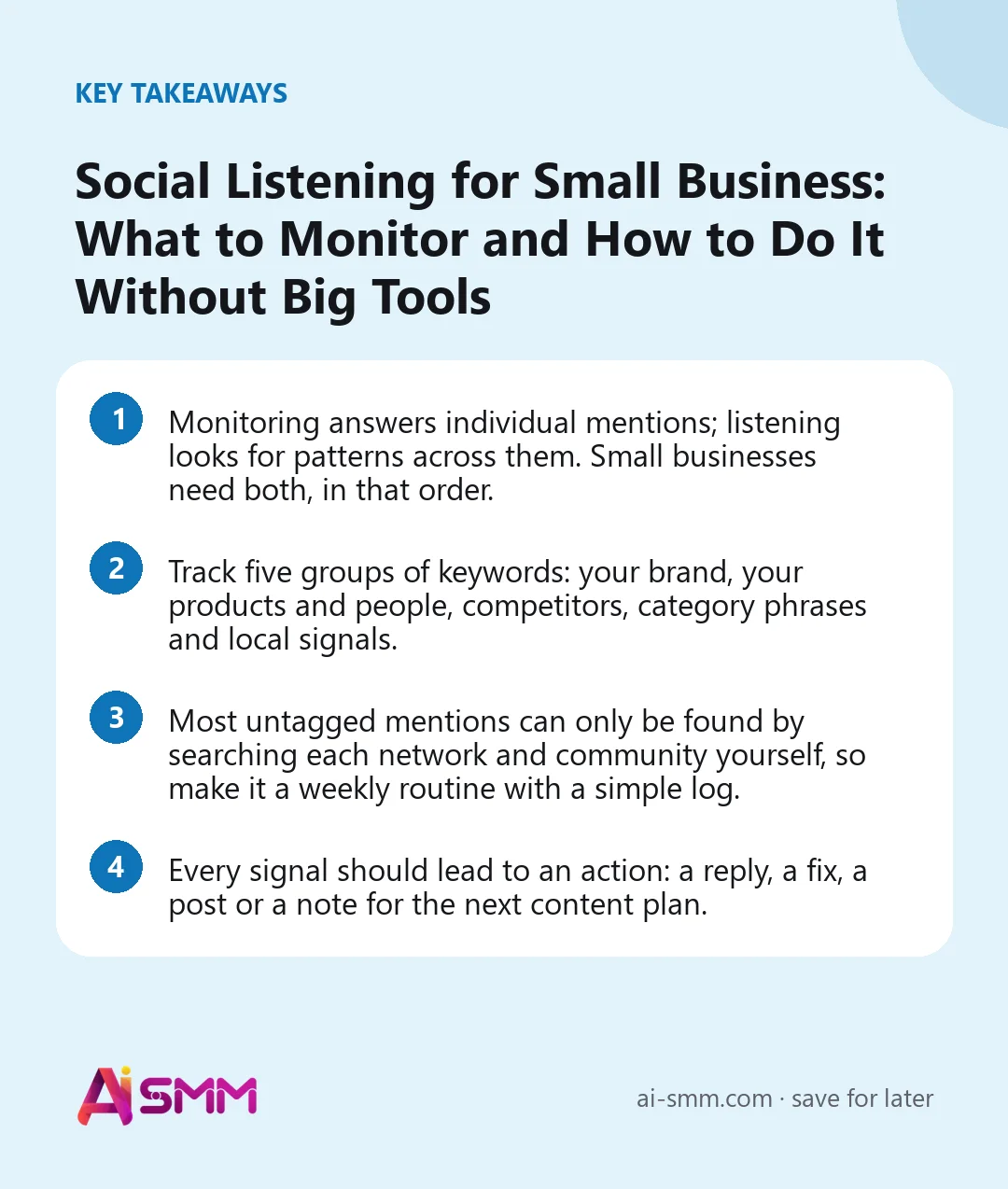
- Monitoring answers individual mentions; listening looks for patterns across them. Small businesses need both, in that order.
- Track five groups of keywords: your brand, your products and people, competitors, category phrases and local signals.
- Most untagged mentions can only be found by searching each network and community yourself, so make it a weekly routine with a simple log.
- Every signal should lead to an action: a reply, a fix, a post or a note for the next content plan.
Social listening vs social monitoring
The two terms overlap, but the difference is useful for planning your time.
| Social monitoring | Social listening | |
|---|---|---|
| Goal | Catch and answer individual mentions | Understand patterns: what people want, dislike and ask about |
| Time frame | Hours | Weeks and months |
| Typical output | A reply, a solved complaint | A new FAQ, a product change, a content idea |
| Example | Replying to someone who tagged your bakery in a story | Noticing that people in your city keep asking for gluten-free cakes |
Start with monitoring, because unanswered mentions lose customers today. Add listening once replies are under control, because patterns shape what you sell and post next.
What to monitor: a keyword map
Write your list down. A keyword map you can see is one you will actually use. Aim for 10–20 terms to start.
| Group | Examples for a small bakery | Why it matters |
|---|---|---|
| Brand | Business name, common misspellings, handle, website domain | People often misspell or skip the @; those mentions never notify you |
| Products and people | Signature product names, the owner’s name, a well-known baker on staff | Reviews often name the product or the person, not the business |
| Competitors | Two to five direct competitors’ names and handles | Their complaints are your opportunities; their praise shows what customers value |
| Category phrases | “birthday cake order”, “best croissant”, “gluten-free bakery” | Shows demand and questions before people have picked a business |
| Local signals | City or district name plus category, local hashtags, location tags | For local businesses, most buying questions are asked in local spaces |
| Recommendation requests | “can anyone recommend”, “looking for”, “where to buy” | The closest thing to a warm lead in public |
Add negative combinations to the list as well: your brand name plus “problem”, “refund”, “never again”. They surface issues early.
Where to listen
Different places need different methods. Some come to you, others only show up when you search.
| Place | How mentions reach you | How to check |
|---|---|---|
| Comments and DMs on your own accounts | Notifications | Daily, ideally in one shared inbox |
| Tags and @mentions | Notifications on most networks | Daily, together with comments |
| Untagged mentions in posts and captions | No notification | Search each network by keyword weekly |
| Competitors’ comment sections | No notification | Scroll their latest posts weekly |
| Local groups, public Telegram chats, forums, Reddit | No notification unless you are a member with alerts on | Join the relevant ones and search them weekly |
| Review platforms and maps | Sometimes an email | Weekly |
| Web mentions (blogs, news) | Free web alert services | Set alerts for your brand name once |
Stories, private groups and DMs between other people are invisible to any tool unless you are part of them. Accept that listening always sees only part of the conversation.
How to do social listening manually: a 20-minute weekly routine
The routine below fits most small businesses. Set a fixed slot, for example Monday morning, and keep a simple log.
Daily (5–10 minutes)
- Clear comments, DMs, tags and @mentions on your own accounts.
- Reply to questions first, then complaints, then thanks.
Weekly (20 minutes)
- Search your brand keywords in each network you use. Instagram search for keywords, hashtags and places; TikTok search for videos and comments; X advanced search with the exact phrase and “without @”; Threads and Reddit search for keywords; YouTube search for your brand and product names.
- Check competitors’ last five posts and read the comments: complaints, questions nobody answered, what people praise.
- Search category and local phrases: “[city] + [category]”, “recommend + [category]”. Look at the latest results, not the top ones.
- Scan local groups and public chats you have joined for your keywords.
- Log anything useful in the listening log below, and act on anything urgent right away.
Monthly (30–60 minutes)
- Read the log and count repeats. Three similar signals are a pattern.
- Turn patterns into decisions: a FAQ answer, a post, an offer, a process change.
- Update the keyword map: remove terms that bring only noise, add new phrases customers use.
A simple social listening log template
| Date | Where | Keyword | What was said | Type | Action | Done |
|---|---|---|---|---|---|---|
| Mon 6 | City group | “birthday cake” | Someone needs a cake for Saturday, 3 replies recommend others | Lead | Replied with a link to order | Yes |
| Mon 6 | Competitor’s Instagram | Competitor name | Several comments: “no delivery on Sundays?” | Opportunity | Post about our Sunday delivery | Planned |
| Mon 6 | Threads | Brand misspelling | Customer praises our sourdough, no tag | Praise | Thanked, asked to repost to story | Yes |
| Mon 6 | Review site | Brand name | Two reviews mention long queue at 8–9 am | Issue | Pre-order option for mornings | In progress |
The “type” column is what turns monitoring into listening: after a month, count how many leads, issues, questions and opportunities you logged, and where they came from.
How to turn what you hear into action
| Signal | Action |
|---|---|
| A question asked again and again | Add it to your FAQ, pin it, answer it in a post and in your chat replies |
| A recurring complaint about you | Fix the process first, then tell people it is fixed |
| A recurring complaint about competitors | If you do better on that point, make it visible in posts and your bio |
| A recommendation request | Reply helpfully and without pressure; mention what you offer only if it truly fits |
| Praise without a tag | Thank the person and ask permission to share it |
| A new phrase customers use | Use it in captions, bios and search keywords |
What social listening looks like in three small businesses
A beauty salon
The owner searches the salon name and “manicure + district” every Monday. Over a month she notices that people in the local group keep asking who does manicures on Sunday evenings and nobody answers with a name. She opens two Sunday slots, posts about them and replies to the next question in the group with a link to booking.
An online shop selling handmade candles
Reading competitors’ comments, the owner sees repeated complaints that scents are too strong for small flats. She starts a “light scent” line, describes scent strength on every product card and writes a post answering the question directly.
A B2B accounting firm
The partner follows phrases like “new tax rules” and “switching accountant” in professional communities and on LinkedIn. The same three questions come up every quarter, so they become a short post series and a checklist that prospective clients ask for in DMs.
In all three cases the listening itself took minutes a week; the value came from logging the signals and acting on the pattern.
When a paid social listening tool is worth it
Dedicated listening platforms search many networks and the web for your keywords, collect untagged mentions in one feed, estimate sentiment and alert you when mention volume spikes. They are worth considering when:
- You get more mentions than you can read in 20 minutes a week.
- You operate in several cities or countries and cannot join every local group.
- You run PR or influencer campaigns and need to measure mention volume.
- A crisis could spread quickly, for example in food, health or childcare.
Know the limits before you pay. Access to some networks’ data is restricted, private groups and stories are not visible, and automated sentiment misreads sarcasm and slang. For a single-location business, a manual routine usually finds the important mentions just as well.
Listening ethically
- Listen to public conversations only. Do not join private groups under false pretenses.
- Do not pile into a conversation with sales pitches. Helpful first, promotion only when asked or clearly relevant.
- Do not save or share personal data from what you find beyond what you need to reply.
What AI SMM covers, and what it does not
AI SMM is not a dedicated social listening platform: it does not search networks or the web for untagged mentions of your brand. It covers the monitoring part and some of the competitor part. Comments and DMs from Instagram and Facebook, replies and mentions on Threads, mentions and DMs on X, Bluesky and Mastodon, YouTube comments, WhatsApp and your website chat arrive in one inbox, so the daily part of the routine is one screen. TikTok, LinkedIn, Pinterest and Reddit have no inbox in AI SMM, so check them in their apps.
For competitors, the Competitors tab in analytics compares their growth and posting activity with yours over a chosen period. The assistant in your browser can collect the people who comment on a competitor’s account, with AI marking who fits your audience and saving them to Contacts, which helps turn listening into outreach you approve. When the monthly review turns up a pattern, the AI content studio can draft posts answering it in your brand’s tone. Local businesses can see how this fits together on the local business page.
FAQ
Is social listening worth it for a very small business?
Yes, in its simplest form. Twenty minutes a week spent searching your name, your competitors and local phrases often finds unanswered questions and recommendation requests that turn into customers. You do not need a paid tool to start.
What is the difference between social listening and competitor analysis?
Competitor analysis looks at what competitors post and how their accounts perform. Social listening looks at what people say, about you, competitors and the whole category, wherever they say it. They overlap in competitors’ comment sections.
How do I find mentions of my business that do not tag me?
Search each network for your business name, misspellings and product names, check local groups and review sites, and set a free web alert for your brand name. A paid listening tool automates part of this if the volume is high.
How often should a small business check mentions?
Comments, DMs and tags daily; untagged mentions, competitors and local groups weekly; patterns monthly. Increase the frequency during launches, promotions or when something negative starts to spread.
If replies are scattered across apps, start by bringing them together: try the AI SMM inbox on the free plan and spend the time you save on the weekly listening routine.
Posts, chats, video and sales in one workspace. 7 days free.
Start free