
 AI SMM team
An Instagram marketing strategy is a one-page plan that answers six questions: what the account must achieve for the business, who it is for, what you will post, how often, how a viewer turns into a client, and how you will know it works. Most small businesses skip the plan and post “when there is time”, which is why the account grows slowly and nobody can say whether it pays off. This guide walks you through building the plan step by step, with templates you can fill in over an afternoon.
It is written for owners, freelancers and small teams without a dedicated marketer. You do not need a big budget or daily Reels; you need clear choices and a rhythm you can keep for three months.
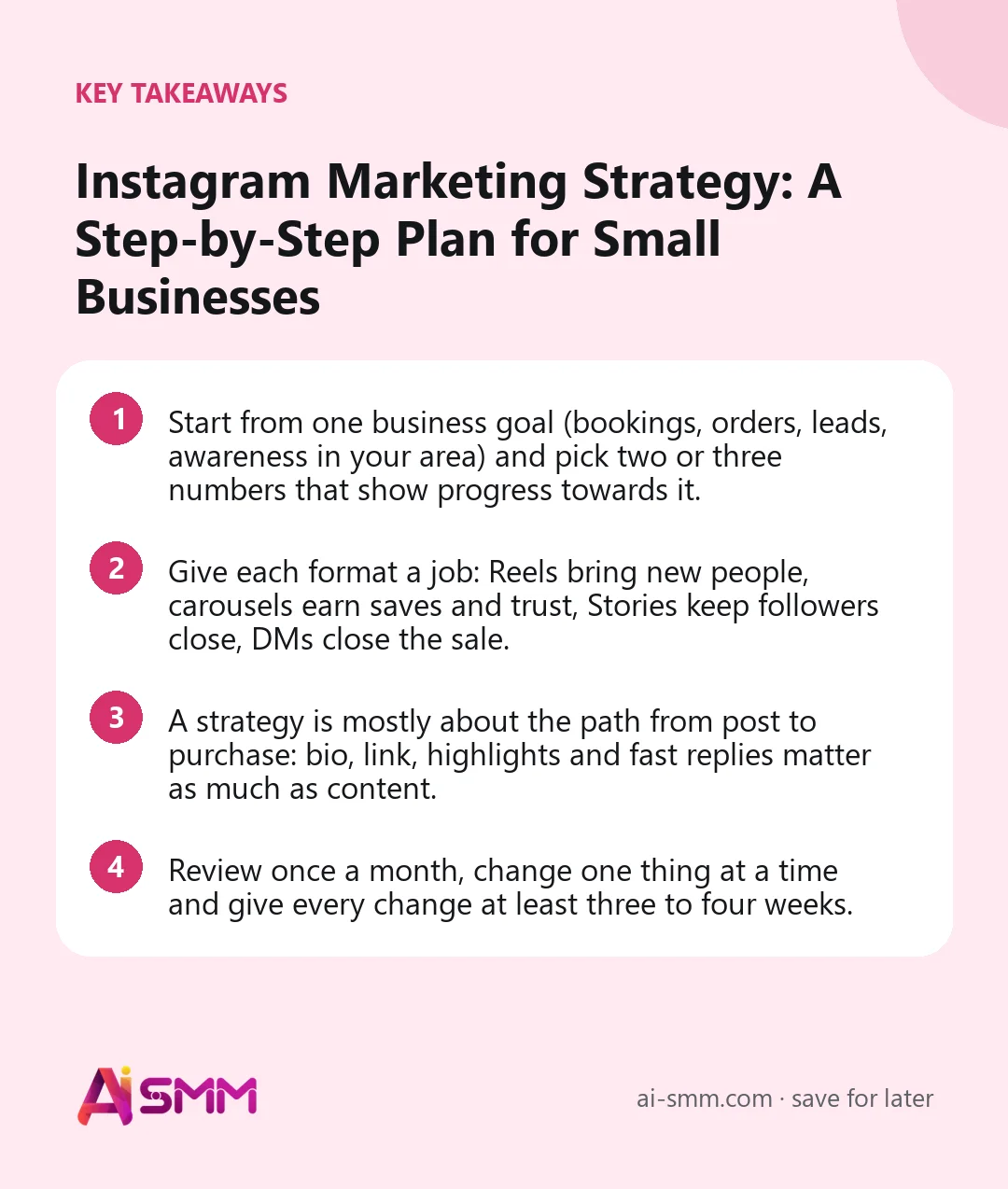
- Start from one business goal (bookings, orders, leads, awareness in your area) and pick two or three numbers that show progress towards it.
- Give each format a job: Reels bring new people, carousels earn saves and trust, Stories keep followers close, DMs close the sale.
- A strategy is mostly about the path from post to purchase: bio, link, highlights and fast replies matter as much as content.
- Review once a month, change one thing at a time and give every change at least three to four weeks.
What an Instagram marketing strategy is (and what it is not)
A strategy is a set of decisions, not a list of post ideas. Ideas change weekly; decisions stay for a quarter. A useful Instagram strategy fits on one page and covers:
- Goal: the business result Instagram should support.
- Audience: the specific people you want to reach and what they care about.
- Positioning: why someone should follow you instead of the five similar accounts nearby.
- Content pillars and formats: the three to five themes you post about and the format that suits each.
- Rhythm: how often you publish, who makes what and when.
- Conversion path: what a person does after they like your post, step by step, until they pay.
- Measurement: the few numbers you check and when.
What it is not: a promise of viral growth, a copy of a big brand’s plan, or a 40-slide deck nobody opens again. If a decision does not change what you post or how you answer people, it does not belong in the plan.
Step 1. Set one business goal and three numbers
Instagram can do many things for a business, but a small account doing everything at once usually does nothing well. Pick the main goal for the next 90 days and match it with metrics you can actually see.
| Business goal | What Instagram should do | Numbers to watch |
|---|---|---|
| More bookings (salon, clinic, studio) | Show results, prices and free slots; make booking easy | Profile visits, link taps to booking, DMs asking about slots |
| More orders (shop, bakery, handmade) | Show products in use, answer questions, lead to checkout | Product-related DMs, link taps, orders with an Instagram promo code |
| Leads for services (experts, B2B) | Prove expertise, collect contacts with a useful freebie | Saves, DMs with a keyword, leads collected |
| Local awareness (new venue, new area) | Reach nearby people who have never heard of you | Reach from non-followers, followers from your city, visits mentioning Instagram |
Write the goal as a sentence with a number you can check: “By the end of the quarter, Instagram brings 20 booking requests a month, up from about 8.” It does not need to be precise; it needs to be checkable.
Step 2. Describe the audience you want on Instagram
“Women 25–45” is not an audience description. What helps is knowing what your future client is trying to solve and what makes them hesitate. Answer these for your two or three main client types:
- What problem brings them to a business like yours, and how do they describe it in their own words?
- What stops them from buying: price, trust, distance, fear of the result, lack of time?
- What do they already follow on Instagram, and what do they save or send to friends?
- Where are they physically? For local businesses, a follower in another country is nice but does not book.
The best source is your own inbox and your staff: the questions clients ask before buying are ready-made post topics. If you want a structured way to do this, start by writing down the ten questions you hear most often.
Step 3. Audit your profile and three competitors
Before planning new content, look at what you have. Open your profile as a stranger would, on a phone, and check:
- Name field: does it include what you do and where (“Nail studio · Riverside”)? The name field is searchable, so it doubles as Instagram SEO.
- Bio: who you help, with what, and one clear next step.
- Link: does it lead somewhere useful on a phone (booking, catalog, a page with all options)?
- Highlights: prices, works, reviews, how to order or book, location. A newcomer should answer “can I buy here?” in 30 seconds.
- Last nine posts: would a stranger understand what you sell and why you are different?
Then pick three competitors: one bigger, two similar in size. Note which of their posts get comments and saves (not just likes), how often they post, which formats they use and how they reply. You are not copying them; you are looking for gaps: topics nobody covers well, questions left unanswered in their comments, a tone nobody uses.
Step 4. Choose content pillars and a format mix
Content pillars are the three to five themes you rotate. They keep the feed coherent and make planning faster. For most small businesses a mix like this works:
- Results and proof: before/after, finished orders, reviews, numbers.
- Useful knowledge: tips, mistakes, how to choose, how to care for a product.
- Behind the scenes and people: the team, the process, the workshop, the everyday.
- Offer: products, services, prices, free slots, promotions.
- Community: client stories, local events, answers to questions from followers.
Each format has a job. Plan the mix by job, not by habit:
| Format | Main job | Best for pillars | What to judge it by |
|---|---|---|---|
| Reels | Reach people who do not follow you yet | Results, useful knowledge, behind the scenes | Views, reach from non-followers, follows |
| Carousels | Earn saves and trust with depth | Useful knowledge, results, offer explained | Saves, shares, profile visits |
| Single photo or video | Announce, show a product, keep the feed alive | Offer, community | Comments, DMs, link taps |
| Stories | Stay close to followers daily, sell softly | Behind the scenes, offer, community | Replies, link taps, drop-off between frames |
| Live and collabs | Borrow trust and audience, answer questions at length | Useful knowledge, community | New followers, questions, leads after the event |
If you are new to short video, our Instagram Reels guide covers planning, filming and hooks.
Step 5. Set a posting rhythm you can actually keep
Consistency beats volume. An account that posts three times a week for six months usually does better than one that posts daily for three weeks and then disappears. Choose a rhythm by the time you really have:
| Time per week | Feed and Reels | Stories | Engagement |
|---|---|---|---|
| About 2 hours | 1 Reel + 1 carousel | 3–4 days a week, 2–4 frames | Replies to all comments and DMs the same day |
| About 5 hours | 2 Reels + 1–2 carousels or posts | Most days | Plus 15 minutes a day commenting on local and partner accounts |
| About 10 hours | 3–4 Reels + 2 carousels | Daily, with polls and questions | Plus one collab or Live a month |
Batch the work: one session to plan the month, one or two sessions to film, one to write captions and schedule. Planning the month in advance also shows gaps early, such as a week with only promotional posts. For timing, start with your audience activity data and test two or three slots for a few weeks.
Step 6. Build the path from post to purchase
This is where most Instagram strategies are weakest. A person likes a Reel, then what? Map every step and remove friction:
- Post: ends with one clear action (“comment PRICE and we will send the list”, “book via the link in bio”).
- Profile: bio and highlights answer the first questions without a message.
- Link: leads to a mobile page with booking, catalog or contact options, not to the home page of a slow website.
- DMs: answered within hours, ideally minutes, with ready answers for common questions (prices, delivery, free slots).
- Follow-up: people who asked but did not buy get one polite reminder, a useful tip or an offer.
Comment-to-DM mechanics work well for small accounts: a Reel promises a checklist or price list, people comment a keyword, and they receive it in DMs, which opens a private conversation. Keep the promise real and useful; a gift that feels like bait costs you trust. For the full sales side, including how to set up the profile like a shop window, see how to sell on Instagram.
Step 7. Plan engagement, not just posts
Instagram is a social network: accounts that talk to people get more conversation back. Put engagement into the plan with a concrete routine:
- Reply to every comment in the first hour or two after posting; ask a follow-up question where it fits.
- Answer DMs the same day. A fast, human reply often decides whether a person books with you or with the competitor who replied first.
- Spend 10–15 minutes a day on other accounts: local businesses, partners, clients who tagged you. Leave comments that add something, not “nice!”.
- Use Stories stickers (polls, questions, quizzes) at least weekly to keep a two-way conversation going.
- Repost client content with permission and thank people by name.
Step 8. Add growth levers beyond your own posts
Organic posting alone is slow for new accounts. Pick one or two levers per quarter:
- Collabs: a joint post with a complementary business (a florist and a cafe, a trainer and a nutritionist) shows up for both audiences.
- User-generated content: encourage clients to post and tag you, for example with a small thank-you for a photo review.
- Micro-creators: local creators with a few thousand engaged followers are often more useful and affordable than large ones.
- Search: use the words people search for in your name field, bio, captions and alt text; hashtags help a little, keywords help more.
- Paid promotion: boost a post that already performs well organically to people in your area; do not boost posts nobody liked.
Avoid giveaways that require following ten accounts: they bring people who want a prize, not your product, and your engagement rate drops afterwards.
Step 9. Measure monthly and adjust one thing at a time
Once a week, look at reach, top and bottom posts and the number of conversations. Once a month, answer the business question: did Instagram bring more requests or sales than last month? Compare posts with your own average rather than with other accounts, and give any change three to four weeks before judging it. Our Instagram analytics guide explains which metrics answer which question and what to do when they move.
To connect Instagram with money, use a separate link for Instagram, an Instagram-only promo code or keyword, and a simple “where did you hear about us?” question for new clients.
A one-page Instagram strategy template
Copy this into a document and fill in each line. If a line takes more than two sentences, simplify.
| Section | Your answer |
|---|---|
| Goal for 90 days | For example: 20 booking requests a month from Instagram |
| Main client types | Two or three short descriptions with their main problem and doubt |
| Why follow us | One sentence: what we show or teach that others do not |
| Content pillars | Three to five themes with the share of posts for each |
| Format mix per week | For example: 2 Reels, 1 carousel, Stories 5 days |
| Conversion path | Call to action → profile → link → DM → follow-up |
| Engagement routine | Who replies, how fast, daily minutes on other accounts |
| Growth lever this quarter | For example: two collabs with neighbouring businesses |
| Numbers and review dates | Weekly check on Mondays, monthly review on the 1st |
Example: a 90-day plan for a neighbourhood bakery
This is an illustrative example, not a case study. Say a bakery with 900 followers wants more pre-orders for cakes.
- Goal: 15 cake pre-orders a month through Instagram, up from about 5.
- Pillars: cakes and results (40%), behind the scenes at 6 a.m. (25%), tips on choosing and storing (20%), offers and seasonal menu (15%).
- Rhythm: two Reels (decorating process, “how many people does this cake feed”), one carousel (price guide by size), Stories most mornings with fresh bakes and a poll.
- Path: highlights “Cakes and prices”, “How to order”, “Reviews”; a Reel ends with “comment CAKE for the price list”; the price list arrives in DMs with a link to the order form.
- Lever: a collab with a nearby flower shop before a holiday.
- Review: count pre-orders that mention Instagram each month; keep the formats that bring DMs, drop the ones that do not.
Common Instagram strategy mistakes
- No goal beyond “more followers”. Followers are a means; decide what they should do.
- Only promotional posts. People follow for value and personality and buy when the offer appears at the right moment.
- Great content, broken path. A vague bio, a slow link or DMs answered after two days waste the reach you earned.
- Changing everything monthly. New style, new topics and new frequency at once make it impossible to learn what works.
- Copying trends that do not fit. A trend helps only if it can carry your message; otherwise it brings the wrong audience.
How to run your Instagram strategy in AI SMM
AI SMM covers the whole cycle for Instagram in one place. In the content calendar you plan feed posts, carousels, Reels and Stories on a schedule and see the month’s balance of pillars at a glance. The AI content studio writes captions and creates images and stories in your brand’s voice, and its planner turns a campaign brief into a dated month of ideas.
The conversion part lives in the unified inbox, where Instagram comments and DMs arrive in one queue with AI reply drafts, and in chat flows, where a comment with a keyword triggers a public reply and a DM with the promised item. Once a month, analytics shows reach, engagement per post and audience data next to your competitors, with an AI hint on what to try next.
FAQ
How long does it take for an Instagram marketing strategy to work?
Expect first signals (better saves, more DMs) in four to six weeks and a clear picture after about three months of consistent posting. Accounts that change direction every few weeks rarely get a clear picture at all.
How many times a week should a small business post on Instagram?
Two or three feed posts or Reels a week plus Stories on most days is a realistic target for a small team. A lower rhythm kept for months beats a higher one kept for weeks.
Do I need Reels in my Instagram strategy?
If you want new people to find you, yes: Reels are the format Instagram shows most to non-followers. If your goal is to sell to existing followers, carousels, Stories and fast DMs may matter more, but most accounts benefit from at least one Reel a week.
Should I pay for ads or grow organically?
Start organically to learn which posts resonate, then boost the proven ones to a local or interest audience. Ads amplify a working message; they rarely fix a weak one.
Take an afternoon this week, fill in the one-page template and plan the first month of posts. When you are ready to put the plan on a calendar and handle comments and DMs in one place, try AI SMM with your Instagram account.
Posts, chats, video and sales in one workspace. 7 days free.
Start free