
 AI SMM team
A giveaway looks like the easiest growth trick on Instagram: post a prize, ask people to follow, like and tag a friend, and watch the numbers climb. Then the problems arrive. Half the entrants unfollow the day after the winner is announced, someone complains that the draw was rigged, a fake account messages your followers pretending they won, and you spend an evening checking hundreds of comments by hand. A giveaway can bring real, interested people, but only when the rules are clear, the entries can be checked and the prize attracts customers rather than prize hunters.
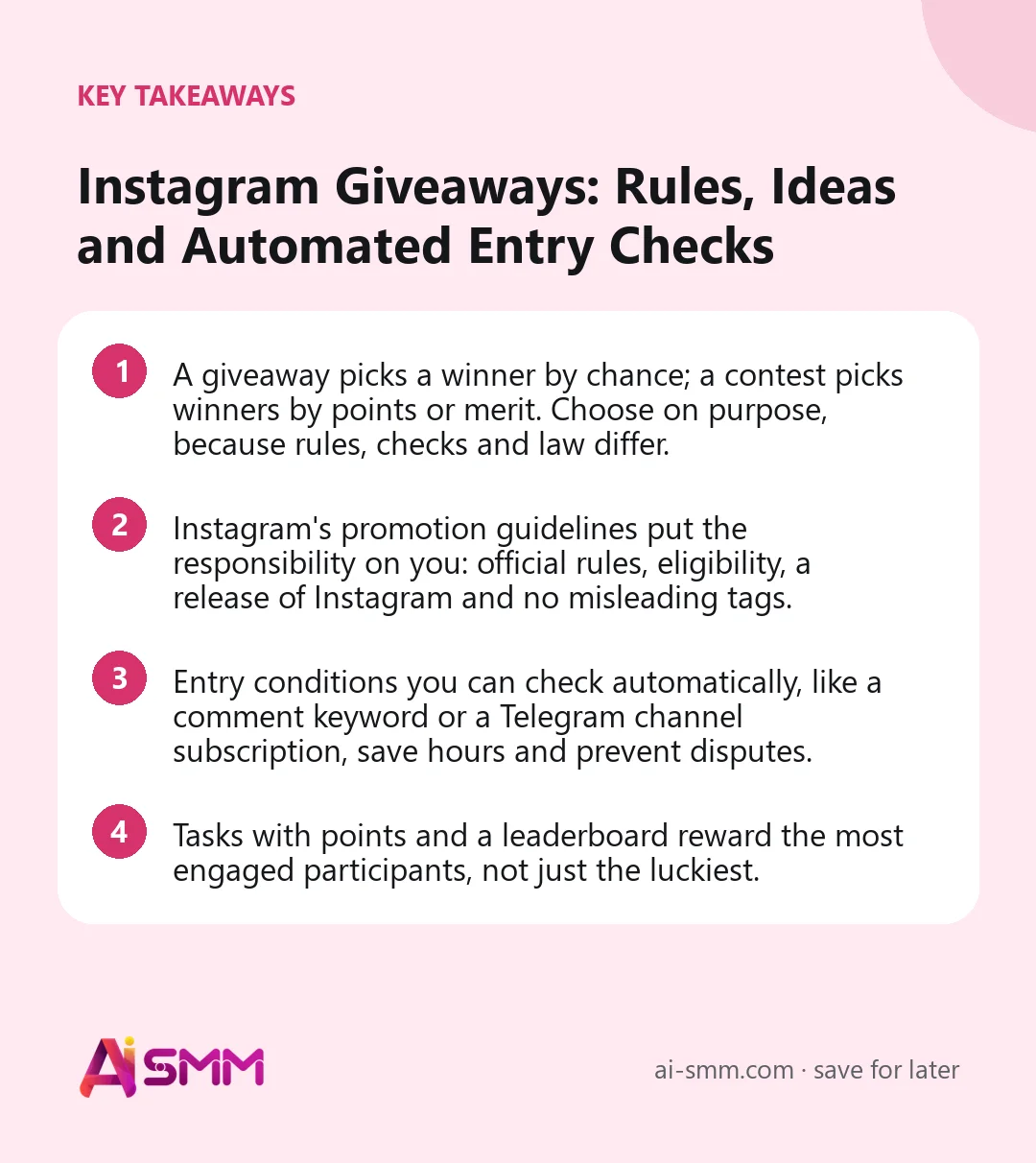
- A giveaway picks a winner by chance; a contest picks winners by points or merit. Choose on purpose, because rules, checks and law differ.
- Instagram’s promotion guidelines put the responsibility on you: official rules, eligibility, a release of Instagram and no misleading tags.
- Entry conditions you can check automatically, like a comment keyword or a Telegram channel subscription, save hours and prevent disputes.
- Tasks with points and a leaderboard reward the most engaged participants, not just the luckiest.
1. Giveaway or contest: decide what you are running
People use the words interchangeably, but they are different mechanics with different consequences.
| Giveaway (draw) | Contest (tasks and points) | |
|---|---|---|
| How the winner is chosen | At random from valid entries | By points, votes or a judge’s decision |
| What it rewards | Luck; everyone has an equal chance | Effort and engagement |
| Typical entry | Follow, comment, subscribe | Complete tasks, invite friends, submit work |
| Main risk | Prize hunters who leave afterwards | Unclear scoring and complaints about fairness |
| Best for | Quick reach and a burst of new followers | Deeper engagement and a community around the brand |
In many countries the law treats games of chance and skill-based contests differently, especially when a purchase is required to enter. That alone is a reason to decide which one you run before writing the post.
2. Follow the platform’s promotion rules
Instagram allows promotions, but Meta’s own promotion guidelines make the organizer responsible for running them lawfully. In practice that means:
- Official rules. Publish the terms: who can enter, dates, the prize, how the winner is chosen and announced.
- Eligibility. State age and location restrictions, and respect local law on prize promotions.
- A release of Instagram. Entrants must acknowledge that the promotion is not sponsored, endorsed or administered by Instagram, and release Instagram from liability.
- No misleading tags. Do not ask people to tag themselves in photos they are not in. Asking them to mention a friend in a comment is common; tagging people in content that does not show them is not allowed.
Telegram has no separate promotion guidelines, but its terms of service and anti-spam rules still apply to your channel and bot. On any platform, buying fake entries or using bought accounts to inflate numbers risks the account and makes the result meaningless. Guidelines change, so reread the current version before each campaign.
3. Write official rules that answer every question in advance
Most disputes after a giveaway come from something the rules did not say. A short rules post or a pinned page prevents them.
Checklist for your rules
- Organizer name and how to contact them.
- Start and end date and time, with the time zone.
- Who can take part: minimum age, countries or cities, whether employees and their families are excluded.
- Exactly what counts as a valid entry, and how many entries per person.
- The prize, its value and whether it can be exchanged for cash.
- How the winner is chosen and when it will be announced.
- How you will contact the winner, and how long they have to reply before a new winner is drawn.
- What happens to participants’ data and how to opt out.
- Taxes on the prize, if your country applies them to promotional winnings; ask your accountant.
4. Pick a prize and a format that attract customers, not prize hunters
A new phone attracts everyone who likes free phones. A set of your own products attracts people who want your products. The best giveaways for a small business give away something only your target customer would get excited about.
Ideas that work for small businesses
- Your bestseller or a signature set: a coffee shop’s beans and mug, a skincare brand’s routine kit.
- A service experience: a free haircut, a month of classes, a photoshoot.
- “Try it with a friend”: two passes or two portions, so the winner brings a new person.
- A co-hosted giveaway with a neighboring business whose audience overlaps yours (a bakery and a florist, a gym and a healthy food delivery).
- A user-generated content contest: best photo with your product, judged by clear criteria.
- A quiz contest: points for correct answers about your product or field, with the top scores winning.
- A referral race: points for each friend who joins and completes an action, with a leaderboard.
- A milestone thank-you: when your Telegram channel reaches a round number, reward subscribers who have been there longest.
5. Use entry mechanics you can check automatically
“Follow, like, tag two friends and share to your Story” is hard to verify at scale. Every condition you cannot check turns into hours of manual work or an honor system that invites cheating. Build the entry around actions a system can confirm.
Mechanics that can be checked
- Comment keyword to DM. A person comments a keyword under the giveaway post and immediately gets a DM confirming the entry and repeating the rules. The comment is visible publicly, and the DM gives you a conversation with every participant.
- Telegram channel subscription. In Telegram, a bot can check that the person is actually subscribed to your channel before registering the entry, and refuse politely if not. No manual checking, no fake entries from people who never joined.
- A tag on the contact. Every confirmed participant gets a tag, so the final list of entries is a filter, not a spreadsheet you assemble by hand.
- A personal referral link. Each participant gets their own link; friends who join through it are counted automatically.
If your rules include a condition you cannot check automatically, such as following an Instagram account, check it for the chosen winner before announcing, and say in the rules that you will.
6. Design tasks and a leaderboard that feel fair
A contest with tasks turns a one-day spike into a week or two of engagement. Participants see a list of tasks, earn points for each, and watch their position on a leaderboard. Done well, it rewards your most engaged followers; done badly, it rewards whoever finds a loophole.
How to set it up
- List five to eight tasks with clear, checkable completion: subscribe to the channel, answer a quiz, invite a friend who subscribes, visit the store, share a photo that gets approved.
- Weight points by value to you. A friend who actually joins is worth more than a click; a completed quiz more than a reaction.
- Cap repetitive tasks so nobody wins by inviting 300 bot accounts.
- Show the leaderboard with shortened names (“Anna K.”, not a full name and handle), which protects participants’ privacy and still feels real.
- Announce the tie-breaker in advance: earliest to reach the score, or a random draw among those tied.
Points earned during the contest can stay on each person’s contact card afterwards, which gives you a ready list of your most active followers for the next launch.
7. Choose and announce winners transparently
For a random draw, pick from the final list of confirmed entries and show how you did it: a screen recording of a random number generator applied to the numbered list works well. For a contest, publish the final leaderboard. Then:
- Announce the winner in a post or Story, tagging them only with their permission.
- Contact the winner from your official account only, and say publicly how you will do it.
- Warn followers about impostors. Fake accounts copying your name often message participants claiming they won and asking for a “delivery fee” or card details. Pin a note: you never ask for payment or card data to deliver a prize.
- If the winner does not reply within the deadline in your rules, draw again and say so publicly.
8. Keep the participants after the giveaway ends
The day after the winner is announced is when giveaways usually lose people. Plan what happens next before you start.
- Send non-winners a thank-you with a small consolation offer, such as a discount valid for a week.
- Invite them to your next useful thing: a free lesson, a new collection preview, a quiz.
- Look at who completed the most tasks: those are candidates for a loyalty program or an ambassador role.
- Compare numbers two weeks later: how many new followers stayed, how many placed an order, what each cost you.
Worked example: a skincare brand runs a two-week contest
Say a small skincare brand wants to grow its Telegram channel and reach Instagram followers who have never ordered. On Instagram, a Reel announces a two-week contest with a routine kit as the top prize and three mini-sets for runners-up. People comment “GLOW”, receive a DM with the rules and a link to the Telegram bot, and the bot checks that they are subscribed to the channel before registering them.
Inside the bot, participants see a task list: a five-question skin-type quiz, inviting a friend who subscribes, and sharing a photo of their current routine. Each task adds points, and the leaderboard shows shortened names. At the end, the top four win, everyone else gets a 15% code valid for seven days, and the brand pins a warning that it never asks winners for card details. Two weeks later it checks how many new subscribers stayed and how many used the code.
Common giveaway mistakes
- No written rules, so every complaint becomes an argument.
- A generic, expensive prize that attracts people who will never buy from you.
- Conditions nobody can check, followed by hours of scrolling through comments.
- Asking people to tag themselves in photos, which breaks Instagram’s guidelines.
- No warning about fake “winner” messages, leaving followers exposed to scams in your name.
- No plan for the day after, so new followers leave as fast as they came.
How this works in AI SMM
Giveaways and contests are built as flows in chat automation. On Instagram, a comment keyword triggers a public reply and a DM with the rules. On Telegram, a flow checks the channel subscription before registering an entry and can give each participant a referral link. Gamification blocks add quizzes with scoring, tasks with points and a leaderboard, and points are saved on each contact card, so you keep a list of your most engaged followers. Questions from participants land in the inbox with everything else. A ready template for a contest with tasks opens as a draft you can adapt.
FAQ
Is it allowed to ask people to tag friends in the comments?
Asking people to mention friends in a comment is common. What Instagram’s guidelines forbid is tagging people in content they are not in. Check the current guidelines before your campaign.
Can I check automatically that someone subscribed to my Telegram channel?
Yes. A flow can check the subscription before registering an entry or sending a gift, and answer politely if the person has not joined yet.
How do I pick a random winner fairly?
Take the final list of confirmed entries, number it, and use a random number generator on a screen recording or live stream, then publish the result.
Should I run a giveaway or a contest with points?
A giveaway is simpler and gives a quick burst of reach. A contest with tasks and a leaderboard takes longer but rewards the people most interested in your brand.
If you want your next giveaway to bring customers instead of prize hunters, build it with checkable entries, tasks and a fair leaderboard using gamification in your chats.
Posts, chats, video and sales in one workspace. 7 days free.
Start free