
 AI SMM team
A content distribution strategy is the plan for how each piece of content reaches people after you publish it: which channels carry it, in what order, in which shape and how you measure what worked. Most small businesses spend 90% of their effort creating and 10% distributing, then wonder why a great article or video got 40 views. Below is a practical framework: the four channel types, how to choose yours, a 30-day release plan for a single piece, tracking and a checklist you can reuse every time.
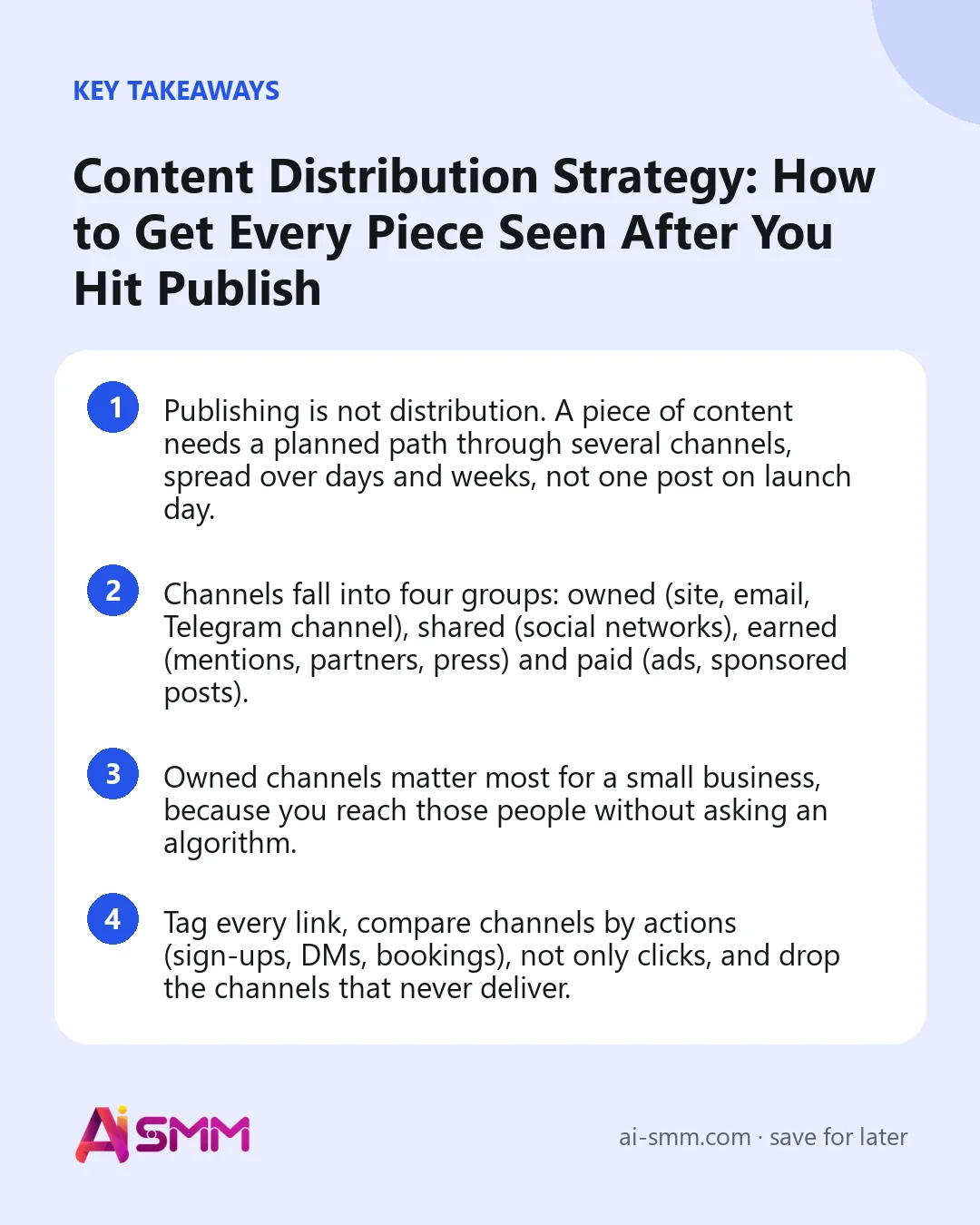
- Publishing is not distribution. A piece of content needs a planned path through several channels, spread over days and weeks, not one post on launch day.
- Channels fall into four groups: owned (site, email, Telegram channel), shared (social networks), earned (mentions, partners, press) and paid (ads, sponsored posts).
- Owned channels matter most for a small business, because you reach those people without asking an algorithm.
- Tag every link, compare channels by actions (sign-ups, DMs, bookings), not only clicks, and drop the channels that never deliver.
What a content distribution strategy is
Content marketing has two halves: making things worth attention and getting them in front of the right people. A content distribution strategy is the second half written down. It answers:
- Where will this piece be published and promoted?
- In what form will it appear in each place (full article, carousel, clip, email, short post)?
- When will each version go out: launch day, the following week, a month later?
- Who else can help spread it: partners, clients, staff, communities?
- How will you know which channels worked?
Distribution is related to repurposing, but it is not the same. Repurposing is changing the format; distribution is deciding the route and the timing. You can repurpose a webinar into ten clips and still distribute them badly by posting all ten on one network on the same afternoon.
The four channel types: owned, shared, earned, paid
| Type | Examples | Strengths | Limits |
|---|---|---|---|
| Owned | Website and blog, email list, web push subscribers, Telegram channel, chat subscribers, link in bio page | You control reach and timing; no algorithm between you and the reader | Grows slowly; you need to earn subscribers first |
| Shared | Instagram, TikTok, YouTube, LinkedIn, Facebook, Threads, Pinterest and other networks | Discovery beyond your audience; free | Reach depends on algorithms and changes without warning |
| Earned | Partner reshares, press mentions, guest posts, podcasts, customer posts, community discussions | Borrowed trust; reaches new audiences | Not in your control; takes relationships and time |
| Paid | Boosted posts, social ads, sponsored posts in channels, influencer placements | Fast, predictable reach, precise targeting | Stops when you stop paying; needs a budget and testing |
A healthy strategy uses shared and paid channels to bring people in and owned channels to keep them. The question to ask of every social post is: does it move some of these viewers into something I own, such as a subscription, a chat or an email list? The comparison of organic and paid social media covers when to add budget.
Step 1. Decide what each piece of content is for
Not every piece deserves the full treatment. Sort content into three tiers before you plan distribution:
- Hero pieces (1–2 a month): a detailed guide, a webinar, a case study, a seasonal offer. These get the full 30-day plan below.
- Regular pieces (weekly): a useful post, a short video, a newsletter issue. Two or three channels, launch week only.
- Everyday pieces: quick updates, Stories, replies. One channel, no plan needed.
For each hero piece, write one line: “This exists to get [who] to [do what].” For example: “This guide to preparing for a tax audit exists to get sole traders to book a free 20-minute check.” That line decides the channels and the call to action everywhere.
Step 2. Choose your channels (fewer is better)
List where your audience already spends attention, then choose the smallest set you can do properly. For most small businesses that is:
- 2–3 social networks where your customers are active,
- 1–2 owned channels (email list, Telegram channel, web push, your site),
- 1 earned route you work on continuously (a partner business, a local community, an industry newsletter),
- optional paid support for hero pieces that already show organic promise.
| Business | Shared | Owned | Earned |
|---|---|---|---|
| Beauty salon | Instagram, TikTok | Chat subscribers, link in bio booking page | Collab posts with a nearby photographer or bridal shop |
| B2B consultant | LinkedIn, YouTube | Email newsletter, website blog | Guest posts, podcasts, industry groups |
| Online shop | Instagram, Pinterest, TikTok | Email list, web push, Telegram channel | Micro-creator reviews, customer posts |
| Café | Instagram, Facebook | Telegram channel, chat with a loyalty flow | Local city pages, neighbour businesses |
Step 3. Adapt the piece for each channel
The same message, native to each place. Copy-pasting one caption with a link everywhere is the most common distribution mistake: it ignores how each network shows content and what its audience expects.
- Instagram: a carousel with the 5–7 key points, a Reel with the most surprising one, a Story with a link.
- LinkedIn: a text post with your opinion and the one insight professionals care about, link in the post or first comment.
- TikTok and YouTube Shorts: one idea per clip, with the hook in the first seconds.
- Pinterest: a vertical pin with a clear title that links to the full piece.
- Telegram channel: a short summary with the main takeaway and a link; bold first line for the chat preview.
- Email: a personal note on why you made it and who should read it, with one button.
- Threads and X: a strong statement from the piece, then a follow-up post with the link.
Step 4. Spread the release over 30 days
Launch day is only the start. Different people see different posts, and even your own followers miss most of what you publish. A simple release plan for a hero piece:
| When | What goes out | Where |
|---|---|---|
| Day 0 | Full piece published; announcement to owned audiences | Website or YouTube; email; Telegram channel; web push |
| Day 0–1 | Main social post with the strongest angle | Your 2–3 main networks, each in its native format |
| Day 2–4 | Second angle: a clip, carousel or quote | The network where the first post did best |
| Day 3–7 | Send to partners, people quoted, relevant communities | Direct messages, partner channels, groups (where self-promotion is allowed) |
| Day 7–10 | Answer the best questions from comments as a new post | Networks with active discussion |
| Day 10–14 | Paid boost, only if organic signals were strong | The best-performing post, to a lookalike or local audience |
| Day 30 | Reminder or “in case you missed it” with a new hook | Social networks, email P.S., link in bio |
| Every 3–6 months | Update and re-release evergreen pieces | All channels |
Put the whole plan into your content calendar on the day you finish the piece. If it lives only in your head, only day 0 happens.
Step 5. Use people, not just channels
- Partners: if you mention a supplier, a venue or another business, tell them and give them a ready image and caption. Collab posts on Instagram put the post on both profiles.
- People you quote: an expert quoted in your guide is likely to share it with their audience.
- Your team: employees’ personal accounts, especially on LinkedIn, often reach more people than the company page. Make it easy with a short suggested text, never mandatory.
- Customers: content that features a customer (with permission) gets shared by that customer to people who trust them.
- Communities: niche groups, forums and chats. Read the rules, contribute first and share only where it genuinely answers a question.
Step 6. Turn viewers into owned audience
Every distributed piece should give some readers a reason to subscribe to something you own:
- a checklist or template sent by DM when someone comments a keyword,
- a Telegram channel or email for “the next part”,
- web push subscription on the article page for new guides,
- a link in bio page with the piece, the offer and booking in one place.
Over a year, this is what separates businesses that depend on each algorithm update from businesses that can reach their customers on demand. The guide on how to grow your email list from social media goes deeper on this step.
Step 7. Track what each channel actually delivers
Add UTM tags to every link you distribute so your website analytics shows which channel, network and even which post brought each visitor. A consistent naming scheme matters more than the tool; see the guide to UTM parameters for social media.
| Channel | Look at | Decision |
|---|---|---|
| Social networks | Reach, saves, shares, profile visits, link clicks, DMs | Keep networks that bring conversations or clicks; reduce the ones that only bring likes |
| Opens, clicks, replies, unsubscribes | Adjust subject lines and frequency | |
| Web push | Clicks per notification, unsubscribes | Send fewer, more relevant pushes if unsubscribes rise |
| Earned | Referral traffic, new followers after a mention | Invest in partners who send engaged people |
| Paid | Cost per lead, cost per booking or order | Boost only what already works organically |
Review once a month. After a quarter, you will know your two or three strongest routes, and each new piece can go there first.
Content distribution checklist
- One sentence: who this piece is for and what they should do next.
- Tier chosen: hero, regular or everyday.
- 2–3 shared networks, 1–2 owned channels, 1 earned route selected.
- A native version written for each channel, not one copied caption.
- Release plan for day 0 to day 30 added to the calendar.
- Partners, quoted people and team told, with a ready text and image.
- Every link tagged with UTM parameters.
- A way to subscribe or start a chat offered in at least one version.
- Monthly review date set.
Running content distribution in AI SMM
The calendar is where the 30-day plan lives: you schedule the launch posts and the follow-ups weeks ahead across all connected networks, with a separate caption and format for each. The AI content studio reshapes one idea into versions for LinkedIn, Instagram and a Telegram channel in the right length and tone, which removes most of the work in step 3.
For owned channels, email campaigns and web push notifications can pick up new articles from your site’s RSS feed and send them automatically, and a link in bio page keeps the current hero piece, offer and booking in one place. To turn social viewers into subscribers, a chat flow can send a checklist in DMs when someone comments a keyword on Instagram or Facebook. The analytics section then shows which networks carried each piece, for the networks that report analytics.
FAQ
What is the difference between content distribution and content promotion?
Promotion usually means pushing a piece harder, often with paid reach. Distribution is the whole route: owned, shared, earned and paid channels, the format for each and the timing. Promotion is one part of distribution.
How many channels should a small business use?
As few as you can do well: typically two or three social networks, one or two owned channels and one partner or community route. Adding channels you cannot maintain spreads effort without adding results.
Is it spam to share the same content several times?
Not if each share has a different angle and format and there is time between them. Most followers never saw the first post. Repeating the exact same caption every day, however, does feel like spam.
Should I spend money on distribution?
Once organic signals show a piece resonates, a small paid boost to a well-defined audience often pays off. Paying to push content that did not work organically rarely fixes it.
A good content distribution strategy makes every hour of creation count several times over. Plan your next hero piece’s 30 days in the AI SMM calendar and see which route brings your clients.
Posts, chats, video and sales in one workspace. 7 days free.
Start free