
 AI SMM team
A YouTube marketing strategy is a plan for what your channel should do for the business, who it is for, which videos you will make and how you will turn viewers into customers. Most small businesses skip that plan: they upload a few videos when there is time, get a few hundred views and decide YouTube “does not work for us”. The problem is rarely the platform. YouTube is where people go to learn how to do something, compare options and check whether a business knows its stuff, and a channel built around those moments can bring enquiries for years. This guide walks through the decisions that make up a strategy and ends with a realistic 90-day plan.
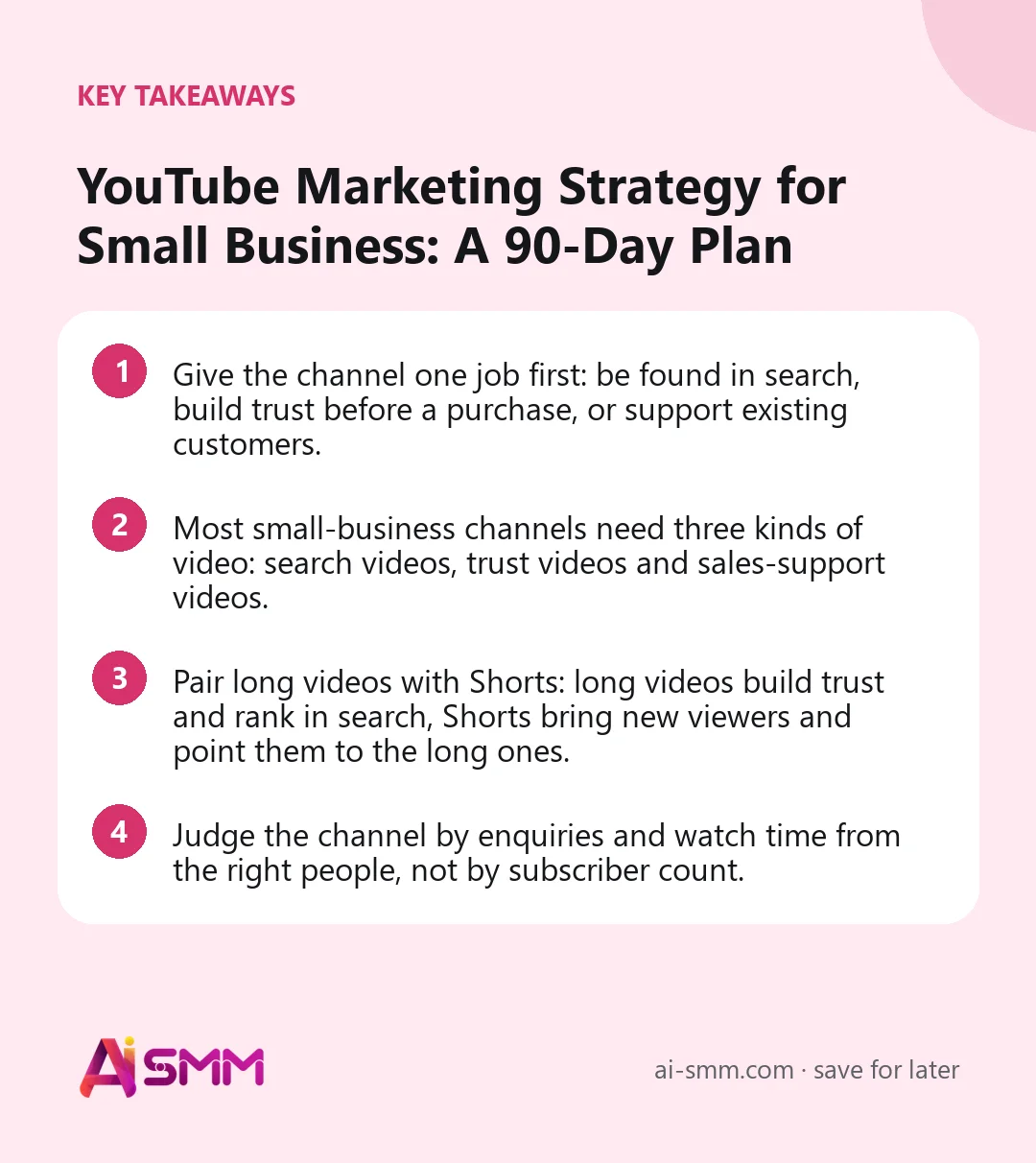
- Give the channel one job first: be found in search, build trust before a purchase, or support existing customers.
- Most small-business channels need three kinds of video: search videos, trust videos and sales-support videos.
- Pair long videos with Shorts: long videos build trust and rank in search, Shorts bring new viewers and point them to the long ones.
- Judge the channel by enquiries and watch time from the right people, not by subscriber count.
Why YouTube belongs in a small business marketing plan
YouTube works differently from feed-based networks. A post on Instagram or Facebook lives for a day or two; a useful YouTube video can be found through search and recommendations for years. That makes it one of the few channels where work compounds: a video you make this month can still bring enquiries next year.
It also answers questions a sales page cannot. A customer who has watched you explain how a kitchen is measured, how a treatment feels or how an accounting service onboards a client arrives with fewer doubts and often a decision already made. For service businesses, experts, local trades and online shops with products that need explaining, that is the real value.
Step 1. Decide the channel’s job
A YouTube channel that tries to do everything does nothing well. Choose one primary job for the first six months:
| Job | Good for | What success looks like |
|---|---|---|
| Be found in search | Trades, clinics, software, courses, anything people research | Views from search, enquiries from people who found you through a video |
| Build trust before a purchase | Expensive or personal services: renovation, coaching, legal, medical, weddings | Clients saying “I watched your videos before calling” |
| Support existing customers | Products with setup or care, subscriptions, B2B services | Fewer repeated questions, better reviews, repeat purchases |
The job decides everything else: which topics you choose, how long the videos are, what goes in the description and what you measure.
Step 2. Define who the channel is for
Write one sentence: “This channel helps [who] to [do what] so that [result].” For example: “This channel helps homeowners in our region plan a bathroom renovation without surprises.” That sentence filters ideas. A video on the history of tiles fails the test; “How much does a small bathroom renovation really cost in 2026” passes.
Then list 20–30 real questions your customers ask before buying. Take them from calls, emails, chats and comments. This list is the backbone of your content plan and usually lasts a year.
Step 3. Choose the three types of video your channel needs
| Type | Purpose | Examples | Share |
|---|---|---|---|
| Search videos | Answer questions people type into YouTube and Google | “How to choose…”, “X vs Y”, “How much does… cost”, “Common mistakes when…” | About 50% |
| Trust videos | Show how you work and who you are | Project walkthroughs, before/after, a day at work, client stories told with permission | About 30% |
| Sales-support videos | Help people decide and take the next step | How booking works, what happens at the first visit, pricing explained, FAQ | About 20% |
These shares are a starting point. A channel whose job is search leans toward search videos; a trust channel for an expensive service can go half and half. For finding the exact search phrases and writing titles that rank, see our guide to YouTube SEO.
Step 4. Long videos and Shorts: how they work together
Long videos and Shorts do different jobs, and a good YouTube marketing strategy uses both:
- Long videos (usually 6–15 minutes for small businesses) answer a question properly, rank in search and build trust. They are where people decide to contact you.
- Shorts (vertical, up to 3 minutes, most work best far shorter) reach people who have never heard of you through the Shorts feed. They work as trailers: one strong moment, one tip, one result, and a pointer to the full video.
The efficient approach is to film long first and cut Shorts from it. One 10-minute walkthrough can give three to six Shorts, which also work on TikTok and Instagram Reels. Our step-by-step guide on how to turn a YouTube video into Shorts covers the cutting itself.
Step 5. Build a production system you can keep
Consistency matters more than production value. A channel that publishes one useful video every two weeks for a year will usually outperform one that publishes ten polished videos in a month and then stops. A simple system:
- Batch planning. Once a month, pick the next two to four topics from your question list.
- Short outline, not a script. Hook, three to five points, a clear next step. Most small-business owners sound better speaking from bullet points than reading.
- One filming session. Film two videos in one session with the same setup: phone or camera on a tripod, a clip-on microphone, window light.
- Light editing. Cut pauses and mistakes, add subtitles, a simple title card. Nothing more is required.
- Packaging. Title, thumbnail and description written for the viewer’s question, not for your brand.
- Repurposing. Shorts, a clip for Instagram and TikTok, a post for your other networks and a short message to your email list or Telegram channel.
| Budget | Kit | Output |
|---|---|---|
| Minimal | Phone, tripod, clip-on mic | 2 long videos + 6 Shorts a month |
| Moderate | Camera or good phone, two lights, part-time editor | 4 long videos + 12 Shorts a month |
| Serious | Dedicated set, editor, someone to manage publishing | Weekly long video + daily Shorts |
Step 6. Turn viewers into customers
Views that do not lead anywhere are a hobby. Build the path from video to enquiry into every upload:
- Say the next step out loud in the video, once near the middle and once at the end: “If you want us to measure your bathroom, the booking link is in the description.”
- Put one main link at the top of the description, to a booking page, a contact form, a chat or a link-in-bio page, not five equal links.
- Pin a useful comment with the link and a short summary.
- Answer comments quickly. A question in the comments is often a lead; a reply the same day can turn it into a conversation.
- Offer something for the next step: a checklist, a price guide, a free consultation, a discount for first-time customers.
- Use playlists that follow the buyer’s journey, such as “Planning”, “Choosing materials”, “Our projects”.
Step 7. Measure what matters
| Metric | What it tells you | What to do about it |
|---|---|---|
| Views per video over 90 days | Whether the topic has demand | Make more videos on topics that keep getting views |
| Average view duration | Whether the video keeps its promise | Shorten intros, get to the point faster |
| Click-through rate on thumbnails | Whether title and thumbnail attract the right click | Test clearer titles that name the problem |
| Comments and questions | Whether people are engaged and considering you | Turn repeated questions into new videos |
| Enquiries mentioning YouTube | The business result | Ask every new client how they found you; track it |
| Subscribers | A secondary signal of long-term interest | Do not chase it; it follows useful videos |
For the full list of reports and how to read them, see our YouTube analytics guide.
A 90-day YouTube marketing plan
| Period | Focus | Output |
|---|---|---|
| Days 1–14 | Channel job, audience sentence, 30 customer questions, channel page and banner, kit set up | Plan for the first eight videos |
| Days 15–45 | Film and publish in batches, cut Shorts from each video, answer every comment | 4 long videos + 12 Shorts |
| Days 46–75 | Keep the rhythm, add a playlist, promote each video on your other networks and email | 4 more long videos + 12 Shorts |
| Days 76–90 | Review: which topics got views and enquiries, which titles worked, what viewers asked | Plan for the next quarter based on the data |
After 90 days you will not have a famous channel, but you will have eight useful long videos that keep working, two dozen Shorts, real data about what your audience wants and usually the first enquiries that started with a video.
Common mistakes in a small-business YouTube strategy
- Uploading adverts and calling it a channel. People search for answers, not commercials.
- Long intros about the company before the useful part.
- Titles that name the brand instead of the viewer’s problem.
- Stopping after a month because early videos got few views; search traffic builds over months.
- Ignoring comments, where many of the leads actually are.
- Publishing a video and never mentioning it anywhere else.
How to run your YouTube strategy in AI SMM
AI SMM connects your YouTube channel to the same calendar as your other networks. AI Content Studio drafts a video outline or script from a brief and writes titles and descriptions from a script, transcript or short note, so packaging stops being the step you put off. Video clipping cuts a long video into vertical clips with subtitles for Shorts, Reels and TikTok; clips wait for your review by default, and you can also choose channels to watch so new uploads are clipped automatically. In the calendar you schedule the long upload and each Short as separate posts, together with announcements on your other networks. YouTube comments land in the shared inbox, where AI can draft a reply from your knowledge base before you send it, and analytics shows subscribers, views and engagement per video.
FAQ
How often should a small business post on YouTube?
One long video every one to two weeks plus a few Shorts a week is a pace most small teams can keep. Regularity over a year matters far more than a burst of uploads.
Do I need to show my face?
It helps trust, especially for services, but it is not required. Screen recordings, hands-on work, product close-ups and voice-over work well for many businesses.
Should I focus on Shorts or long videos?
Use both. Shorts bring new viewers quickly; long videos rank in search, build trust and lead to enquiries. Filming long and cutting Shorts from it gives you both from one session.
How long until YouTube brings customers?
Search-driven channels often see the first enquiries within three to six months of regular publishing, and results keep growing as the library of videos grows. Trust videos can help sooner if you send them to people who are already considering you.
Write your one-sentence channel purpose and list 30 customer questions this week; that is the whole foundation. When the first video is ready, turn it into Shorts with AI SMM and schedule everything from one calendar.
Posts, chats, video and sales in one workspace. 7 days free.
Start free